


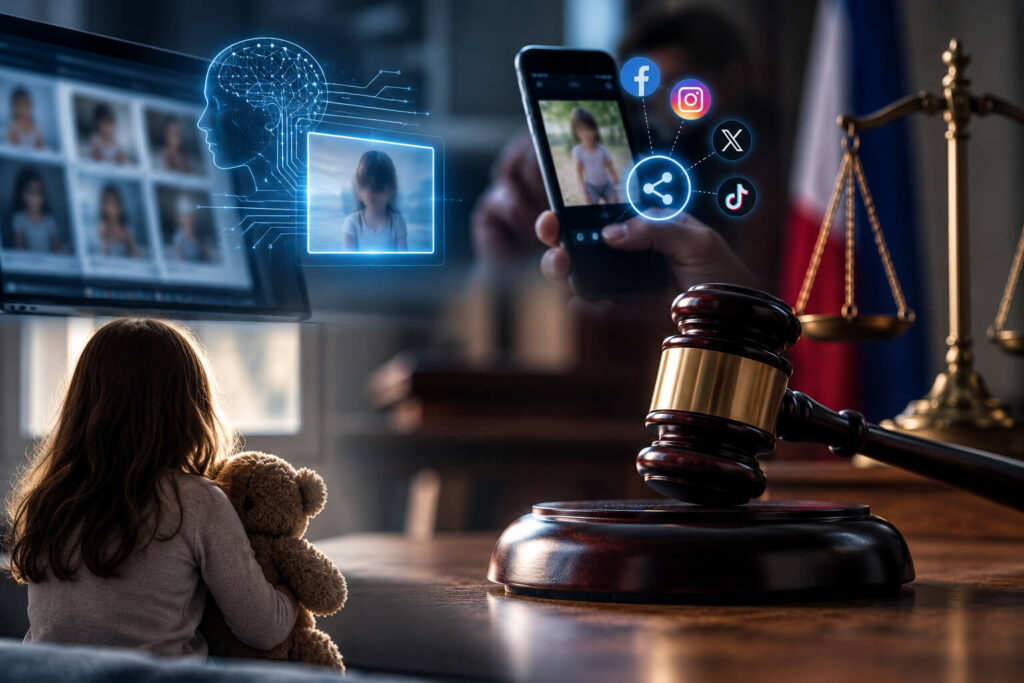
The recent AI-generated CSAM court ruling by a U.S. federal appeals court is stirring a difficult conversation about generative AI, online privacy and the risks surrounding children’s photos on social media.
The case goes beyond one court decision. It touches parents who post family photos, photographers who publish their work, brands that feature children in campaigns and platforms responsible for policing harmful content. Generative AI has added an uncomfortable new dimension because ordinary images found online can potentially be manipulated or used as source material for synthetic content.
Federal Court Rules on Private Possession of Virtual AI-Generated CSAM
The case reached the U.S. Court of Appeals for the Seventh Circuit, which examined whether federal law could criminalize the private possession of obscene AI-generated material depicting fictional children when no actual child appeared in the images. The appeals court affirmed the dismissal of the possession charge, relying on existing U.S. Supreme Court precedent concerning private possession of obscene material and entirely virtual depictions. The decision is narrower than some online discussions may suggest. It does not broadly legalize the creation or distribution of CSAM, and separate production and distribution charges remain part of the underlying case. The ruling instead focuses on whether private possession of entirely virtual material can be prosecuted under the specific circumstances presented to the court.
Generative AI Has Changed the Problem
The legal question becomes harder because image-generation technology has changed dramatically since many of the precedents governing virtual imagery were established. Modern generative AI systems can produce synthetic people and scenes that look increasingly realistic, making the boundary between a photograph and an artificially created image much harder to recognize. The Seventh Circuit acknowledged that technological shift, noting the challenge created by AI-generated depictions that can resemble material involving real children. Still, the appeals court said it remained bound by Supreme Court precedent. That leaves lawmakers and courts applying older legal principles to technology capable of producing content that would have been difficult to imagine when those principles were written.
Why Parents Are Reconsidering Photos of Their Children
For parents, the case adds another concern to the long-running debate over children’s digital footprints. Family photos posted on Facebook, Instagram, TikTok and other platforms often seem harmless. They might show birthdays, school events, holidays or ordinary moments at home. The problem is what happens after an image becomes publicly accessible. Photos can be downloaded, copied, reposted or potentially processed using AI tools without the original uploader knowing. That does not mean every photograph of a child will be misused, but it does make controlling an image increasingly difficult once it moves beyond a private account. Parents may now have more reason to review privacy settings, limit public visibility and think carefully about how much identifying information accompanies children’s photos.
Photographers Are Rethinking What They Publish
Professional photographers also have to reconsider how images involving children appear in public portfolios and social media feeds. Family shoots, school events, weddings and community photography can leave recognizable images publicly accessible for years. Generative AI introduces a risk that was barely part of the conversation a few years ago. Photographers may respond by becoming more selective about which images appear on public accounts, using private client galleries more often or seeking clearer consent before publishing photographs involving minors. The issue is no longer simply whether a photograph looks appropriate for a portfolio. It is also about how easily that image can be copied and what could potentially happen to it elsewhere.
Brands Have a Child Privacy Question Too
Brands and marketers face similar questions because children regularly appear in advertisements, influencer campaigns, family-focused promotions and user-generated content. A company may publish an image for a perfectly legitimate campaign, yet lose meaningful control over copies once the content becomes publicly available. This makes consent only one part of the discussion. Brands may also need to consider how long children’s images remain accessible, which platforms receive them and whether an identifiable face is necessary in the first place. Public expectations could move faster than formal regulation here. Companies that work with minors may find themselves expected to adopt stronger safeguards even where existing laws do not explicitly require them.
Social Platforms Face Growing Pressure
Social media platforms sit directly in the middle of the problem because they host enormous volumes of images while also operating systems intended to identify suspected child sexual abuse material. The underlying Seventh Circuit case itself involved Instagram. According to the court opinion, Meta reported a direct message containing suspected AI-generated CSAM to the National Center for Missing and Exploited Children’s CyberTipline. Generative AI complicates moderation because synthetic material can increasingly resemble genuine photography. Platforms therefore face the difficult task of detecting abusive synthetic content while determining whether real people or source images were involved. As AI-generated media becomes more convincing, content moderation systems will have to evolve alongside it.
Old Internet Laws Are Meeting a Very Different AI Era
The broader problem exposed by the ruling is the growing mismatch between fast-moving generative AI technology and legal principles developed in an earlier digital era. Creating photorealistic synthetic imagery once required considerable technical skill and resources. AI tools have dramatically lowered that barrier. Someone can now generate convincing artificial imagery in a fraction of the time, which complicates legal distinctions between virtual content and material involving actual victims. The Seventh Circuit recognized that tension but also made clear that an appeals court cannot simply rewrite Supreme Court precedent because technology has changed. That leaves Congress, higher courts and policymakers with increasingly difficult questions about whether existing laws adequately address modern synthetic media.
What This Means for Social Media
The ruling shows how quickly generative AI is changing what it means to publish an image online. A photograph uploaded for friends, followers or customers can travel well beyond its original audience, and AI creates new possibilities for how that image could be manipulated or repurposed. Parents may become more cautious about publicly posting children’s faces. Photographers could increasingly rely on private galleries. Brands may tighten policies governing campaigns involving minors, while social platforms face mounting pressure to improve detection and reporting systems for synthetic abusive material. The legal debate will continue, but the practical issue already exists. Once an image becomes public, controlling where it goes and how it is used is becoming harder.
Sources
Social Media Today — Court Ruling on CSAM Content Sparks Concerns
https://www.socialmediatoday.com/news/court-ruling-on-csam-content-sparks-concerns/830358/
U.S. Court of Appeals for the Seventh Circuit — United States v. Anderegg, No. 25-1354
https://media.ca7.uscourts.gov/cgi-bin/OpinionsWeb/processWebInputExternal.pl?Path=Y2026%2FD08-25%2FC%3A25-1354%3AJ%3ALee%3Aaut%3AT%3AfnOp%3AN%3A3597567%3AS%3A0&Submit=Display
Wisconsin Public Radio — Federal Court Ruling Conflicts With Part of Wisconsin Law Banning AI Child Pornography
https://www.wpr.org/news/federal-court-ruling-conflict-wisconsin-law-banning-ai-child-pornography-csam