


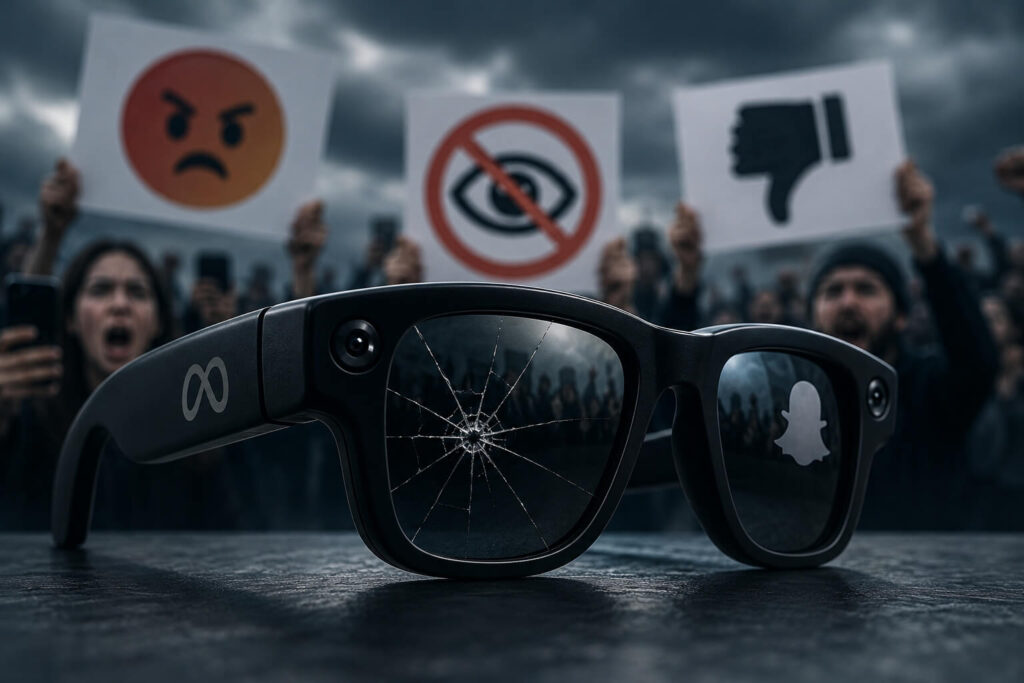
Big Tech wants AI glasses to become the device people wear all day. Consumers may have other ideas.
Meta and Snap are pouring money into camera-equipped eyewear that can record videos, answer questions and place digital information directly in front of the wearer. The pitch sounds convenient. No need to pull out a phone. Just look, speak and let the glasses handle the rest.
That vision is starting to run into a much less polished reality.
Privacy concerns are growing. Some people feel uncomfortable around anyone wearing camera glasses. Others simply do not want another person quietly recording them in a restaurant, shop, workplace or public event.
The technology may be improving quickly. Public trust is not moving at the same speed.
Meta’s AI Glasses Have a Recording Problem
Meta’s glasses were supposed to avoid the mistakes that hurt earlier wearable devices. They look more like ordinary Ray-Bans, which makes them easier to wear in public than the original Google Glass.
That ordinary appearance is also part of the problem.
It can be difficult for people nearby to know whether the wearer is recording. Meta includes an indicator light that turns on when the camera is active, but reports emerged of users paying third parties to remove or disable that light.
Meta responded with a software safeguard that disables the camera when the recording indicator is covered, damaged or tampered with. The update closes one obvious loophole, although it does not erase the broader concern surrounding wearable cameras.
A smartphone pointed in someone’s direction is easy to notice. Glasses are different. A person can appear to be looking normally while capturing everything in front of them.
That changes how people behave around the technology.
Social Media Content Is Making the Backlash Worse
The biggest threat to AI glasses may not come from regulators or rival products. It may come from the content created by their own users.
Camera glasses have appeared in prank videos, unsolicited pickup clips and recordings involving workers or strangers who did not know they were being filmed. Those posts can attract views, but they also reinforce the idea that smart glasses are built for covert recording.
Instagram has started taking action against accounts using Meta glasses to film harassment, invasive pranks and pickup content involving unsuspecting people. The platform’s response shows how quickly the issue has moved beyond hardware design and into content moderation.
That puts Meta in an awkward position.
The company wants people to use its glasses to create and share content. At the same time, some of that content is helping turn the product into something other people do not want around them.
Once a device develops a creepy reputation, technical improvements alone may not be enough to fix it.
Strong Sales Do Not Guarantee Long-Term Acceptance
Meta’s glasses have already found a market.
Sales of Meta-powered smart glasses more than tripled during 2025, according to figures reported by eyewear partner EssilorLuxottica. More than seven million units were reportedly sold during the year.
Those numbers suggest that smart glasses are no longer a tiny experimental category. People see real value in hands-free photos, music, calls, visual assistance and AI-powered information.
Still, sales growth and social acceptance are not the same thing.
A customer may enjoy wearing the glasses. Everyone standing around that customer also forms an opinion about them. That second group could eventually decide whether AI glasses become normal or remain socially uncomfortable.
The reaction is already spreading beyond technology circles. Musicians and public figures have criticised camera glasses because they make it harder to know when someone is filming. Activists have also used parody advertisements and public campaigns to frame the devices as mobile surveillance tools.
Not exactly the image Meta wants attached to its next computing platform.
Snap’s Specs Face a Different Problem
Snap is making its own expensive bet on augmented reality glasses.
The company’s new Specs are more ambitious than Meta’s camera-focused eyewear. They are designed to place interactive digital objects into the wearer’s field of view without requiring a separate phone or external computing device.
The technology is impressive. The glasses themselves are difficult to ignore.
Snap’s Specs have a thick, oversized design that looks more like development hardware than something most people would casually wear to lunch. Images of Snap CEO Evan Spiegel demonstrating the glasses quickly attracted comments about their size and weight.
Then there is the price.
Snap launched the consumer-facing Specs at around $2,195, placing them far outside the casual gadget category. Preorders are open, with shipments expected to begin in selected markets during fall 2026.
For developers and dedicated AR enthusiasts, that may be manageable. For ordinary social media users, it is a difficult sell.
Snap needs people to see the glasses as useful enough to justify the cost and attractive enough to wear in public. Right now, the design threatens to overpower the actual features.
Public Restrictions Could Limit Where AI Glasses Work
Smart glasses lose much of their appeal when users constantly need to remove them.
New York’s court system introduced a statewide prohibition covering smart glasses and other camera-equipped eyewear inside court facilities. Under the policy, visitors must hand the devices to security personnel for safekeeping before entering. The restriction took effect on July 20, 2026.
Courts have obvious reasons to prevent secret recordings. Other venues may reach similar conclusions.
Schools, cinemas, workplaces, casinos, concerts, clinics and private businesses could introduce their own restrictions. Some may ban the devices completely. Others may require wearers to remove or switch them off.
That would leave consumers carrying a product designed for constant use but prohibited in many of the places where they spend time.
Google Glass ran into a similar problem more than a decade ago. The product became associated with high prices, social awkwardness and unwanted recording. Google ended consumer sales in 2015 after the device failed to gain widespread acceptance.
The technology was not the only issue. People simply did not enjoy being around it.
AI Glasses Need Trust More Than Another Feature
Meta sees smart glasses as part of a future in which people interact with AI throughout the day. Instead of opening apps, users could ask questions about whatever they are looking at and receive immediate answers.
There are useful applications here.
AI glasses can help people with visual impairments understand their surroundings. They can provide translations, directions, reminders and hands-free access to information. Researchers have already explored how Meta’s eyewear could support personalised visual-assistance tools for blind and visually impaired users.
Those benefits deserve attention.
The companies building these products cannot assume that useful features will automatically cancel out privacy fears, though. People need to feel confident that they are not being filmed without permission. They also need clear signs showing when a camera is active and meaningful consequences when users abuse the technology.
Better battery life will not solve that. Neither will a smarter assistant.
The real challenge is social permission.
The AI Glasses Backlash Could Shape the Entire Market
Meta and Snap are trying to turn eyewear into the next major computing platform. The ambition is enormous. So is the risk.
Meta has the advantage of stronger sales and frames that look relatively normal. Snap is offering a more advanced augmented reality experience, but its price and bulky design could keep it inside a small enthusiast market.
Both companies face the same question: Will people accept cameras and always-available AI at eye level?
The answer will not come from a launch presentation.
It will come from restaurants, offices, schools, courtrooms, concerts and ordinary conversations. Places where someone notices a pair of smart glasses and wonders whether they are being recorded.
That moment matters more than another flashy demo.
Sources
- Social Media Today – Negative sentiment threatens AI glasses push
- 9to5Google – Meta glasses disable the camera if the privacy light is damaged
- The Verge – Meta faces a smart-glasses content moderation problem
- Specs – Official Snap Specs website
- New York State Unified Court System – Smart glasses prohibition memorandum
- arXiv – WhatsAI visual accessibility research