


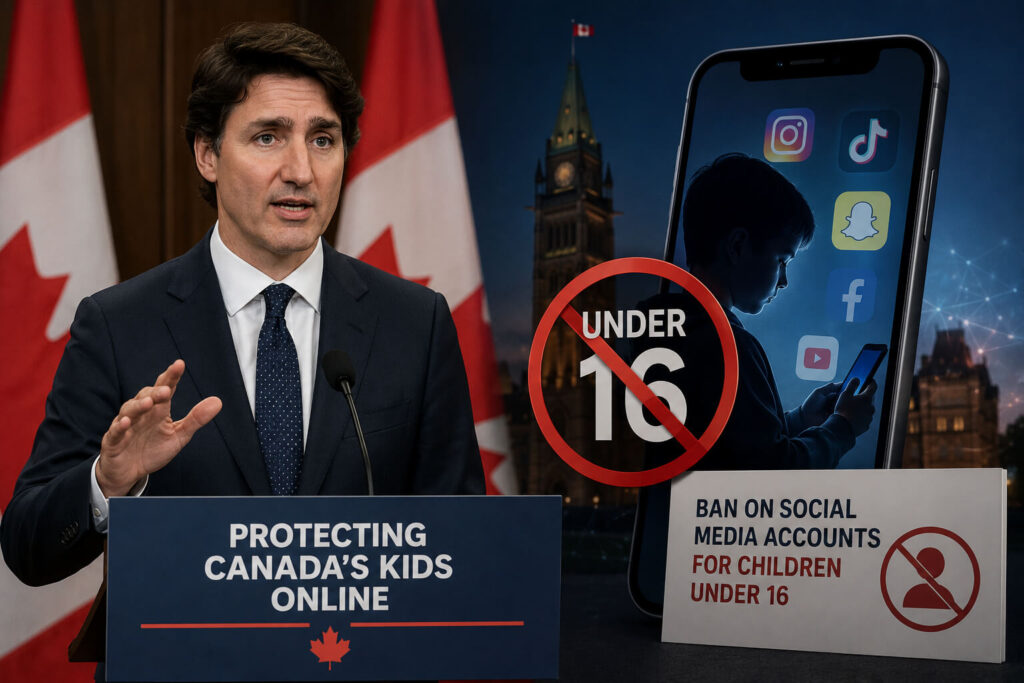
Canada is moving toward one of its strongest social media safety measures yet. It is introducing legislation that could prevent children under 16 from creating or using social media accounts. This would apply unless platforms can prove they are safe for young users.
The proposed law places Canada alongside a growing number of countries taking a tougher stance on children’s access to social media. Moreover, governments around the world are increasingly concerned about the impact of online platforms on child safety, mental health, privacy, and exposure to harmful content.
Under the proposal, social media companies would need to show they have proper safeguards in place before allowing users under 16 to access their platforms. Otherwise, if they cannot meet those safety standards, they could be barred from offering accounts to children in that age group.
What Canada’s Proposed Social Media Ban Would Do
The legislation would require platforms to take stronger responsibility for protecting young users. Instead of simply relying on existing parental controls or user settings, companies would need to prove that their platforms are safe enough for children.
Canada’s plan would also introduce age verification requirements. This means platforms may need to confirm whether users are old enough to access certain services. The details of how age checks would work have not yet been fully outlined. However, the measure is expected to become one of the most debated parts of the proposal.
A new regulator, the Digital Safety Commission of Canada, would also be created to oversee the rules. This body would help determine how platforms are judged and what kind of protections are required.
Harmful Content Is a Key Focus
The proposed law targets several categories of harmful online content. These include content that encourages children to harm themselves, material that promotes violence or hatred, and non-consensual intimate images.
The goal is to reduce the risks children face online while forcing platforms to take more direct action. Canadian officials have argued that social media companies must do more to prevent young users from being exposed to dangerous material.
For social media companies, this could mean stricter moderation systems, improved reporting tools, better response protocols, and clearer accountability when harmful content reaches minors.
Platforms May Be Able to Apply for Exemptions
The Canada social media ban for children under 16 would not automatically block every platform forever. Companies may be able to receive exemptions if they can prove they have strong enough safety systems in place.
However, the standards for those exemptions have not yet been finalized. Canadian officials are expected to release more details later, including what platforms must do to qualify.
This means major platforms such as Instagram, TikTok, Snapchat, Facebook, YouTube, and others could face pressure to update their youth safety policies. This would happen if the law moves forward.
AI Chatbots Are Also Included
The legislation does not only focus on traditional social media platforms. It would also regulate companies behind artificial intelligence chatbots.
AI chatbot providers may be required to follow a duty of responsibility, including measures such as crisis intervention protocols. This is especially important as more young people interact with AI tools for conversation, advice, homework help, and emotional support.
By including AI chatbots, Canada is signaling that online child safety rules may expand beyond social networks. They could move into the wider digital ecosystem.
Canada Joins a Growing Global Trend
Canada’s proposal comes as more countries consider age-based restrictions on social media. For example, Australia has already moved ahead with a ban on social media access for users under 16, while other countries are studying or developing similar measures.
The global debate is centered on a difficult question. How can governments protect children online without creating new concerns around privacy, surveillance, and digital access?
Supporters of age restrictions argue that social media platforms have failed to protect children from harmful content, addictive design, bullying, exploitation, and mental health risks. On the other hand, critics often warn that strict age verification could create privacy risks or limit young people’s access to online communities and information.
What This Means for Social Media Companies
If Canada’s proposal becomes law, social media platforms may need to make major changes to operate in the country. These could include stronger age verification, more transparent safety systems, faster removal of harmful content, and better protections for minors.
The law could also increase pressure on platforms globally. Once one major country introduces stricter child safety rules, others may follow with similar requirements.
For Big Tech, the message is clear: governments are no longer waiting for platforms to self-regulate. The future of social media may include stricter age limits, stronger safety standards, and more legal accountability.
Why This Matters
The Canada social media ban for children under 16 could become a major turning point in the global debate over children’s online safety.
Parents may gain stronger protections for young users. Meanwhile, platforms could face a new era of regulation. For children and teens, the rules could reshape how they access social media, communicate online, and interact with digital platforms.
As Canada continues developing the proposal, the biggest questions will be how the rules are enforced. Furthermore, how platforms verify age and whether the law can protect children without creating new privacy concerns also remain crucial factors.
One thing is clear: the debate over kids and social media is no longer just about screen time. It is now a major policy issue shaping the future of the internet.