


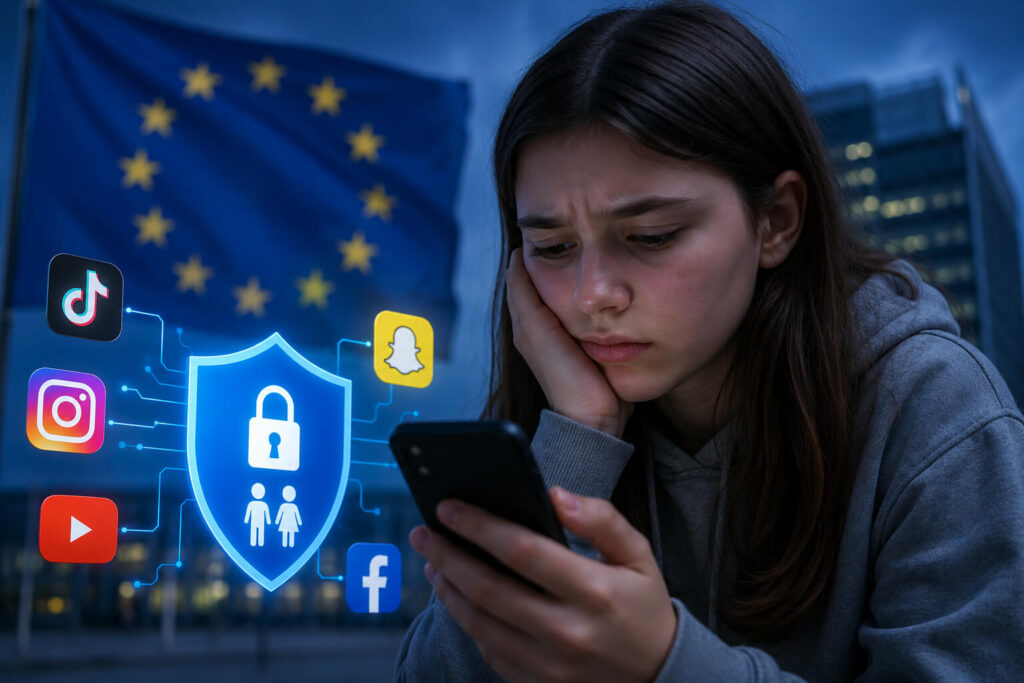
The European Union is no longer just debating whether children spend too much time on social media.
It is now moving closer to real restrictions.
The European Commission has announced the next steps in its push to limit how young people access social media apps, following growing concern over online harm, screen time, mental health, and the way major platforms are built around attention rather than child wellbeing.
Commission President Ursula von der Leyen said the issue has become too serious to leave entirely to platforms and parents. According to her, young people across Europe now spend around four to six hours a day on screens. She also said almost 60% of young children have experienced emotional or psychosocial problems online.
That is the kind of number policymakers do not ignore for long.
Europe Wants Clearer Rules for Children Online
Von der Leyen said social media platforms were not designed with children’s wellbeing as the starting point.
That is the heart of the EU’s argument.
The platforms may offer entertainment, connection, creativity, and community. But they are also built to keep people scrolling. For adults, that is already complicated. For children and teenagers, regulators argue it becomes something else entirely.
The EU is now looking at whether clearer age limits should be introduced for social media use across the region. An under-16 restriction appears to be one possible direction, although some EU member states are reportedly pushing for a lower under-15 threshold.
Nothing is final yet.
But the mood has changed. This no longer feels like a side discussion about parental controls. It is becoming a major digital policy issue.
Age Verification Could Become the Big Test
One of the most important parts of the EU plan is age verification.
Von der Leyen pointed to the EU’s new age verification app as a possible tool to help enforce future rules. The idea is to create a more consistent way to confirm whether users are old enough to access certain online platforms.
That sounds simple until you think about how messy it could get.
Platforms will need reliable systems. Governments will need privacy safeguards. Parents will want control. Teenagers will look for workarounds. And civil rights groups will almost certainly ask how much identity data should be required just to use the internet.
Still, without age verification, social media age limits can become mostly symbolic.
Australia has already shown how difficult this can be. The country moved to ban users under 16 from social media, but early signs suggested many young users were still finding ways around the restrictions. That is exactly the kind of problem Europe will want to avoid.
Big Tech Is Facing a Child Safety Moment
The bigger message here is clear enough.
Big Tech is being pushed into a new era of child safety regulation.
For years, social media companies have rolled out parental controls, teen safety settings, screen time reminders, sensitive content filters, and other tools. Some of them help. Some of them feel like public relations. Many still depend on users, parents, or children themselves to manage the problem.
European regulators seem less willing to accept that arrangement now.
The question is shifting from “Can platforms offer safety tools?” to “Should young users be allowed on these platforms at all?”
That is a much harder question for Meta, TikTok, Snapchat, YouTube, X, and other platforms that rely heavily on young audiences to shape trends, engagement, and culture.
Parents, Platforms, and Governments Are Now Colliding
Von der Leyen said parents should be the ones raising children, not algorithms.
It is a sharp line, but it also captures the political feeling behind the EU’s next move.
Parents often feel they are fighting systems much bigger than themselves. A parent can set rules at home, but social pressure does not stop at the front door. If classmates are all on an app, if group chats happen there, if memes and school drama live there, then staying away can feel like being cut off.
That is why governments are stepping in.
The argument is that individual families cannot solve a platform-level problem alone. Not when the platforms are designed by some of the most powerful technology companies in the world.
Will Teen Social Media Bans Actually Work?
This is where the debate gets uncomfortable.
Supporters of stricter rules say children need a safer start online. They argue that social media can expose young users to bullying, addictive design, harmful content, beauty pressure, scams, adult strangers, and algorithmic rabbit holes before they are ready to handle it.
Critics are not always defending Big Tech. Some simply doubt bans will work.
Young users may still bypass restrictions. Some could move to smaller, less regulated apps. Others may use older relatives’ accounts or lie about their age, as they already do. And if enforcement becomes too aggressive, privacy concerns could grow quickly.
So yes, the EU may be moving in the right direction.
But the actual execution will matter more than the headline.
What Happens Next for Social Media Platforms?
The European Commission is expected to use expert findings and policy reviews to decide what kind of restriction makes sense across the EU.
If broader age limits move forward, social platforms could face new compliance duties around identity checks, age assurance, teen access, parental consent, and safer product design.
This would not be a small adjustment.
For platforms, Europe is often where tougher digital rules start before spreading elsewhere. The Digital Services Act already forced major platforms to take more responsibility for online risks. Teen social media limits could become another major pressure point.
And if the EU lands on a strict under-16 model, other regions may watch closely.
Social media companies should probably treat this as more than a European policy story. It could become the next global template for child safety online.
Sources:
- Social Media Today: EU takes next steps to limit teen social media use
- European Commission: Official website
- European Commission Digital Strategy: Official digital strategy portal