


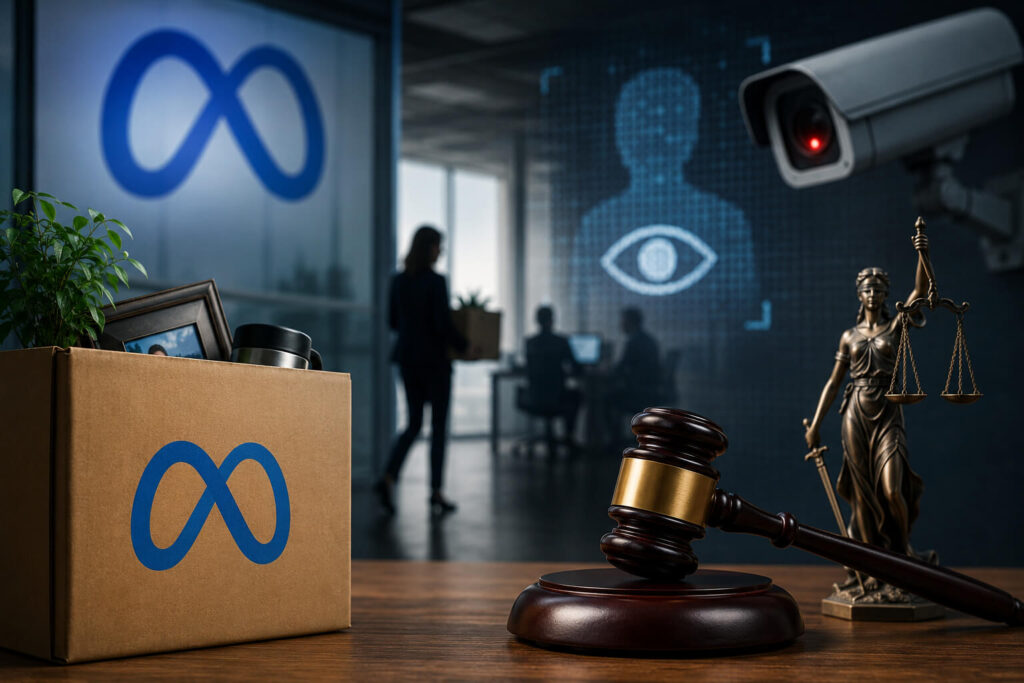
Meta is spending heavily on artificial intelligence. Now, the technology sits at the center of a very different kind of story.
A group of 26 Meta employees has filed a lawsuit alleging that the company used AI-based performance and monitoring systems to help choose workers for a major round of layoffs. According to the complaint, employees who had taken medical, parental, pregnancy, or family leave were more likely to appear near the bottom of internal rankings. That distinction matters.
People on approved leave naturally produce fewer keystrokes, fewer internal activity signals, and fewer measurable outputs. The workers argue that Meta’s systems treated those missing numbers as weak performance rather than legally protected absences. Meta denies that AI made the decisions.
Meta Workers Claim AI Systems Helped Build the Layoff List
The lawsuit was filed in the US District Court for the Northern District of California by 26 current and former Meta workers.
It focuses on Meta’s May 2026 workforce reduction, which affected around 8,000 employees, or roughly 10% of the company’s workforce. The plaintiffs claim Meta did not rely mainly on managers who understood their employees’ projects and contributions. Instead, the company allegedly used several internal AI systems to score, rank, and select people for dismissal.
The alleged inputs went beyond ordinary performance reviews. According to the complaint, Meta considered keystroke and activity-monitoring data, AI token usage, productivity dashboards, and algorithmically assisted employee ratings.
On paper, that may look objective. In practice, the workers say it created a built-in disadvantage for anyone who had temporarily stepped away from work for legally protected reasons.
Protected Leave Could Look Like Poor Performance to an Algorithm
An employee on maternity leave is not typing messages, attending meetings, or producing the same volume of digital activity as someone working full time. Neither is a worker undergoing medical treatment.
The lawsuit argues that Meta’s systems failed to properly account for that difference. Employees could not accumulate productivity scores while away, yet those lower or missing scores allegedly remained part of the layoff selection process.
The complaint claims Meta did not pause the system or conduct a separate review that removed the effects of protected leave and disability accommodations. As a result, people exercising workplace rights may have appeared less productive without actually performing poorly.
That is the uncomfortable part of automated management. A system does not need to contain an instruction saying “penalize workers on leave” to produce that result. It only needs to measure the wrong things without enough context.
The Lawsuit Includes Pregnancy, Medical, and Disability Claims
The plaintiffs describe several cases that they believe show how the alleged system operated. One scientist was reportedly selected for dismissal while taking approved pre-birth pregnancy leave. She received notice of the layoff two days before giving birth.
An engineer claims his performance rating dropped because an injury created what a manager called “broken time.” Another employee was allegedly demoted after taking medical leave and later selected for dismissal while on a second period of leave. Around half of the plaintiffs had taken pregnancy, parental, caregiving, or bereavement leave. Others had requested or received workplace accommodations connected to disabilities.
The lawsuit cites several US employment protections, including the Family and Medical Leave Act, the Americans with Disabilities Act, the Pregnancy Discrimination Act, and the Pregnant Workers Fairness Act. Those claims have not yet been proven in court.
Meta Says People, Not AI, Made the Decisions
Meta has rejected the allegations. A company spokesperson said the claims lacked merit and were not based on facts. Meta maintains that workforce and organizational decisions were made by people rather than artificial intelligence. That response draws an important line, though perhaps not a clean one.
A human manager can still make the final decision after reviewing an AI-generated score, ranking, or recommendation. The presence of a person at the end of the process does not necessarily show how much influence an automated system had earlier. That question will likely become central to the case: did AI merely provide information, or did its rankings effectively decide who appeared on the termination list?
Meta’s Employee Monitoring Program Adds Another Layer
The dispute arrives alongside broader concerns about Meta’s internal employee-monitoring technology. According to reports cited in the lawsuit, the company introduced a program capable of collecting workplace signals such as keystrokes, mouse activity, browser history, messages, emails, and location information from company devices.
The program reportedly faced strong internal resistance. More than 1,600 employees signed a petition raising privacy concerns, and Meta later paused the initiative in June 2026. Monitoring software is not new. Companies have tracked logins, working hours, and device activity for years. AI changes the scale.
Instead of simply recording activity, newer systems can combine thousands of signals, assign scores, identify patterns, and rank workers. The output may look scientific because it arrives in a dashboard. That does not mean the underlying assumptions are fair.
Why the Meta AI Layoffs Lawsuit Matters Beyond One Company
This case is bigger than a dispute between Meta and 26 workers. Businesses are rapidly placing AI inside recruitment, performance assessment, scheduling, productivity tracking, and workforce planning. Some employers may see these tools as a way to remove emotion and inconsistency from management decisions.
Algorithms bring their own inconsistencies. A worker who attends fewer meetings because of a disability accommodation may look less engaged. Someone on parental leave may show lower output. An employee completing difficult long-term work might produce fewer visible digital signals than a colleague handling many small tasks.
None of those measurements automatically tells a company who contributes the most. The Meta AI layoffs lawsuit puts that problem in plain view. When employers use automated rankings for decisions that affect jobs, income, healthcare, and immigration status, “the computer calculated it” will not be a convincing explanation.
The Workers Want the Layoffs Paused
The plaintiffs asked the court to preserve their employment while their claims move through arbitration and litigation. They argue that final termination could create immediate consequences, including lost health insurance during pregnancy or medical treatment, forfeited equity, cancelled leave rights, and immigration complications.
The workers have also sought an independent review of Meta’s AI systems to determine how the company generated the layoff selections. Their employment was scheduled to end beginning July 22, 2026. Meta will have the opportunity to challenge the allegations and explain its selection process.
What happens next may offer an early test of how courts treat AI-assisted workplace decisions. Not fully automated. Not fully human either. Somewhere in the middle, where accountability tends to become blurry.