


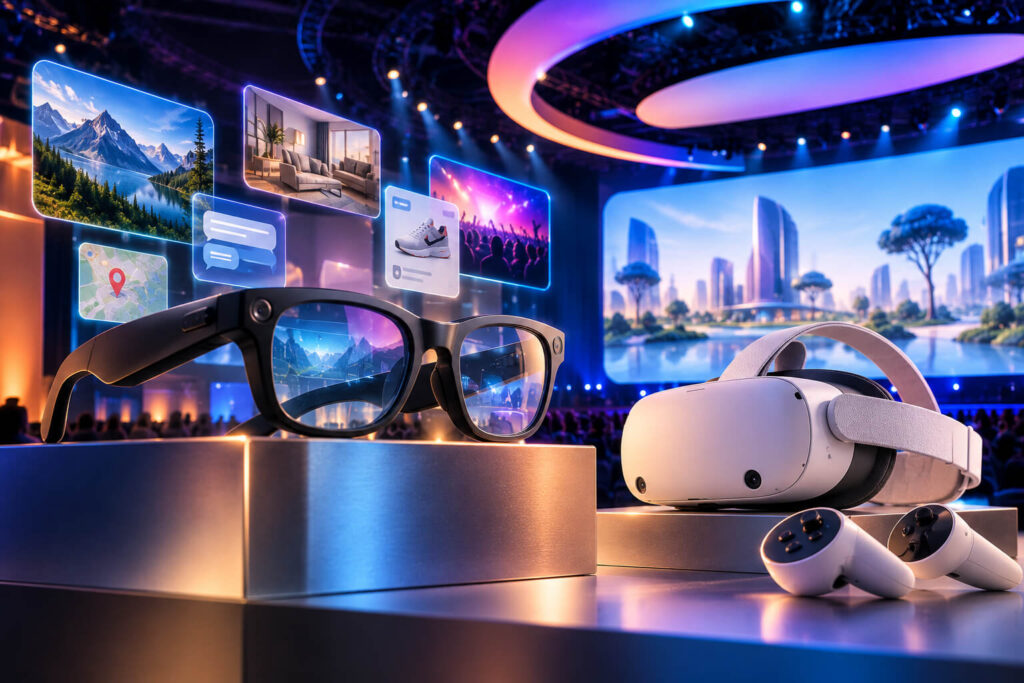
Meta used Connect 2026 to show where its technology strategy is heading next. Artificial intelligence is moving deeper into the company’s hardware plans, with Muse, smart glasses and virtual reality increasingly connected under the same vision.
During Meta Connect 2026, CEO Mark Zuckerberg outlined updates for Muse, Meta’s personal AI agent, alongside new AI glasses, privacy features and a much lighter virtual reality device. The announcements suggest Meta wants AI to become something people carry and wear, rather than a feature they only open inside an app.
The metaverse has not disappeared from Meta’s roadmap. Still, AI has clearly changed the order of priorities. Meta is now building products where AI assistants, wearable hardware and immersive computing increasingly overlap.
Muse Takes a Bigger Role Across Meta’s Devices
Muse was one of the central pieces of Meta Connect 2026. Rather than positioning it as another conversational chatbot, Meta is developing Muse as a personal AI agent capable of helping users complete tasks and interact with services on their behalf.
Meta says Muse operates through a secure cloud environment designed to keep a user’s agent and related information separated from other systems. The company is also expanding what Muse can do through integrations with outside services and businesses.
That could eventually make Muse useful for everyday activities such as shopping, planning trips and handling digital tasks. Meta is also exploring dedicated email addresses for Muse agents and additional personalization options, including customizable voices.
The direction is becoming clearer. Meta does not appear to see Muse as a single app that users occasionally open. It wants the AI agent to follow people across different devices and digital experiences.
Privacy Becomes More Important for AI Glasses
AI glasses bring a different set of privacy questions compared with phones and laptops. Cameras and microphones worn throughout the day can capture far more of a user’s surroundings, which means Meta needs to convince consumers that the technology can operate without creating unnecessary privacy risks.
Meta addressed those concerns at Connect by outlining private processing capabilities for its glasses and additional safeguards around Muse. The company says its systems include protections intended to restrict access to credentials and sensitive actions.
Those measures could become increasingly important as smart glasses move beyond technology enthusiasts. If Meta wants millions of people to wear AI-powered glasses in public, privacy will be part of the product discussion rather than a secondary feature.
Ray-Ban Meta Audio Removes the Camera
One of Meta’s more unusual announcements was Ray-Ban Meta Audio, a pair of smart glasses that removes the camera completely.
Instead, the glasses focus on music, phone calls and hands-free access to AI. That gives consumers another way to use Meta’s wearable technology without having a camera constantly positioned on their face.
Meta says Ray-Ban Meta Audio weighs about 43 grams and can provide up to 12 hours of use on a single charge. Its charging case can extend usage further. The glasses will be available in Clubmaster and Burbank styles, with prices starting at $349.
Removing the camera could help Meta reach people who like the idea of wearable AI but remain uncomfortable with camera-equipped glasses. It also turns smart eyewear into a broader product category rather than a single camera-focused device.
Ray-Ban Meta Gen 3 Pushes Smart Glasses Further
For users who do want a camera, Meta is moving forward with Ray-Ban Meta Gen 3.
The latest generation introduces a slimmer frame, improved battery performance and quicker access to Meta AI through a customizable action button. Meta has also added a six-microphone system designed to improve voice commands and calls in noisy environments.
Creators may pay more attention to the camera improvements. The glasses include a 12-megapixel camera capable of recording 3K Ultra HD video. Meta also plans to introduce additional spatial audio capabilities for captured video.
Battery life reaches up to nine hours, while several frame designs give users more choices than earlier generations. Prices start at $449.
Meta Is Treating Smart Glasses as Fashion
Technology is only part of Meta’s approach to smart glasses. The company is increasingly treating eyewear as a fashion category as well.
Meta is expanding the range with several styles, including Capri, Nova, Aviator and Zena, alongside an updated Adventurer model. Different designs and price points could make it easier for consumers to find smart glasses that resemble ordinary eyewear rather than obvious technology products.
Celebrity collaborations are also part of that strategy. Meta announced a new collection with K-pop star LISA, continuing its effort to connect wearable technology with entertainment, creators and popular culture.
That crossover matters for Meta. Smart glasses will probably have a better chance of reaching mainstream consumers if people want to wear them because of their appearance, not simply because they contain AI.
Muse Is Moving Directly Into AI Glasses
The hardware announcements become more significant when combined with Muse.
Meta plans to bring its personal AI agent directly to its AI glasses. Users could interact with Muse through voice commands while walking, shopping, traveling or completing everyday tasks without repeatedly reaching for a smartphone.
This creates a different relationship between Meta’s AI software and hardware. The glasses become an interface for the assistant rather than simply a device for taking photos, recording videos or listening to audio.
Over time, the AI agent itself could become more important than the individual pair of glasses. A user might interact with the same Muse agent across eyewear, phones and other Meta devices.
Meta Makes VR Hardware Much Lighter
Virtual reality still had a major place at Meta Connect 2026, but the hardware shown at the event looked noticeably different from traditional Quest headsets.
Meta introduced Meta VR Glasses, a device weighing roughly 100 grams. The company achieved the lighter design partly by moving major computing components away from the glasses themselves.
The displays and sensors remain on the user’s face, while processing, battery and storage components sit inside a separate puck connected to the glasses. That approach allows Meta to reduce the weight users need to carry on their heads during longer sessions.
The device also uses micro-OLED displays and supports immersive audio and visual technologies. Meta is integrating AI controls into the operating system as well, allowing users to navigate experiences through combinations of speech, eye movement and hand gestures.
Meta Wants VR to Go Beyond Gaming
Gaming remains important to Meta’s VR strategy, but the company is pitching its new glasses for much more than games.
Meta sees the device working as a personal cinema, entertainment system and private computing environment. Users could watch movies, follow live sports, play games or create large virtual displays for productivity without needing several physical monitors.
Entertainment companies and streaming platforms are also expected to play a role in the experience. Meta is working to bring more immersive video and media content to its VR ecosystem while expanding support for gesture-based gaming.
The company is also developing hologram-style calling. That technology aims to create a more realistic representation of users during virtual conversations, potentially bringing immersive communication into existing messaging and video-calling workflows.
Meta plans to launch its new VR glasses in spring 2027, with pricing starting at $1,299.99.
Meta’s AI Strategy Is Becoming Physical
Meta Connect 2026 showed how quickly the company’s AI strategy is moving beyond software.
Muse provides the intelligence layer. Smart glasses give people a wearable interface for that intelligence. VR hardware takes the same concept into a more immersive environment.
For Meta, this could eventually change how people interact with its wider ecosystem. Facebook, Instagram, WhatsApp and other services currently depend heavily on smartphone screens. AI-powered wearables could give the company another doorway into those experiences.
The shift will not happen overnight. Smartphones remain central to digital life, while AI glasses and lightweight VR devices still need to prove that people want to use them every day.
Meta is nevertheless building toward a future where interacting with its platforms may involve less tapping on a screen and more talking, looking and asking an AI agent to handle the next step.
Sources
Social Media Today — Meta Outlines Muse, AI Glasses and VR Device Updates at Connect 2026
https://www.socialmediatoday.com/news/meta-outlines-muse-ai-glasses-and-vr-device-updates-at-connect-2026/831223/
Meta — Introducing Muse Personal AI Agent
https://about.fb.com/news/2026/09/introducing-muse-personal-ai-agent/
Meta — Ray-Ban Meta Audio, New Styles and Muse
https://about.fb.com/news/2026/09/introducing-ray-ban-meta-audio-glasses-new-styles-plus-muse/
Meta — Introducing Meta VR Glasses
https://about.fb.com/news/2026/09/introducing-meta-vr-glasses-3d-movies-immersive-live-sports-100-grams/