


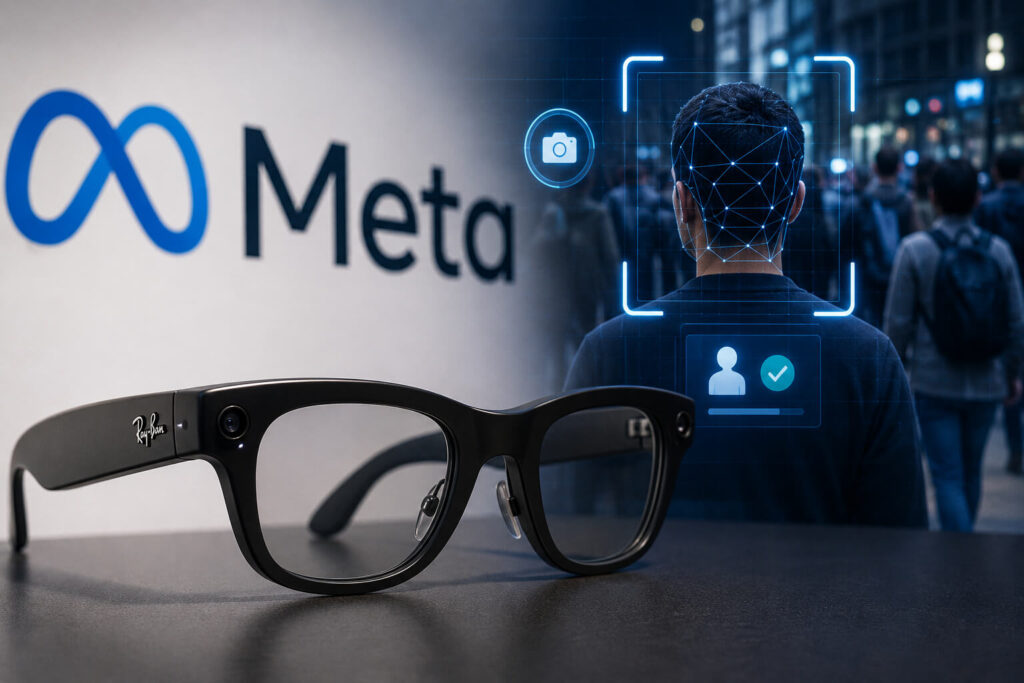
Meta is facing fresh criticism over reports that it may be exploring facial recognition technology for its AI-powered glasses. This move could intensify concerns about privacy, consent, and real-world surveillance.
The latest discussion follows reports that Meta has held conversations with facial recognition technology providers as it evaluates possible identity-based features for its wearable devices. While Meta has pushed back against claims that a consumer-facing feature is imminent, the company has not fully dismissed the idea that facial recognition tools are being considered.
Instead, Meta says no facial recognition feature has been released to consumers and that no final decision has been made.
Meta Says No Final Decision Has Been Made
Meta’s position is that it is still in an exploratory stage. The company has said that people have expressed interest in identity-related features. It has also said that any possible launch would be handled with transparency.
That response, however, has done little to quiet concerns from privacy advocates and social media observers. The issue is not only whether Meta has already built the feature. It is also whether the company is preparing the public for facial recognition to become part of its wearable AI products.
For many users, the idea of smart glasses being able to identify people in public spaces raises serious questions. Unlike facial recognition on a phone or in a photo library, AI glasses are designed to be worn in everyday environments. This design could make recognition tools far more sensitive.
Why Facial Recognition in AI Glasses Is Controversial
Facial recognition technology has long been controversial because it can identify people without their clear awareness or consent. When connected to wearable cameras, the risks become even more complicated.
If Meta adds facial recognition to its AI glasses, users could potentially scan people in public places and receive information about them in real time. Even if Meta limits the feature, the concept raises broader concerns about connecting personal identity, public visibility, and digital profiles.
The debate also touches on a larger issue: AI wearables are moving faster than social norms and privacy regulations. As companies race to make AI assistants more useful in the real world, the line between convenience and surveillance is becoming harder to define.
Meta’s History With Facial Recognition Adds to the Concern
Meta has faced backlash over facial recognition before. In 2021, the company shut down Facebook’s face recognition system, which had been used to identify people in photos and videos. That decision came after years of scrutiny over privacy, biometric data, and user consent.
Since then, Meta has slowly reintroduced facial-recognition-related tools in more limited ways, including features designed to fight impersonation and help users recover accounts. Those use cases are easier to justify because they are connected to security and identity protection.
AI glasses, however, would represent a very different context. A wearable device with a camera, AI assistant, and potential identity features could create a much larger privacy debate.
The Bigger Risk: Wearables as a Surveillance Network
Meta’s AI glasses have become one of the company’s most visible hardware products. As adoption grows, even a small facial recognition feature could have major implications.
The concern is that millions of camera-equipped glasses could create a new type of social media-powered surveillance layer. Even if Meta says it would apply safeguards, the public may remain skeptical. This skepticism is due to the company’s past data privacy controversies.
This is why the current debate matters. The question is not only whether Meta launches facial recognition in AI glasses soon. It is whether one of the world’s biggest social media companies is moving toward a future where AI devices can recognize people in everyday life.
What This Means for Social Media Users
For regular users, this development shows that social media platforms now extend beyond apps and feeds. Companies like Meta are building AI products that move into the physical world.
That shift could make social networking more interactive. However, it also creates new privacy risks. Features such as identifying someone at an event or remembering a past connection may seem helpful. Still, they could feel invasive if the technology recognizes people without permission.
As AI glasses become more common, users should expect more debate around consent, biometric data, and how much control people have over their identity in public spaces.
Final Thoughts
Meta has not confirmed that facial recognition is coming to its AI glasses, but the company’s repeated responses suggest that the idea remains on the table. For now, Meta is trying to reassure the public that nothing has launched and no final decision has been made.
Still, the privacy concerns are unlikely to disappear. If Meta eventually brings facial recognition to AI glasses, it could become one of the most important social media privacy debates of the AI era.