


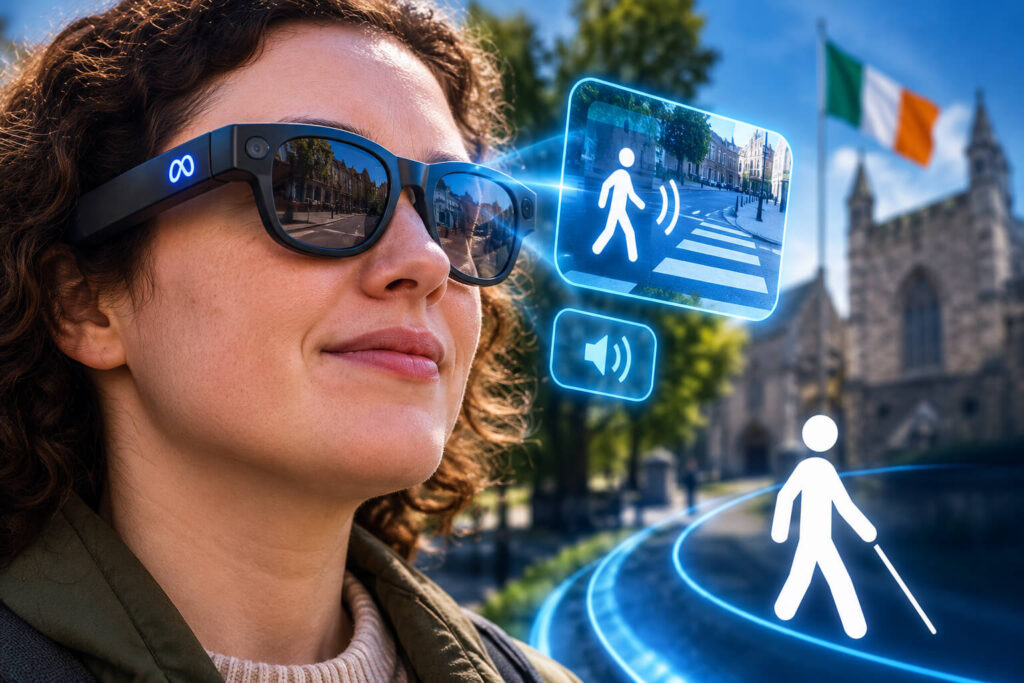
Meta is putting thousands of its AI-powered glasses into the hands of people who may have a very practical reason to use them. In particular, the launch of Meta AI glasses for vision-impaired users could mean a significant improvement in accessibility and day-to-day independence.
The company is providing 15,000 pairs of Ray-Ban Meta AI glasses to Vision Ireland, the country’s national sight-loss charity. People will be able to apply for the devices through Vision Ireland, with the glasses being distributed free of charge as part of the program.
This is more than another product giveaway. Meta has spent years pitching smart glasses as something that could eventually become part of everyday computing. For people with limited vision, some of those features already have a much more immediate purpose.
Meta AI Glasses Find a Different Kind of Use Case
Ray-Ban Meta glasses combine cameras, speakers and Meta AI in a wearable frame. Instead of constantly reaching for a phone, users can interact with the AI assistant using voice commands and ask questions about what is around them.
That becomes especially interesting from an accessibility standpoint. A person with impaired vision could potentially use the glasses to get additional information about objects, surroundings or other visual details without needing to hold up a separate device.
Meta has increasingly highlighted that side of the product. The Vision Ireland initiative follows another large accessibility-focused program announced in June, when Meta said it would provide 130,000 pairs of its AI glasses to legally blind U.S. veterans.
The numbers suggest this is becoming a deliberate part of Meta’s wearable strategy rather than a small corporate charity project.
The Timing Is Hard to Ignore
The program also arrives while Meta’s smart glasses are dealing with a very different kind of attention.
Privacy concerns have followed camera-equipped glasses for years, and recent controversy has focused on people attempting to hide or disable the visible recording indicator on Meta’s glasses. Meta responded with an update designed to deactivate the glasses if users attempt to conceal or damage the recording light.
That recording feature has become a reputational problem because people nearby may not always feel comfortable being filmed by someone wearing what otherwise looks like a fairly ordinary pair of glasses.
So yes, an accessibility program involving thousands of users genuinely shows what the technology can do. It also gives Meta a much friendlier story to tell about a product category currently wrestling with uncomfortable questions about surveillance and consent.
Both things can be true.
Meta Still Believes Glasses Could Replace the Phone
Meta CEO Mark Zuckerberg has repeatedly positioned glasses as one of the most natural ways to interact with AI. His longer-term vision is considerably bigger than taking photos or asking an assistant simple questions.
Meta sees wearable glasses becoming a persistent interface between users and artificial intelligence — potentially handling tasks that people currently perform through smartphones. Zuckerberg has even suggested that glasses could eventually overtake phones as people’s main technological companion.
That makes accessibility programs particularly useful for Meta because they demonstrate something smartphone manufacturers have struggled with for years: AI becomes much more interesting when it understands what a person is seeing in real time.
For someone with impaired vision, that capability isn’t futuristic branding. It can be genuinely useful.
Accessibility Could Become One of AI Wearables’ Strongest Arguments
Smart glasses have spent a long time searching for their killer use case.
Taking hands-free videos is convenient. Listening to music through the frames is neat. Talking to an AI assistant without pulling out a phone feels futuristic for a while.
Accessibility is different.
If wearable AI can consistently identify objects, describe environments and help people navigate everyday situations, the technology starts solving problems instead of simply creating another gadget category.
Meta’s decision to distribute 15,000 pairs through Vision Ireland puts that idea in front of a much larger real-world audience.
There will still be questions about privacy, recording and how Meta handles information collected through wearable cameras. Those aren’t disappearing because the glasses have useful accessibility features.
But this program does show why AI glasses probably shouldn’t be judged only by their ability to capture content for social media. The more interesting future may be what happens when the camera becomes a pair of digital eyes connected directly to an AI assistant.
Sources
- Social Media Today — Meta gives 15,000 pairs of AI glasses to vision impaired users
- Vision Ireland — referenced as the organization distributing the glasses through Meta’s accessibility initiative.
- Engadget — referenced by Social Media Today as reporting on Meta’s Vision Ireland program.