


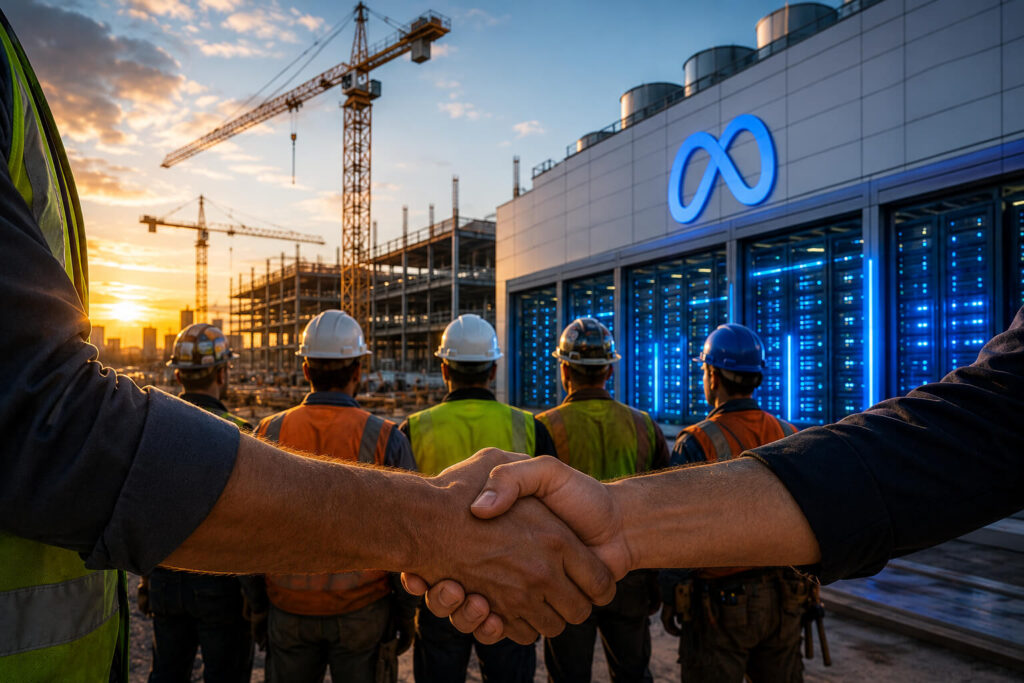
Meta is putting more money and attention behind the workers needed to build its growing AI infrastructure. Recently, Meta building trades union partnership initiatives have also become an important part of these efforts.
The company has announced a new partnership with North America’s Building Trades Unions (NABTU) aimed at expanding training and career pathways for skilled tradespeople across the United States. The timing isn’t subtle. Meta is spending heavily on data centers to support its AI ambitions, and those projects need electricians, pipefitters, construction workers and other specialized trades at a scale that is becoming harder to ignore.
Meta and NABTU Are Building a Skilled-Trades Pipeline
Under the partnership, Meta will work with NABTU and its established registered apprenticeship network to connect more people with training, credentials and full-time careers tied to infrastructure construction.
The program will also connect with Meta’s America’s Workforce Academy, another piece of the company’s broader workforce push. Instead of creating an entirely separate training system, Meta is leaning into NABTU’s existing apprenticeship infrastructure. NABTU represents more than 3.2 million skilled craft professionals across the U.S. and Canada and says its unions and contractor partners support more than 1,900 apprenticeship and training facilities across North America.
That makes this more than a symbolic labor partnership. Meta needs people who can actually build the physical backbone behind its AI products.
AI May Live in the Cloud, but Somebody Still Has to Build It
The AI boom is usually discussed in terms of models, chips and software. There is a much less glamorous layer underneath it: enormous buildings, electrical systems, cooling equipment, water infrastructure and power connections.
Meta says demand for highly skilled tradespeople is climbing as AI infrastructure expands. Its partnership with NABTU is meant to create a more dependable path from apprenticeship programs into those construction jobs.
That labor issue could become increasingly important. The biggest technology companies are racing to increase computing capacity, and a shortage of qualified workers can slow construction just as effectively as a shortage of chips.
Meta’s Data Center Push Is Also Running Into Local Resistance
There is another side to the announcement.
Meta has been trying to emphasize the economic upside of its data center investments at a time when large-scale data center construction is drawing more scrutiny from communities. Complaints surrounding projects have included pressure on utilities, water use, infrastructure disruption and road damage. Social Media Today notes that opposition to hyperscale data centers has been building as these facilities spread into more communities.
A partnership built around apprenticeships, skilled jobs and local career opportunities gives Meta something concrete to point to when making the case that its infrastructure spending can benefit the places where these projects are built.
It doesn’t automatically settle concerns over electricity, water or land use. Jobs, though, are a much easier local benefit to see.
The Partnership Fits Meta’s Bigger AI Infrastructure Strategy
Meta has made AI a central part of its long-term strategy, and that means the company needs a much larger physical computing footprint behind Facebook, Instagram, WhatsApp, Threads and Meta AI.
The NABTU agreement follows Meta’s broader Future Is For Everyone Fund, which the company says will support communities, teachers, first responders, energy systems and water infrastructure in areas affected by the expanding AI economy. The labor partnership pushes that idea into workforce development, with apprenticeships positioned as a route into careers created by the construction boom.
There is a practical business reason for doing this. Faster expansion requires workers. Community acceptance matters too.
Meta needs both.
The AI Race Is Turning Into an Infrastructure Race
The partnership is another reminder that competition in artificial intelligence is no longer happening only inside research labs.
Companies building increasingly powerful AI systems need data centers. Data centers require enormous amounts of construction. Construction requires trained people who may take years to develop the skills and certifications needed for specialized jobs.
Meta’s agreement with NABTU puts workforce development directly into that equation.
And while much of the conversation around AI still revolves around what the next model can do, the companies spending billions on the technology are confronting something far more physical: finding enough people, power and infrastructure to keep the machines running.