


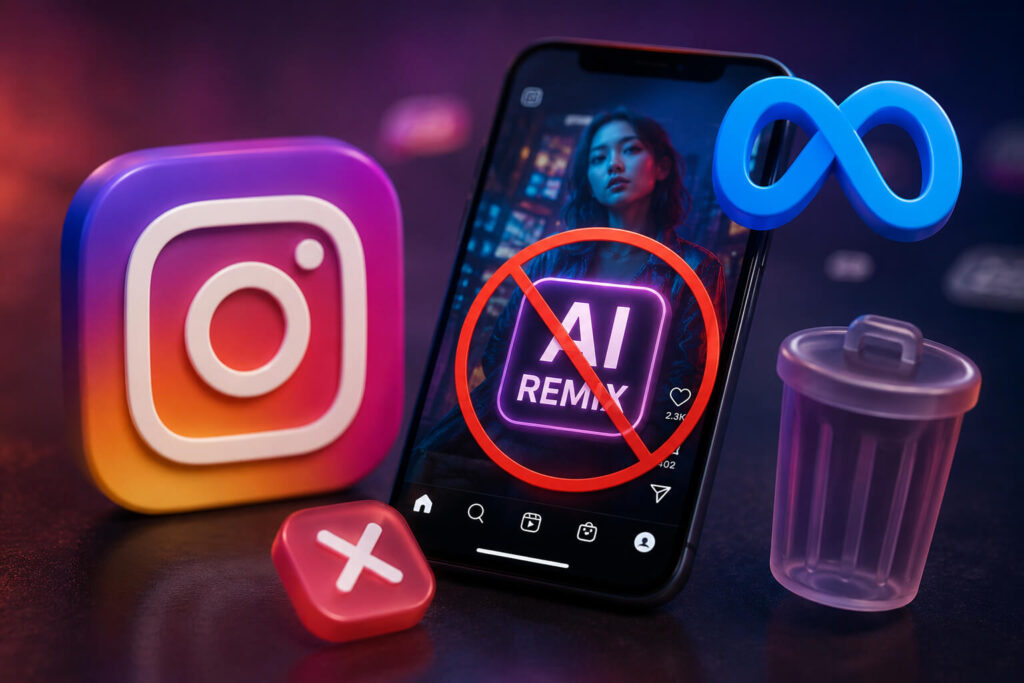
Meta has pulled back one of Instagram’s newest AI features almost immediately after launching it. In a surprising move, Meta removes Instagram AI remix option just days after its initial rollout.
The company removed an option that allowed Instagram users to reference other public accounts inside Meta AI image generation tools. The idea was simple on the surface: users could @mention a public Instagram profile and use that account’s public posts as part of an AI-generated image prompt.
But the reaction was not exactly warm.
For many users, this felt less like a fun creative tool and more like another reminder that public content on social platforms can quickly become raw material for AI systems. And this time, the concern grew fast enough that Meta reversed course in just two days.
Instagram’s AI Remix Feature Was Enabled by Default
The part that really bothered people was not only the feature itself. It was the default setting.
Meta had reportedly enabled the AI remix option for all users automatically. That meant public Instagram posts could be referenced in AI image generation unless the user manually opted out.
That is a big difference.
Opt-in gives users a choice before their content is used. Opt-out puts the burden on users after the feature is already active. For creators, public figures, artists, influencers, and even regular users, that felt uncomfortable. Not everyone wants their face, style, posts, or identity pulled into someone else’s AI-generated content.
Meta introduced the feature alongside its latest Muse Image model, which the company described as one of its more advanced image and video generation tools. The AI push itself was not surprising. Meta has been moving aggressively into AI across Facebook, Instagram, WhatsApp, and its standalone Meta AI products.
Still, this specific feature crossed a line for many users.
Backlash Came Quickly
The concern was obvious. Someone could reference a public profile and generate AI images connected to that person’s likeness, content, or visual identity.
That opens the door to misuse.
Talent agencies reportedly raised alarms almost immediately, warning clients about possible identity theft and unauthorized use of their image. For people whose careers depend on their public image, even a small AI remix feature can become a serious risk.
And for regular Instagram users, the question was simpler: why should someone else be able to use my posts in AI content without asking me first?
Meta heard the response and removed the tool.
The company said the feature was meant to be creative and give users control, but admitted that it “missed the mark.” That is a pretty rare fast retreat from Meta, especially on something tied to AI.
Meta’s AI Push Is Running Into Trust Problems
This is where the story gets bigger than one Instagram setting.
Meta wants AI inside everything. Search, messaging, content creation, ads, recommendations, creative tools. That strategy makes sense from a business angle. AI keeps users engaged, gives advertisers new tools, and helps Meta stay competitive against OpenAI, Google, TikTok, Snap, and others.
But speed is becoming the problem.
Users are already uneasy about how social platforms collect data, rank content, and shape behavior. Add AI generation into that system, and the concerns get sharper. People are not just asking whether AI tools are useful. They are asking what those tools are trained on, what they can copy, and who gets control when personal content becomes remixable.
Instagram has always been built around sharing. AI changes the meaning of sharing a little. Maybe a lot.
A public post used to mean other people could see it, like it, comment on it, or share it. Now users have to wonder whether that same post can become part of a synthetic image or AI-made scene.
That is a different kind of exposure.
Why This Matters for Creators and Brands
For creators, this decision matters because Instagram is still one of the most important platforms for personal branding. A creator’s face, content style, captions, visuals, and identity are business assets.
An AI remix tool that references public accounts could blur the line between inspiration and imitation. It could also create messy legal and reputation problems, especially when AI-generated images look close enough to a real person or brand.
Brands should be watching this too.
Many companies encourage public posting, influencer partnerships, and user-generated content. But if AI tools can easily reference public content, brands may need clearer rules around what they publish, what they allow partners to post, and how they protect official visuals.
This is not only about celebrities. Small creators, local businesses, journalists, photographers, and niche influencers could all be affected.
Meta Removed the Feature, But the Debate Is Not Over
Meta deserves some credit for moving quickly. The feature launched, people pushed back, and the company removed it instead of letting the controversy drag on.
But the bigger question remains.
Should platforms be allowed to activate AI content-use features by default? Or should users clearly agree first before their public posts become part of AI generation tools?
That question will keep coming back.
Social media companies are racing to make AI feel normal inside everyday apps. The problem is that users are becoming more aware of how much control they may be losing in the process.
Meta removed Instagram’s AI remix option for now. But this feels less like the end of the issue and more like an early warning.
AI features may be exciting. They may be creative. They may even be useful.
But when they touch identity, public posts, and personal content, platforms cannot just move fast and hope users accept it later.
Source: Social Media Today: Meta removes Instagram’s AI remix option