

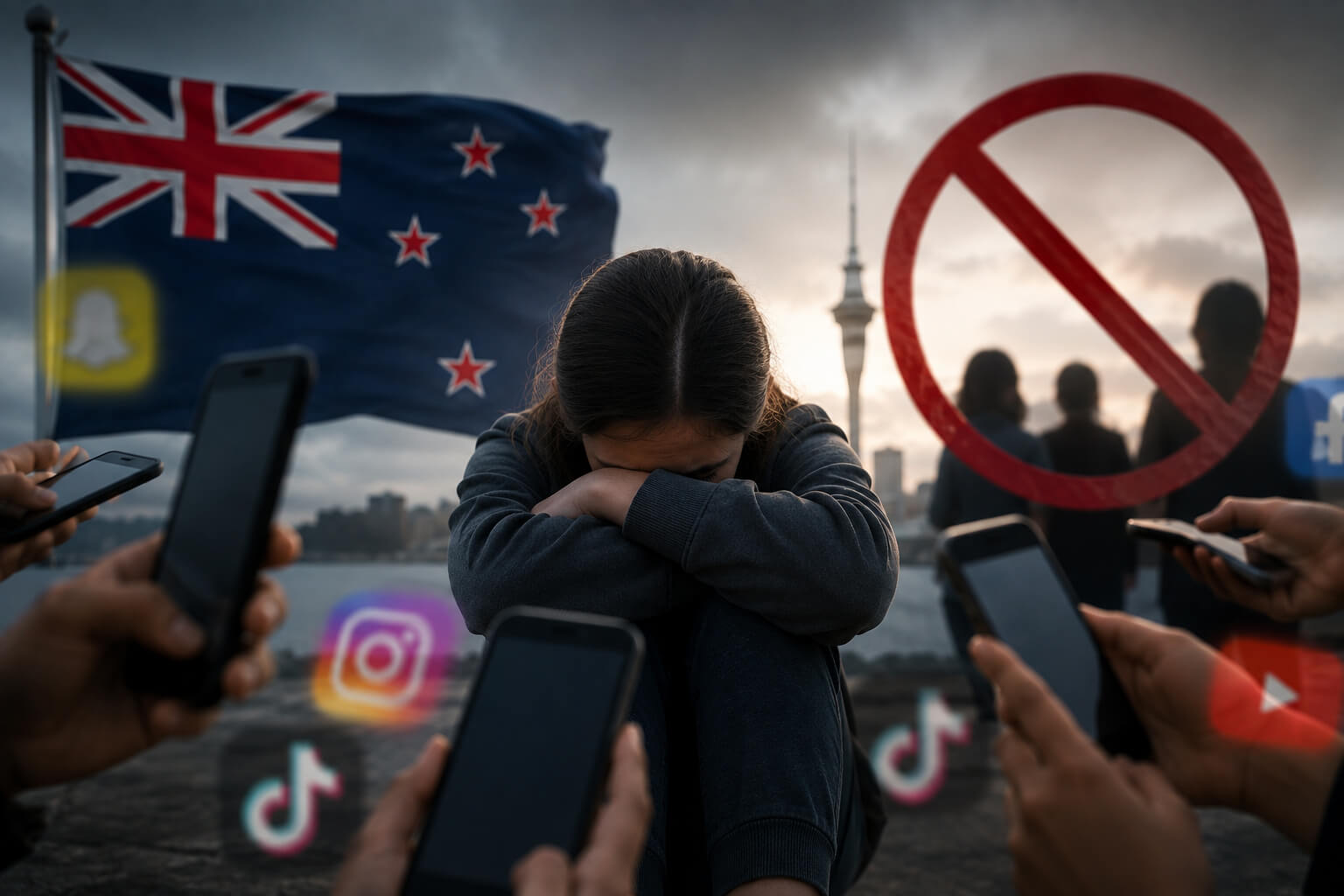
New Zealand is moving closer to restricting social media access for younger teenagers. The government has introduced a new Online Safety Bill aimed at users under 16. The proposal would place new responsibilities on major social media platforms and highlights the growing discussion about New Zealand teen social media restrictions.
Instagram, TikTok, Snapchat and Facebook are among the services mentioned in the proposal. These platforms could be required to take reasonable steps to confirm that users are at least 16 years old.
The proposal follows similar moves in Australia and other countries. Governments are increasingly questioning how young teenagers use social media. Concerns around harmful content, excessive use and online safety are driving much of that pressure.
New Zealand Wants Platforms to Check Users’ Ages
The proposed law would change how major platforms handle younger users. Social networks may need to take reasonable steps to verify age before allowing access. That could affect Instagram, TikTok, Snapchat and Facebook. The bill focuses on platforms seen as higher risk for younger users.
The exact verification methods are not yet clear. That will likely become one of the biggest issues. Age checks sound simple until platforms have to enforce them. Birth dates can be changed. Accounts can also be shared. Some teenagers may simply move to another service.
Still, the direction is clear. New Zealand wants platforms to take more responsibility for who uses their services.
The Bill May Not Move Quickly
The proposal has arrived, but implementation could still take time. According to reporting cited by Social Media Today, the bill may not progress before New Zealand’s November 2026 election. That means the political debate could continue for months.
A change in government priorities could also affect the final version. Platforms may need to prepare for tougher age checks without knowing the exact rules yet.
That type of uncertainty is becoming common across social media. Companies are facing pressure to act before every regulatory detail is settled.
Australia Is Already Testing a Similar Approach
New Zealand is not starting from scratch. Australia has already introduced major restrictions on teen social media access. Its policy is becoming an important test for age-based regulation.
Early results have raised questions. Australia’s eSafety Commissioner released a six-month update in August 2026. The findings suggested many underage teenagers were still accessing social platforms.
The report also found limited change in problematic online use or teen wellbeing. Some young users simply shifted more time toward messaging apps and online games.
Removing Teen Accounts Has Not Solved the Problem
Platforms have removed large numbers of accounts under Australia’s rules. Meta recently said it removed more than 750,000 accounts linked to underage users in Australia.
That number sounds significant. Yet many teenagers are still finding ways onto social platforms.
This highlights one of the biggest weaknesses in age-based bans. Removing accounts does not remove demand. A teenager locked out of one account can create another. Some may also enter a false birth date.
The rules may reduce official access. They do not automatically end social media use among younger people.
Teenagers Could Simply Move Somewhere Else
Young people use digital platforms to communicate. If one service becomes unavailable, another option is usually close by.
That could mean messaging apps, gaming communities or smaller social platforms. Some of those services may have weaker moderation systems.
Critics have warned about this possibility. A ban on mainstream social media could push teenagers toward less regulated spaces.
That creates a difficult outcome. The goal is safer online activity. The result could sometimes be activity that is harder to monitor.
Age Verification Remains the Weak Point
Age verification is likely to become one of New Zealand’s biggest practical challenges. Australia has already shown how difficult enforcement can be.
Many teenagers can bypass simple age restrictions by entering an older birth date. Stronger verification could reduce those loopholes.
That creates another problem, though. More aggressive checks may require identity documents or biometric information. Users may not want to provide that data just to access social media.
Weak verification creates loopholes. Strong verification creates privacy concerns. Regulators still have to find a workable middle ground.
Social Platforms Face Growing Global Pressure
New Zealand’s proposal is part of a much wider regulatory shift. Governments are increasingly focusing on how social platforms treat younger users.
Age limits, parental controls and recommendation systems are getting more attention. The pressure is no longer limited to one country.
Australia has already moved ahead with restrictions. Other governments are exploring similar rules. New Zealand now adds another proposal to that growing list.
For platforms, this creates a complicated regulatory map. A teenager may face one standard in Australia and another in New Zealand. Europe may take a different approach again.
The Debate Is Bigger Than a Simple Social Media Ban
The argument around teen social media use can easily become too simple. Supporters of restrictions point to harmful content, screen time and mental wellbeing.
Critics focus on enforcement and unintended consequences. Both sides are dealing with the same reality. Teenagers are deeply connected to digital spaces.
Blocking one group of apps does not remove that behavior. It may simply move it somewhere else.
The bigger question is where teenagers go next. Regulators also need to know whether those alternatives are actually safer.
New Zealand’s proposal brings that question back into focus. The country may eventually restrict access for users under 16. Whether the policy produces the intended result is still uncertain.
Sources
- Social Media Today — New Zealand Introduces Teen Social Media Restrictions
Read the original article - Australia eSafety Commissioner
Visit the official eSafety Commissioner website
