


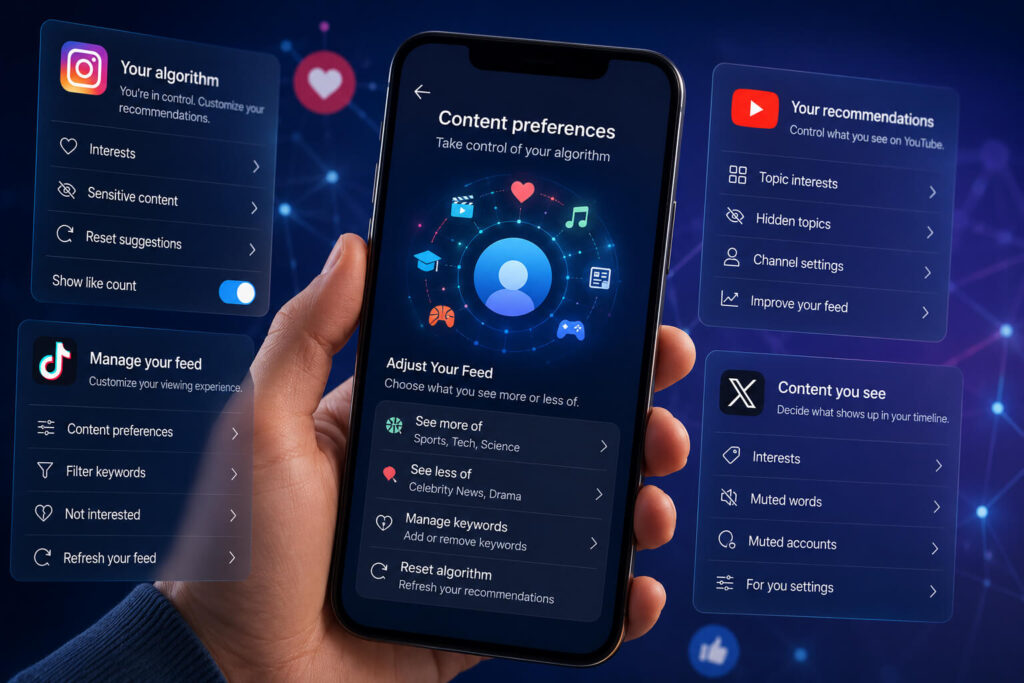
For years, social media users had limited control over what appeared in their feeds. People could follow accounts, like posts, mute keywords, or tap “Not Interested,” but the actual recommendation system remained largely controlled by the platforms.
That model is starting to change.
Major social media platforms are now introducing tools that allow users to shape their own feeds more directly. Instead of relying only on hidden algorithms, platforms such as Threads, Instagram, and TikTok are giving users more ways to tell the app what they want to see — and what they want to avoid.
This marks an important shift in the future of social media. Feeds are becoming less like a fixed broadcast channel and more like a personalized content experience that users can actively adjust.
Why User-Controlled Social Media Algorithms Matter
User-controlled social media algorithms give people more influence over the content they consume every day. This is especially important as recommendation systems have become central to how users discover news, entertainment, creators, brands, and communities.
For users, the benefit is simple: a feed that better matches their interests.
For social media companies, the business case is also clear. When people see more relevant content, they are more likely to stay engaged, watch longer, interact more, and return to the app.
This is where AI is becoming increasingly important. New AI-powered tools can help platforms understand user preferences more clearly and make algorithm settings easier to adjust.
Threads Introduces More Private Algorithm Controls
Threads is one of the latest platforms to give users more direct control over their recommendations.
Meta’s text-based social app has been testing tools that allow users to guide what appears in their feed. Earlier features encouraged users to publicly post instructions about the topics they wanted to see more or less of.
Now, Threads is moving toward more private controls. Instead of posting publicly about algorithm preferences, users can adjust their interests behind the scenes.
This gives users a more comfortable way to shape their experience. For example, someone could ask to see more posts about sports, podcasts, business, or entertainment while reducing stressful news or topics they no longer want dominating their feed.
Instagram Expands Algorithm Customization
Instagram is also giving users more visibility into how its recommendations work.
The platform has introduced tools that show users the topics Instagram believes they are interested in. From there, users can adjust those topics and guide the app toward content they want to see more often.
This is especially important for Instagram because recommendations now appear across several major areas of the app, including Feed, Explore, and Reels.
By making recommendation topics easier to view and edit, Instagram is moving toward a more transparent system. Instead of users guessing why certain posts keep appearing, they can better understand and influence the signals shaping their feed.
TikTok Offers Topic Controls for the For You Feed
TikTok has also been building more user controls into its recommendation system.
The platform’s “Manage Topics” feature allows users to adjust how much they want to see certain categories of content in the For You feed. These categories may include topics such as sports, travel, humor, food, current events, and dance.
TikTok has also expanded filtering tools with AI-powered keyword controls. These tools can help limit related terms and similar content, making it easier for users to reduce unwanted recommendations.
Because TikTok’s For You feed is one of the most influential recommendation systems in social media, these controls could play a major role in how users shape their daily content experience.
AI Is Making Algorithms Easier to Understand
One reason this shift is happening now is the rise of AI and large language models.
Traditional recommendation systems were often difficult for users to understand. They worked behind the scenes, using complex signals such as watch time, likes, shares, follows, comments, and past behavior.
AI may make these systems easier to explain and control. Instead of forcing users to only interact through likes and dislikes, platforms can let people describe their preferences more naturally.
For example, a user may be able to say they want more business news, fewer celebrity updates, more educational content, or less political commentary. The platform can then use that input to adjust recommendations more directly.
The Future of Social Media Feeds
The rise of user-controlled social media algorithms suggests that the next era of social media will be more personalized and interactive.
Instead of platforms deciding everything automatically, users may increasingly expect dashboards, sliders, topic controls, keyword filters, and AI-powered preference tools.
This could improve the user experience, but it also raises new questions. How much control will users really have? Will platforms fully respect user preferences? And will algorithm transparency become a competitive advantage?
What is clear is that social media feeds are evolving. The platforms that give users more control may be better positioned to build trust, improve engagement, and keep people coming back.
Bottom Line
User-controlled social media algorithms are becoming one of the biggest trends in the future of online platforms.
Threads, Instagram, and TikTok are all moving toward feeds that users can customize more directly. With AI helping people communicate their preferences, social media may become less passive and more personalized.
For users, this means more control over what they see. For platforms, it means a new way to keep audiences engaged in an increasingly competitive social media landscape.