


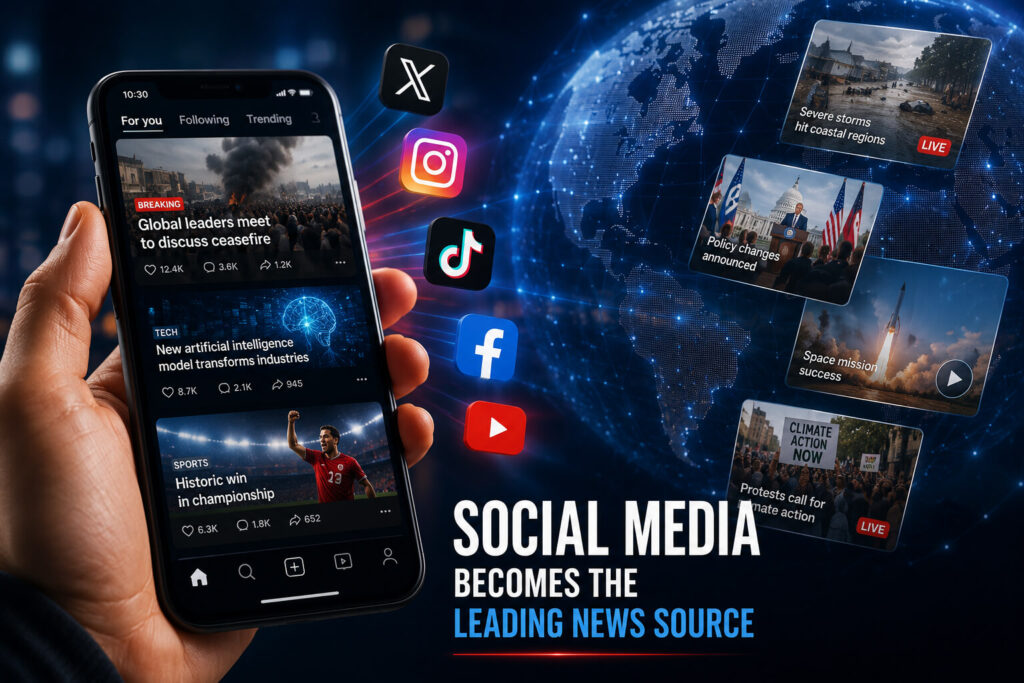
Social media is no longer just where people react to the news. It is increasingly where they find it first.
A new 2026 Digital News Report from the Reuters Institute shows that social platforms have become the leading source of news for many people worldwide, overtaking traditional channels such as television and news websites. The shift highlights how platforms like TikTok, Instagram, YouTube, Facebook, and X continue to reshape the way audiences discover, consume, and discuss current events.
For publishers, journalists, creators, brands, and everyday users, the report points to a major change in the global news ecosystem: news consumption is now more social, more algorithm-driven, and more influenced by online personalities than ever before.
Social Media Is Now the Main Gateway to News
According to the Reuters Institute’s 2026 findings, more people now rely on social media platforms as their regular source of news than on TV or direct visits to news websites and apps.
This marks a significant turning point for the media industry. For years, social platforms have played a supporting role in news distribution by helping publishers reach wider audiences. Now, they are becoming the primary entry point for many users.
Instead of opening a news website or tuning into a broadcast, many people now discover headlines through short videos, creator commentary, trending posts, algorithmic recommendations, and shared links inside social apps.
That means the first version of a story many people encounter may not come from a traditional newsroom. It may come from a creator, influencer, commentator, or viral post.
TikTok and Instagram Are Gaining More News Influence
One of the clearest trends in the report is the rising influence of visual-first platforms, especially TikTok and Instagram.
TikTok has become a major news discovery platform for younger users, who often prefer short-form video explainers, firsthand footage, and personality-led commentary. Instagram is also growing as a place where users encounter breaking updates, political clips, cultural stories, and news summaries through Reels, Stories, and carousel posts.
This shift shows how video is becoming central to news consumption. Audiences are not only reading headlines. They are watching news unfold through clips, reactions, livestreams, and creator-led analysis.
For social media managers and publishers, this means news content must be adapted for platform behavior. A traditional article may still matter, but short-form video, strong visuals, clear captions, and fast context are now essential for reaching audiences where they are.
X Is Losing Ground as a News Platform
The report also points to a decline in X’s role as a major news source.
For many years, Twitter, now X, was one of the most important platforms for breaking news, journalist updates, political discussion, and real-time public conversation. But changes to the platform, audience fragmentation, and the rise of alternatives have weakened its position.
Some users have moved to platforms such as Threads, while others have shifted their attention to TikTok, Instagram, YouTube, or creator-driven newsletters and podcasts.
X still plays a role in real-time news discussion, especially around politics, sports, finance, and global events. However, its influence appears less dominant than it once was.
Creators Are Becoming News Sources
Another major takeaway from the Reuters report is the growing role of online creators as trusted or frequently used news sources.
Creators, influencers, podcasters, livestreamers, and independent commentators are now competing with traditional media outlets for attention. In many cases, audiences feel more connected to individual personalities than to established news brands.
This can make news feel more accessible and relatable. A creator may explain a complex issue in a simple video, add personal context, or speak in a tone that feels more authentic to their followers.
But there are risks. Creators are often rewarded by engagement, not always by accuracy. Viral content can spread quickly even when it lacks context, balance, or verification. As more people depend on creator-led news, misinformation and opinion-driven framing may become harder to separate from factual reporting.
Algorithms Are Shaping What People Know
The growing reliance on social media as a news source also means algorithms now play a bigger role in shaping public awareness.
On traditional news websites, editors decide which stories are featured. On social platforms, recommendation systems often decide what users see based on engagement, watch time, interests, and behavior.
This can help users discover relevant stories, but it can also create information bubbles. People may see more of what they already agree with, while important but less engaging news may receive less visibility.
The result is a news environment where attention often determines importance. Stories that spark emotion, conflict, humor, or outrage may travel faster than stories that require deeper context.
AI Chatbots Are Emerging as News Tools
The report also notes that AI chatbots are becoming part of how people access news and information.
Tools powered by artificial intelligence can summarize events, answer questions, and provide quick explanations. For users who want fast context, this can be convenient.
However, AI-generated answers can be inaccurate, outdated, or missing important nuance. When people rely on chatbots without checking original sources, there is a risk that incorrect information may spread more easily.
This creates a new challenge for publishers and platforms: how to make trusted journalism visible and accessible in an AI-driven information environment.
What This Means for Publishers and Brands
The rise of social media as the leading news source creates both opportunities and challenges.
For publishers, it means distribution strategies must go beyond posting links. Newsrooms need to think about how stories appear inside social feeds, video platforms, creator ecosystems, search results, and AI-generated summaries.
For brands, it means social listening and rapid response are more important than ever. Public opinion can form quickly based on viral posts, influencer commentary, or trending narratives. Companies need to monitor social conversations and respond with clear, accurate information when needed.
For creators, the shift brings more responsibility. As more audiences treat creators as news sources, accuracy, transparency, and source-checking become increasingly important.
Why This Shift Matters
The Reuters Institute’s 2026 report confirms what many users already experience daily: social media is now at the center of modern news consumption.
This does not mean traditional journalism is no longer important. In fact, verified reporting may be more important than ever. But the path between journalism and the public is changing.
People are increasingly discovering news through feeds, videos, creators, algorithms, and AI tools. That creates a faster and more interactive news environment, but also one where misinformation, bias, and engagement-driven content can spread rapidly.
As social media becomes the leading news source, the biggest challenge will be ensuring that speed and reach do not come at the expense of accuracy and trust.
Key Takeaway
Social media has become the world’s leading gateway to news, with TikTok and Instagram gaining influence, X losing some of its former dominance, creators becoming major information sources, and AI chatbots emerging as a new discovery tool.
For anyone working in media, marketing, communications, or content creation, the message is clear: the future of news is social, visual, algorithmic, and increasingly creator-led.