

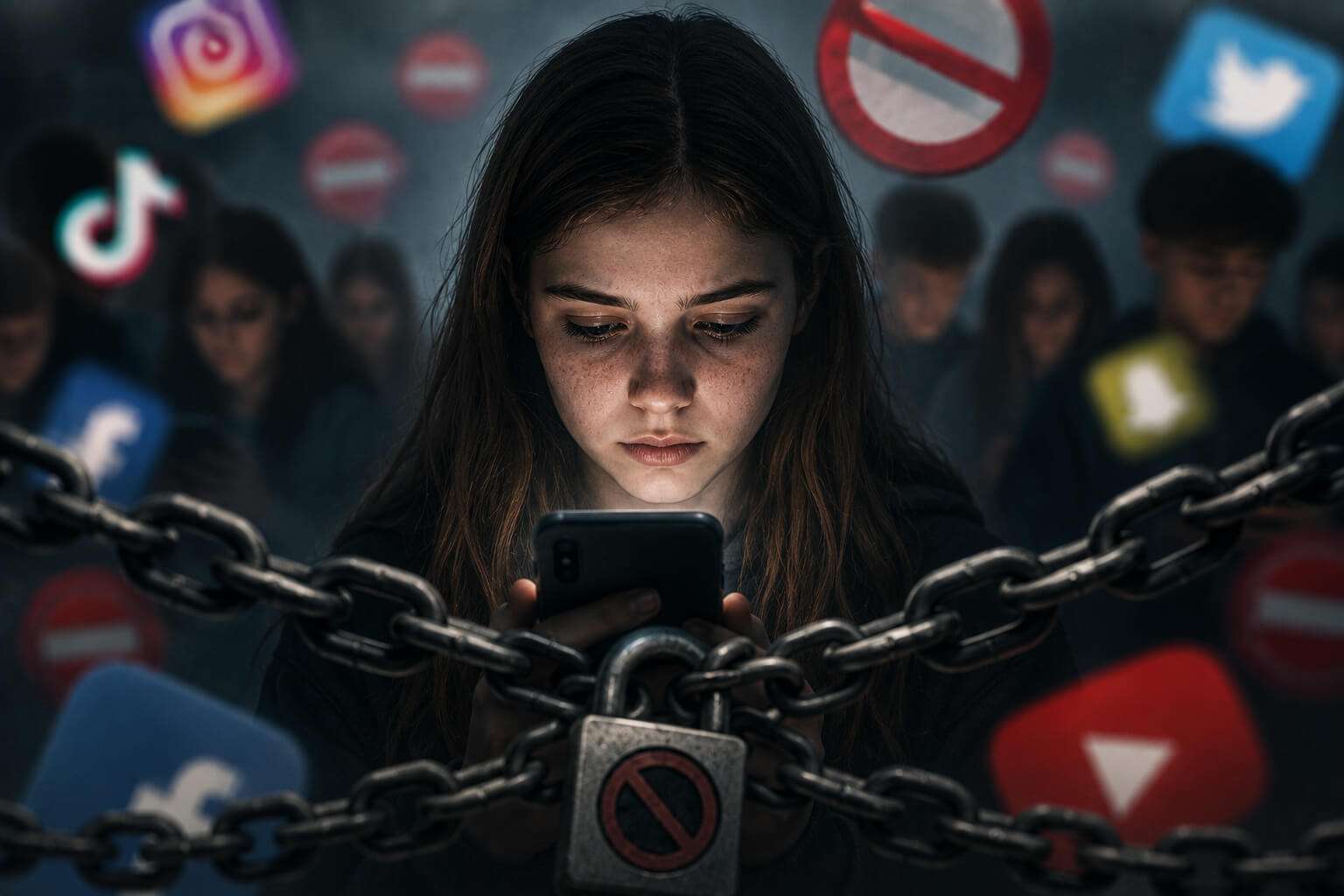
Governments are increasingly looking at teen social media bans as a way to protect younger users from harmful content, addictive platform features and excessive screen time.
Passing a law, though, is the relatively simple part.
Making millions of teenagers actually stop using Instagram, TikTok, Snapchat, YouTube and other platforms is proving much harder.
Australia has become the biggest real-world test of that idea. Its social media age restrictions took effect on December 10, 2025, requiring covered platforms to take reasonable steps to stop Australians under 16 from creating or maintaining accounts. The policy attracted global attention almost immediately.
Months later, the bigger question isn’t whether governments can announce social media restrictions. It’s whether those restrictions can survive teenagers finding ways around them, inconsistent age checks, legal challenges and platforms that all operate differently.
Australia Is Showing How Difficult a Teen Social Media Ban Can Be
Australia’s rules apply to major platforms including Facebook, Instagram, Snapchat, Threads, TikTok, Twitch, X, YouTube, Kick and Reddit.
That’s a broad list. It still doesn’t create a sealed internet.
Young users can move between services, use accounts with inaccurate birth dates, access content without signing in or simply migrate toward platforms that aren’t covered by the same restrictions.
Social Media Today points to Australia’s experience as an early warning for other governments considering similar laws. The restrictions have faced questions about circumvention and whether the rules are producing meaningful changes in problematic online behavior or youth wellbeing.
That matters because Australia isn’t some theoretical policy experiment anymore. Other countries are watching.
If its model works, expect more governments to borrow from it. If it mostly pushes teenagers into different corners of the internet, lawmakers have a different problem.
Age Verification Is Still the Weak Link
Every teen social media ban eventually reaches the same awkward question: How does an app know how old someone really is?
Typing a birthday into a sign-up box clearly isn’t enough.
More aggressive verification could involve identity documents, facial age estimation, app store account information or some form of digital identity system. Each option solves one problem while opening another.
Requiring government identification could improve accuracy but immediately raises privacy and data-security concerns. Automated age-estimation technology isn’t perfect either. Putting more responsibility on Apple and Google through their app stores could create a more consistent system, although that would hand even more control to two already dominant technology companies.
This isn’t a minor technical detail buried inside the legislation. Age assurance is basically the entire enforcement mechanism.
Without reliable age detection, a minimum-age rule can quickly become a digital version of a sign saying “16+ only.”
Teenagers Aren’t Going to Suddenly Stop Being Online
There’s also an assumption hiding underneath many of these proposals: remove social media accounts and teenagers will spend dramatically less time online.
Maybe some will.
Others will simply go somewhere else.
Messaging services, gaming communities, smaller social platforms, forums and emerging apps can all absorb activity pushed away from mainstream networks. New services can appear faster than legislation can be rewritten.
That creates an uncomfortable possibility. A ban intended to make young people safer could push some users away from heavily scrutinized mainstream platforms and toward smaller services with weaker moderation systems.
The internet doesn’t disappear when an Instagram account does.
France Shows the Legal Fight Is Only Beginning
The push for youth social media restrictions isn’t limited to Australia.
France has also pursued restrictions on younger social media users, but its effort has faced significant legal resistance. In August 2026, France’s Constitutional Council blocked legislation that would have restricted social media access for children under 15, raising concerns involving freedom of expression and privacy safeguards.
That gives other governments another headache.
Even when lawmakers believe a restriction is justified on child-safety grounds, courts may still ask whether the measure is proportionate and whether age-verification requirements create excessive privacy risks.
A policy can be popular and still run into constitutional trouble.
Social Media Bans Could Hit Advertising Too
There is a business angle that gets less attention.
Teenagers are part of the audience ecosystem advertisers pay social platforms to reach, either directly or because younger users influence entertainment, fashion, gaming and consumer trends.
Social Media Today cited eMarketer reporting suggesting brands could reduce digital advertising spending if stricter youth social media restrictions are introduced in markets such as the UK.
A decline in younger audiences doesn’t automatically destroy the digital advertising market. Far from it.
But removing or reducing an entire demographic changes audience targeting, campaign planning and the value advertisers place on certain platforms. The effects could be especially noticeable for brands built around younger consumers.
For social platforms, this isn’t only a safety-policy debate. There’s money attached to every version of the outcome.
Restrictions on Platform Design May Be Harder to Ignore
An outright ban isn’t the only option being tested.
A recent court ruling in New Mexico offers a very different model: keep younger users on social platforms but place restrictions around how those platforms interact with them.
Measures ordered against Meta included private accounts by default for younger users, limits on when push notifications can be sent, hidden like counts and restrictions on monthly usage.
That approach targets something governments can regulate more directly: platform design.
Instead of trying to prevent every determined 15-year-old from opening an account, regulators can force companies to change the features that may encourage compulsive use or unwanted interactions.
It’s less dramatic than announcing a national social media ban.
It may also be easier to enforce.
Social Media Platforms Still Have Plenty of Responsibility
The difficulty of enforcing teen social media bans doesn’t mean concerns about younger users are imaginary.
Social platforms have spent years optimizing recommendations, notifications, engagement loops and content discovery. Those systems are extremely good at keeping people scrolling.
For teenagers, the effects of those systems remain a major focus of lawmakers, researchers, parents and courts.
Meta and other technology companies have introduced additional protections for younger users, including private accounts and stricter messaging controls. Meanwhile, lawsuits and regulatory actions continue to pressure platforms to do more.
The debate is shifting.
It isn’t simply “social media is bad” versus “social media is harmless.” The harder argument is over which platform features create unacceptable risks, which restrictions actually reduce those risks and how governments can enforce them without creating an enormous identity-verification system for everyone else.
Teen Social Media Bans May End Up Looking Very Different
The first generation of teen social media bans is exposing just how complicated the idea becomes once governments try to enforce it.
Age checks can be bypassed. Platforms don’t all work the same way. Teenagers move between services. Courts can challenge sweeping restrictions. Privacy questions appear almost immediately.
None of that means governments are likely to abandon youth social media regulation.
Quite the opposite.
But the policies that survive may look less like a simple ban and more like a combination of age assurance, default privacy protections, notification limits, usage controls and tougher rules around how platforms design experiences for minors.
There’s no clean switch that turns teenage social media use off.
Governments are discovering that in real time.
Sources
- Social Media Today — Teen social media bans face barriers to success
- Australian eSafety Commissioner — Social media age restrictions
- Australian eSafety Commissioner — Social media ban or delay FAQ
- The Guardian — France and international developments involving social media restrictions
