

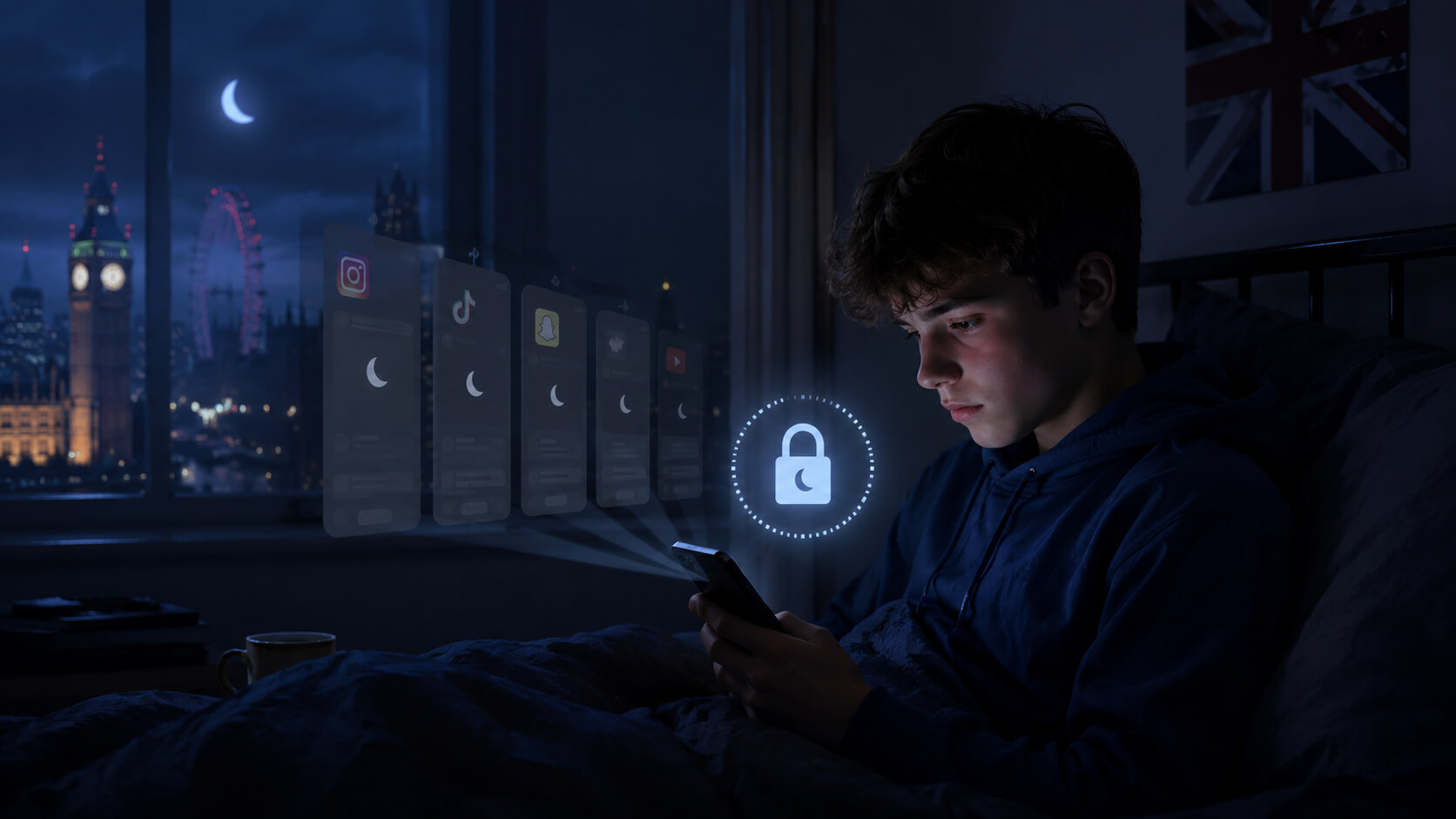
Britain’s proposed social media crackdown may not stop at banning younger teenagers from major platforms. The idea of a UK teen social media blackout is also being discussed as part of these proposals.
UK officials are now considering an overnight social media blackout for users aged 16 and 17, potentially blocking access to apps between midnight and 6 a.m. The setting would reportedly be enabled by default, meaning teenagers would need to change it manually if they wanted to continue scrolling through the night.
It is not quite a government-enforced phone shutdown. Not yet, anyway.
The proposal is another layer in the UK’s much broader attempt to change how social platforms treat children and teenagers. Ministers have already announced plans to prevent platforms such as TikTok, Instagram, Snapchat, YouTube, Facebook and X from offering social media services to children under 16.
The UK Teen Social Media Blackout Would Run From Midnight to 6 A.M.
Under the proposal, social media apps would automatically restrict access for 16- and 17-year-old users between midnight and 6 a.m.
Reports suggest the blackout would operate as a default setting rather than an absolute legal lockout. A teenager could potentially change the setting, although the exact process has not been fully explained. Whether it would require parental permission, another age check or simply a few taps inside an app remains unclear.
That detail matters.
A curfew that can be disabled in seconds is very different from one backed by parental controls or verified age information. It may still discourage casual late-night scrolling, but determined users would probably find their way around it.
The proposal appears to be aimed at the familiar cycle of opening one app before bed, watching a few videos and suddenly realizing it is 2:30 in the morning. Social platforms are exceptionally good at removing natural stopping points. The UK government wants some of those stopping points put back.
Infinite Scrolling and Addictive Features Are Also Being Targeted
The overnight blackout is not the only idea being discussed.
Features designed to keep users scrolling could also be switched off by default for younger users. That could affect infinite feeds, algorithmic recommendations, autoplay and other engagement tools that constantly place fresh content in front of the user.
No “you have reached the end” message. No obvious reason to close the app. Just another video, another post and another notification.
This is where the UK proposal becomes more interesting than a simple age ban. Officials are beginning to focus on how social platforms are built, not only on who is allowed to create an account.
The UK government has already said it is examining overnight curfews and breaks in infinite scrolling for people under 18. It also wants protective restrictions to remain active by default for 16- and 17-year-olds, avoiding a sudden removal of safeguards when someone turns 16.
Children Under 16 Could Face a Much Wider Social Media Ban
The curfew for older teenagers sits alongside a tougher proposal for children under 16.
The government plans to prevent major social platforms from offering their services to under-16s. Snapchat, TikTok, YouTube, Instagram, Facebook and X are among the platforms expected to fall within the rules.
Messaging services such as WhatsApp and Signal are not currently expected to be included.
The government is also planning restrictions on livestreaming and communication between children and strangers. Some of these protections would extend beyond traditional social networks and into gaming platforms, where messaging, live content and social features have become difficult to separate from gameplay.
Legislation is expected to be brought before Parliament before Christmas, with the first protections currently expected to take effect in spring 2027.
Age Verification Is Still the Uncomfortable Part
Writing a social media curfew into policy is one thing. Knowing which users are actually 16 or 17 is another.
Teenagers routinely enter false birth dates when creating accounts. Some borrow adult credentials. Others move to smaller platforms, use browser versions or find new services that sit outside the original restriction.
The UK says it wants stronger age-assurance measures and has asked Ofcom to study which methods can effectively determine whether a user is over 16. Officials have also promised to learn from Australia, where enforcing age-based social media restrictions has proved complicated.
The privacy question has not disappeared either. Reliable age checks may require facial age estimation, identity documents, payment information or verification through a separate provider. Each method brings its own problems.
Parents may support stronger protections while still feeling uncomfortable about handing a teenager’s passport or biometric information to an online platform.
That tension will not be solved by another settings menu.
Teenagers Will Probably Test Every Loophole
Any overnight restriction will face the same basic problem as most digital rules: teenagers understand technology too.
VPNs could provide one route around location-based controls. Secondary accounts may offer another. Users might change their registered age, access platforms through desktop browsers or move to services that are not covered by the legislation.
The current proposal reportedly does not include specific restrictions on VPN use.
Platforms will also have to decide what counts as access during the blackout. Would teenagers still receive emergency messages? Could they use direct messaging while feeds are disabled? Would educational videos remain available? What happens to a creator who is 17 and earns money from posting content for an international audience?
Small questions tend to become big implementation problems once millions of accounts are involved.
Social Platforms Could Be Forced to Redesign Teen Experiences
For TikTok, Instagram, Snapchat, YouTube, Facebook and X, the UK plan could mean more than adding a nighttime reminder.
Platforms may need to build separate experiences based on age, location and time of day. Recommendation systems could be limited. Livestreaming tools may need additional controls. Stranger messaging could be disabled. Infinite feeds might require pauses or deliberate restart prompts.
Advertisers would feel some of the impact as well.
Teen engagement during late-night hours could fall, affecting impressions, viewing time and campaign performance. Creators whose audiences are heavily concentrated among younger users may also see changes in reach.
The bigger risk for platforms is that the UK’s approach will not remain a UK-only experiment. Governments across Europe and elsewhere are debating similar restrictions. A successful policy could quickly become a model. A messy rollout would become a warning.
A Midnight Curfew Sounds Simple Until the Details Arrive
There is an obvious appeal to the UK teen social media blackout. Teenagers need sleep. Social apps are designed to compete for attention. Midnight scrolling rarely improves anyone’s morning. Still, the proposal is not as simple as switching off TikTok at 12:01 a.m.
It depends on accurate age checks, workable enforcement and settings that teenagers cannot casually bypass. It also needs enough flexibility to preserve useful communication without leaving enormous loopholes. The UK is trying to draw a boundary around a part of teenage life that has become increasingly difficult to control. The boundary may be midnight. Whether social platforms and their youngest users respect it is another matter.
Sources
- Social Media Today: UK officials propose overnight social media blackout for teens
- UK Government: Social media to be banned for under-16s in landmark government move
- Reuters: UK plans default midnight social media curfew for 16-17 year-olds
