


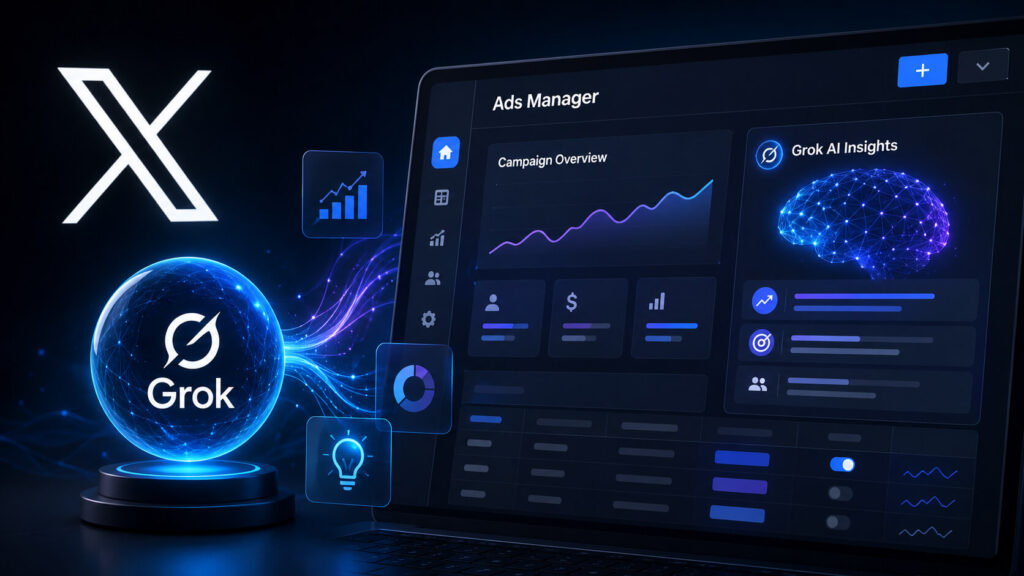
X is putting Grok inside its advertising dashboard.
The social platform has started beta testing a new Grok-powered assistant within Ads Manager, giving selected advertisers a place to ask questions about campaigns, creative ideas, targeting, and promotional strategy without leaving the dashboard.
It is a relatively small interface change for now. The direction behind it is much bigger.
X appears to be working toward an ad system where artificial intelligence does more than suggest a headline or explain a metric. Grok could eventually help plan, build, target, check, and optimize entire campaigns.
Grok Is Becoming an Advertising Assistant Inside X
Advertisers included in the beta can reportedly ask Grok for guidance directly through X Ads Manager.
That could include questions about campaign setup, audience strategy, ad performance, or ways to improve promotional content. X has also added tooltips and creative prompts designed to help advertisers develop ads inside the platform.
The idea feels familiar. Meta and Google have already packed their advertising systems with automated recommendations, generated creative assets, and AI-assisted targeting.
X is taking its own route by putting a conversational chatbot in the middle of the experience.
Instead of searching through help pages or opening several reporting tabs, an advertiser could simply ask Grok what is going wrong with a campaign. At least, that is the promise.
How useful the answers will be in real campaigns is still unclear.
X’s Advertising Platform Was Already Being Rebuilt Around AI
The Grok integration did not appear from nowhere.
In April 2026, X introduced what it described as the largest update to its advertising system in the platform’s history. The rebuilt platform uses xAI models to improve ad retrieval, ranking, targeting, and delivery.
X said the system was designed around simplicity, advertiser control, and stronger performance. Its AI models are meant to understand user behavior and match ads with interests, conversations, and real-time activity happening across the platform.
That last part matters for X.
The platform has always positioned live conversation as one of its strongest qualities. News breaks there. Sports discussions erupt in real time. Product launches, political debates, memes, financial chatter, and cultural moments can suddenly dominate the feed.
An ad system capable of reading those shifts quickly could be valuable.
It could also go badly if the system misunderstands context or places brands beside content they would rather avoid.
Elon Musk Wants Grok to Automate the Entire Ad Process
The long-term ambition is not subtle.
Elon Musk previously said Grok could eventually automate advertising on X almost completely. An advertiser could upload an ad, and the system would decide how to target it, where to place it, who should see it, and how the campaign should be optimized.
That would push Grok beyond the role of assistant.
It would become the media buyer, creative adviser, targeting engine, optimization tool, and potentially the brand safety reviewer at the same time.
Musk has also discussed using Grok to evaluate content for brand safety and match products with users based on their behavior and interests. X executives have described AI tools that could score ad quality and improve video campaign targeting.
None of that means full automation is ready.
The new Ads Manager assistant looks more like an early step. Grok gives advice. The advertiser still makes the decisions.
For now.
Advertisers May Get Faster Answers but Not Guaranteed Results
An always-available advertising assistant could be genuinely useful, particularly for smaller businesses without dedicated media teams.
A local company running its first campaign may not understand bidding, conversion objectives, audience exclusions, creative testing, or performance reporting. Asking a chatbot could be easier than navigating a large advertising knowledge base.
Experienced advertisers may also use Grok to spot patterns or generate fresh campaign angles.
Still, AI-generated advice is not automatically good advice.
Campaign performance depends on product quality, pricing, creative execution, landing pages, audience demand, tracking accuracy, and dozens of other details. A chatbot can process data and suggest changes, but it cannot rescue every weak offer.
Advertisers will also want to know how Grok reaches its conclusions.
A recommendation to increase spending or change targeting carries more weight when the system clearly explains the evidence behind it. Otherwise, the assistant risks becoming another machine that confidently tells marketers to spend more money.
Brand Safety Remains the Difficult Part
Automation becomes more complicated when brand safety enters the picture.
X has faced continued concern from advertisers over content moderation, harmful material, political controversy, and the unpredictable nature of conversations on the platform. Grok itself has also faced scrutiny over some of its generated responses and images.
Using the same AI system to guide ad placement and assess brand safety creates an obvious trust question.
Advertisers will need proof that Grok can understand context rather than merely detect keywords.
A post discussing violent extremism in a legitimate news report is not the same as content promoting it. Sarcasm, parody, breaking news, and political commentary are similarly difficult for automated systems to interpret consistently.
X may believe its access to platform-wide data gives Grok an advantage. Brands will probably want more than belief.
They will want measurable controls, transparent reporting, and evidence that unsuitable placements are actually being prevented.
X Is Trying to Make Advertising Easier Again
There is a practical business reason behind the update.
Advertising remains central to X’s ability to generate revenue, even as the company continues pushing subscriptions and other paid services. Making campaign creation easier could help X attract smaller advertisers while encouraging existing clients to launch campaigns more frequently.
Grok gives X something it can promote as different.
Google has Gemini. Meta has its own advertising AI. X now has Grok sitting directly inside its ad platform, drawing from the conversations and behavioral signals available across the network.
Whether that produces better advertising is another question.
The beta will need to show that Grok can deliver recommendations marketers can actually use, not just quick answers wrapped in confident language.
Grok in Ads Manager Is Only the Beginning
The current rollout is limited, and X has not announced when the feature will become available to every advertiser.
Even so, the beta makes the company’s advertising roadmap fairly easy to see.
First comes campaign guidance. Creative generation and deeper optimization could follow. More targeting decisions may eventually move into the system. Full campaign automation remains the larger goal sitting in the background.
That future may appeal to businesses that want to launch ads with less manual work.
It may worry agencies and media buyers whose expertise is being packaged into an automated dashboard.
Most advertisers will probably land somewhere in the middle. They will use the assistance, test the recommendations, and keep a close eye on what Grok is doing with their money.
That seems sensible.
An AI assistant can offer ideas. Giving it the entire advertising budget is a different conversation.
Sources
- Social Media Today: X Adds Grok-Powered Insights to Ads Manager
- Social Media Today – X’s Rebuilt AI-Powered Ad Platform: X introduces rebuilt AI-powered ad platform
- Digiday – Elon Musk’s Grok Advertising Plans: Elon Musk outlines AI-led Grok future for advertising on X