

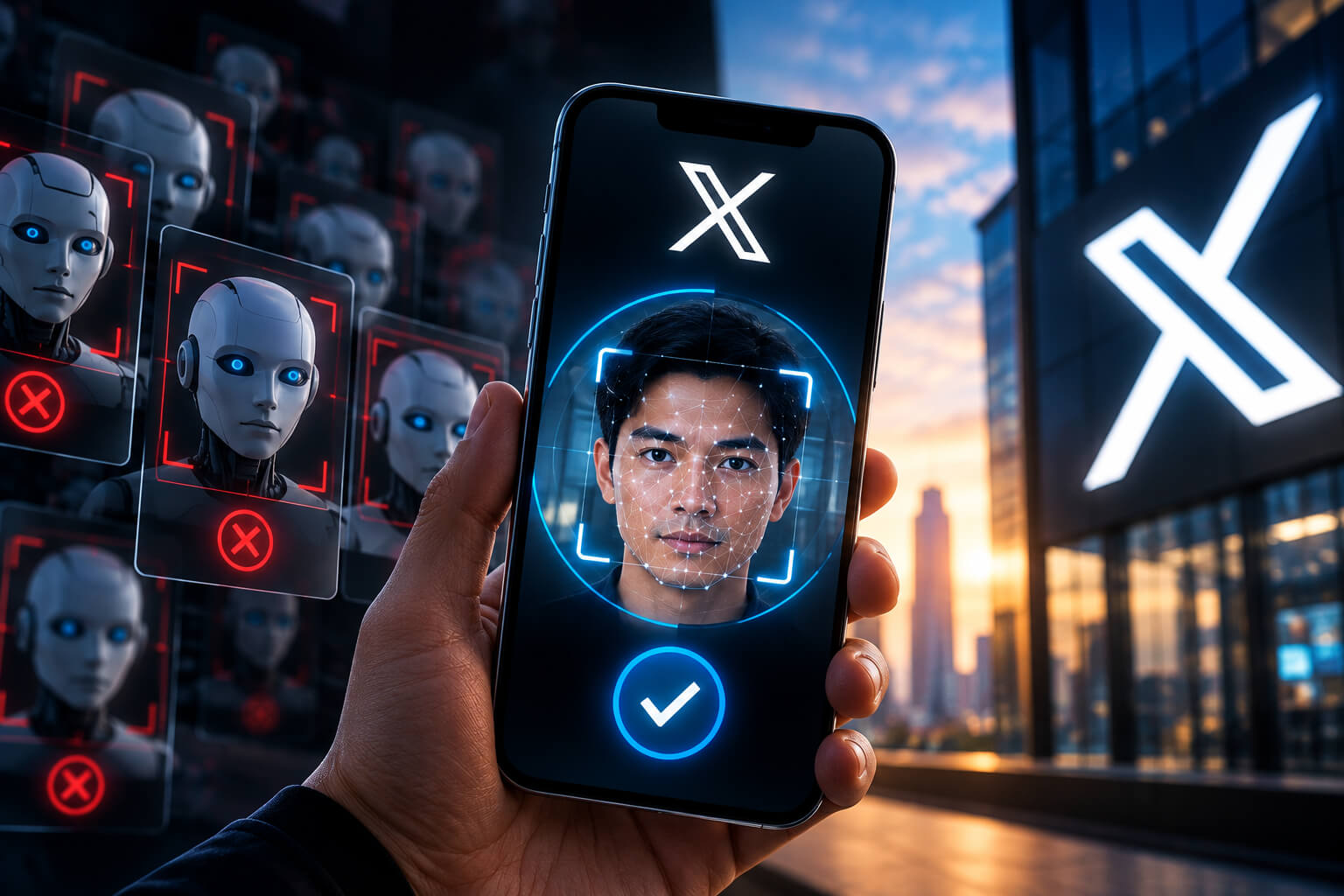
X is adding another layer to its fight against bots, and this time the platform wants suspicious accounts to prove there is an actual person behind them.
The social network has introduced a liveness check for accounts that its systems flag for unusual or automated-looking activity. Depending on the device and region, users may be asked to complete a selfie video or confirm their presence through device biometrics such as Face ID or Touch ID.
X says the feature is designed to determine whether a real person is operating an account, rather than identify who that person is.
X Will Ask Suspicious Accounts to Prove They Are Human
The new system comes into play when X detects behaviour that resembles automated activity. Instead of immediately treating the account as a bot, the platform can send the user through a liveness check to establish that a human is actually present.
Users may be offered different verification methods. On supported devices, X can use Face ID, Touch ID or an Android device’s biometric unlock system. Another option involves recording a short selfie video that the system can analyse for signs of a live person.
The distinction matters. X is not presenting the check as an identity-verification process. It is meant to answer a simpler question: is a real person operating this account?
Selfie Video and Face ID Are Among the Available Options
The selfie option asks users to record a short video using their device’s front-facing camera. A third-party automated system then analyses the footage to determine whether the submission comes from a live person rather than a photograph, replayed video or other spoofing attempt.
Users with compatible devices may instead be able to use Face ID, Touch ID or Android biometric authentication. According to X’s documentation, the biometric method runs through the device itself, with X receiving a pass-or-fail result and a signal indicating that the request came from a genuine application.
That gives users a way to complete the check without recording a selfie, although the available options can vary depending on the device, application version and region.
X Is Also Testing a Hand-Motion Check
There is another option coming to the system that could make the process feel less like an identity check.
X says it is developing a hand-motion check that will ask users to move or wave a hand in front of their camera. The idea is to provide another way of demonstrating that a person is physically present without requiring a facial selfie.
It is still listed as coming soon, so it is not yet the standard option for everyone. If widely deployed, the hand check could become a useful alternative for users who would rather not submit a face video.
Accounts Can Lose Posting Features Until They Complete the Check
A flagged account does not simply carry on as normal while ignoring the verification request. X says users who have not completed a required liveness check can lose access to certain write actions.
Those restrictions can include posting, following other accounts and sending direct messages. Reading content can remain available, but full account functionality returns after the user successfully completes the check.
The system is therefore designed to put some pressure on accounts to complete verification without necessarily shutting down the account altogether.
X Says the Check Is About Human Presence, Not Identity
There is an important distinction in how X describes the technology. The liveness check is intended to establish that a person is present, rather than determine the person’s identity.
For biometric verification, X says it receives the result of the device check rather than the user’s actual fingerprint, face or iris information. For selfie verification, X says the process provides a liveness confidence result rather than sending the raw video to X.
That approach could make the feature less intrusive than conventional identity verification, although requiring access to a camera or device biometrics will still raise privacy questions for some users.
X Is Expanding Its Anti-Bot Fight as AI Makes Automation Harder to Spot
The move comes as the definition of a “bot” becomes harder to pin down. Automated accounts have existed on social platforms for years, but modern AI tools can generate posts, respond to users and operate accounts in ways that look increasingly human.
X has already been working on improved detection systems for AI-powered bot profiles and automated activity. Earlier in 2026, the company announced additional measures aimed at identifying bots, spam and scraping activity.
The liveness check attacks the problem from a different direction. Instead of trying to determine only whether an account behaves like a bot, X can ask the account operator to demonstrate that a human is physically present.
The Move Comes With an Interesting Contradiction for X
X’s anti-bot campaign has been a long-running part of Elon Musk’s vision for the platform. Before completing his acquisition of Twitter, Musk repeatedly criticised the service’s bot and spam problem and promised to tackle it aggressively.
The challenge now is more complicated because automated accounts are not necessarily all malicious. Businesses use automated systems, developers build bots and X itself has been expanding its use of AI-powered accounts and agents.
That creates a difficult line for the platform to draw. X wants to eliminate spam and coordinated manipulation while still allowing legitimate automation and new AI-based services to develop.
X’s Bot Detection Is Becoming More About Human Behaviour
The liveness check suggests that X is moving toward a layered approach to account verification.
Automated systems can examine how an account behaves, while liveness checks can provide another signal when activity looks suspicious. The platform can then restrict an account until it demonstrates that a human operator is present.
It will not eliminate every bot. A determined operator can still find ways around individual verification systems, while legitimate users can occasionally trigger automated security measures by behaving in ways that resemble automation.
But for X, adding a physical human-presence test gives its moderation systems another tool at a time when distinguishing people from AI-driven accounts is becoming increasingly difficult.
X Wants to Keep More Genuine Human Activity on the Platform
The bigger issue for X is not simply how many bots it can remove. It is whether the platform can maintain a healthy balance between human users, legitimate automated services and increasingly sophisticated AI agents.
The new liveness check gives X another way to challenge accounts that appear suspicious without automatically assuming that every unusual account is malicious.
For users who encounter the check, it may take only a few seconds. For X, however, the feature represents another step in a much larger attempt to decide what counts as genuine activity on a social network increasingly filled with automated systems.
Sources
- Social Media Today — X adds liveness check to counter bots
https://www.socialmediatoday.com/news/x-adds-liveness-check-to-counter-bots/832558/ - ID Tech — X Adds Device Biometrics and Selfie Checks for Suspected Bot Accounts
https://idtechwire.com/x-adds-device-biometrics-and-selfie-checks-for-suspected-bot-accounts/ - MediaPost — X Asks Flagged Accounts To Prove Their ‘Liveness’
https://www.mediapost.com/publications/article/418646/x-asks-flagged-accounts-to-prove-their-liveness.html - Social Media Today — X Looks To Combat Bots With New Detection Tools
https://www.socialmediatoday.com/news/x-looks-combat-bots-detection/746263/
