

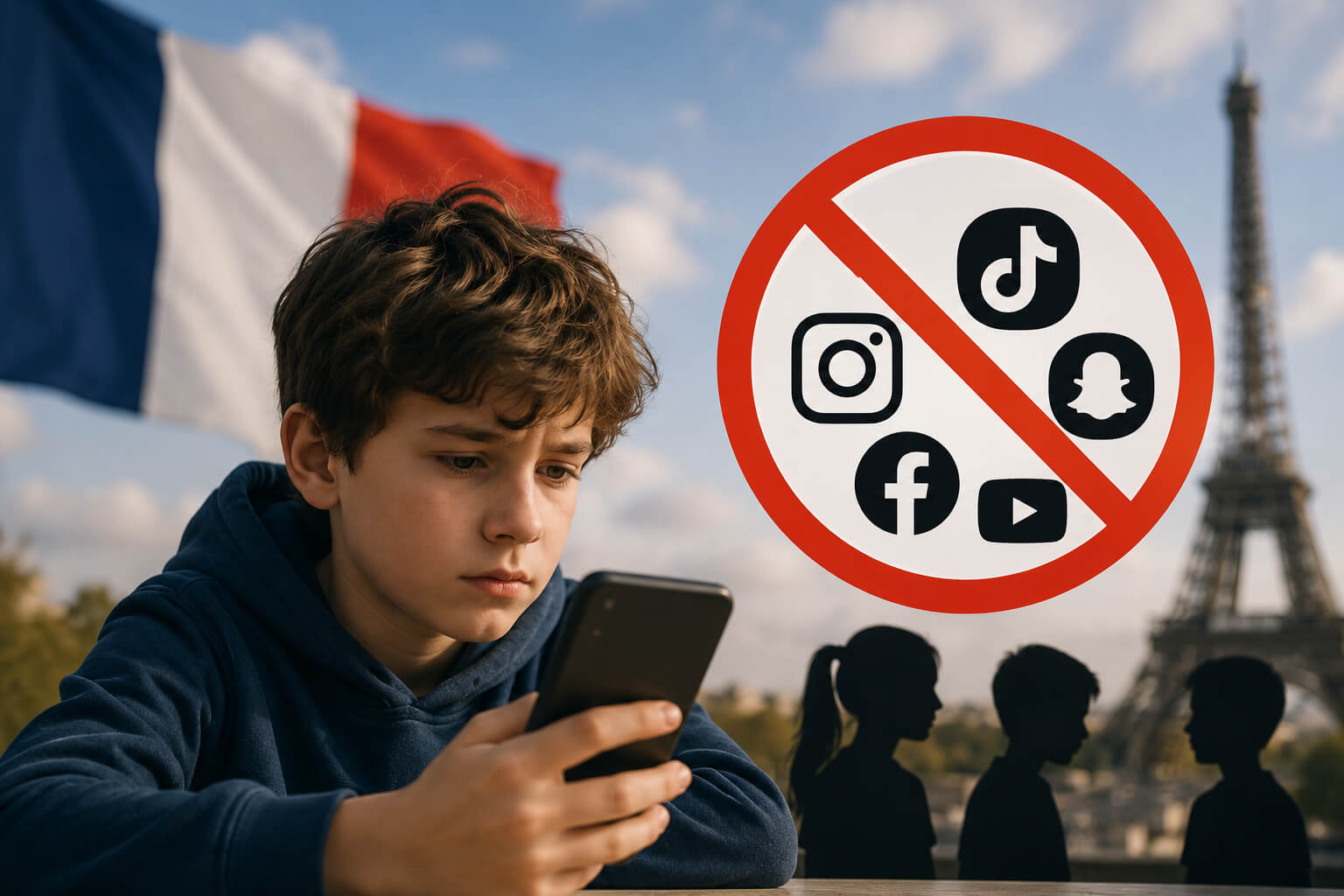
France may soon shut children under 15 out of social media entirely. The proposed France social media ban for under 15s is making headlines and raising important questions for parents and young people alike.
Lawmakers have reached a compromise on legislation that would prevent younger users from accessing major social platforms, putting the country closer to one of Europe’s toughest age-based restrictions.
The timing is deliberate. President Emmanuel Macron wants the rules in place by the beginning of the new school year in September 2026. Parliament, however, is racing against its summer recess and a mandatory European Union review process.
So, technically, the deal is moving. Whether platforms can actually enforce it by September is another question.
French Lawmakers Reach a Compromise on the Under-15 Ban
A joint parliamentary committee made up of members from France’s National Assembly and Senate agreed on a final version of the bill on July 20.
The compromise was necessary because the two chambers had previously approved different versions of the legislation. Lawmakers needed one text before Parliament could hold its final votes.
Under the proposed rules, social media platforms would have to prevent children younger than 15 from opening or maintaining accounts. The ban would apply broadly rather than targeting a small list of supposedly harmful platforms.
Educational services, online encyclopedias and certain open-source platforms would remain available.
That distinction matters. France is not proposing a general internet ban for children. The legislation specifically targets social networking services built around profiles, engagement feeds, recommendations and continuous interaction.
France Wants the Rules in Place by September
Macron has pushed lawmakers to introduce the ban before French students return to school in early September.
That is an ambitious deadline.
Even after France completes its final parliamentary votes, the legislation must go through the European Union’s notification procedure. EU rules require member states to notify the European Commission before introducing certain national regulations affecting digital services.
The notification period means the legislation cannot formally take effect before August 10, leaving platforms and regulators with only a few weeks to prepare for a September launch.
There is also the much larger problem of implementation. Social networks would need dependable ways to determine whether someone is 14, 15 or 40 without collecting more personal information than necessary.
No small task.
Age Verification Could Affect Every Social Media User
A ban aimed at children may eventually require age checks for everyone.
Platforms cannot reliably identify underage accounts unless they verify the ages of their wider user base. That could mean identity document checks, facial-age estimation, digital identity wallets or third-party verification services.
French lawmakers have discussed privacy-preserving systems based on “double anonymity.” Under that model, an outside provider confirms that a user meets the age requirement without handing the user’s full identity to the social platform.
Still, privacy concerns will not disappear. Age-verification systems can collect sensitive information, create new cybersecurity risks and potentially exclude legitimate users who lack accepted identification.
The legislation may also create difficult classification questions. Messaging apps, gaming services and online communities increasingly contain social feeds, public profiles and recommendation tools. Deciding which services count as social media could get messy very quickly.
The Bill Also Targets Mobile Phones in High Schools
The proposed law goes beyond TikTok, Instagram, Snapchat and similar platforms.
It would also expand restrictions on mobile phone use inside French schools by introducing a ban in high schools. France already limits phone use in primary and middle schools, but the new provision would extend that approach to older students.
For Macron’s government, the social media ban and the school phone restrictions belong to the same broader argument: children need more distance from addictive digital systems.
The president has accused large platforms and recommendation algorithms of manipulating young users’ emotions for commercial gain. Supporters of the bill also point to cyberbullying, harmful content, disrupted sleep and declining self-esteem among teenagers.
French reporting cited research showing that around 90% of people aged 12 to 17 in the country use a smartphone every day, with social media taking up a large share of that activity.
Pressure on Social Platforms Has Been Building
France’s proposal did not appear out of nowhere.
The country passed legislation in 2023 requiring parental consent for social media users under 15, although questions over enforcement and compatibility with EU rules limited its impact.
The new bill takes a more direct position. Instead of asking parents to approve an account, it would block children under 15 from using covered platforms altogether.
Public pressure has also grown following complaints from families who say social platforms failed to protect teenagers from harmful recommendation systems. Several French families have taken legal action against TikTok, alleging that its algorithm exposed vulnerable teenagers to content connected to self-harm and suicide.
Platforms argue that they already provide parental controls, teen account settings and content protections. Governments increasingly seem unconvinced.
EU Law Forced France to Rewrite Its Approach
An earlier version of the French proposal created legal concerns because it gave national regulators greater power to identify and restrict particular platforms.
Digital services operating across Europe already fall under the EU Digital Services Act. That framework gives the European Commission significant authority over the largest online platforms.
France therefore amended the bill to avoid creating a separate blacklist controlled only by national authorities. The revised version establishes a general age rule while leaving platform oversight aligned with the European system.
It is a quieter legal detail, but an important one. France can set national child-protection rules, though it cannot simply replace the EU’s platform enforcement structure.
Social Media Bans Are Spreading Beyond France
France is part of a much wider political shift.
Australia has already introduced a social media ban for children under 16, while Indonesia and several European countries have considered or adopted similar restrictions. The United Kingdom has also been developing stronger age controls and default social media curfews for teenagers.
These policies share a basic idea: voluntary safety tools have not done enough.
They also share the same weakness. Children often know how to bypass age gates, borrow accounts, change birth dates or use virtual private networks. Research into Australia’s system suggests that young users actively test and work around platform controls when they see the restrictions as unfair or ineffective.
A law can set the boundary. Making that boundary hold is harder.
The Real Test Will Be Platform Enforcement
The political message from France is clear enough. Children under 15 should not be inside algorithm-driven social networks.
The practical message is still blurry.
Platforms will need to introduce age checks that are effective, privacy-conscious and difficult to bypass. French regulators must determine which services fall under the law. EU authorities will need to confirm that enforcement fits within existing digital legislation.
Then there is the cultural side. Social media has become deeply embedded in teenage friendships, school conversations, entertainment and identity. Removing access will not automatically remove the demand.
France may approve the law before September. That would be a major political win for Macron.
Whether millions of young users suddenly disappear from social platforms is a different story.
Sources
- U.S. News & World Report – French lawmakers race to introduce an under-15 social media ban
- Associated Press – French lawmakers reach compromise on under-15 social media ban
- Reuters via The Star – French Parliament committee approves social media ban
- Le Monde – Why social media age verification could affect everyone in France
- PBS News – French lawmakers approve social media ban for children under 15
