

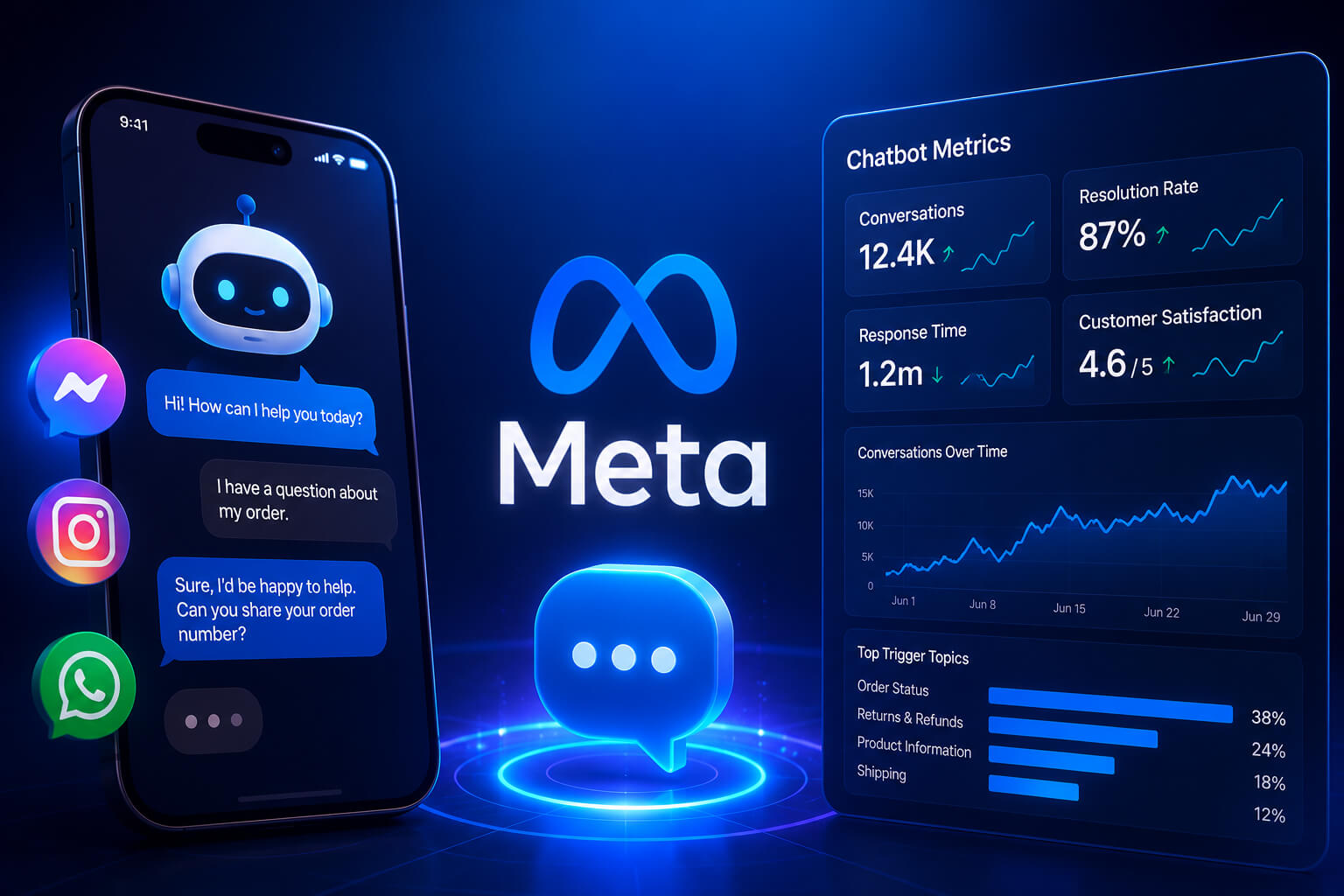
Meta is adding new chatbot performance metrics for businesses using its AI-powered Business Agents, giving brands a clearer view of what is actually happening inside customer conversations.
That may sound small. It is not.
For brands using Messenger and WhatsApp as customer service channels, the chatbot is no longer just a cute automation tool sitting in the corner. It is often the first thing a customer meets. Sometimes the only thing. So knowing whether that bot is helping, confusing people, or quietly losing potential buyers matters a lot.
Meta’s Business Agents are designed to respond to customer queries across Messenger and WhatsApp, allowing businesses to offer automated support around the clock. The company recently expanded access to these tools, and now it is adding more data inside Meta Business Suite so brands can judge whether the bots are doing their job properly.
What the New Meta Chatbot Metrics Track
The new Meta chatbot metrics focus on three useful areas: AI conversations, buying intent, and containment rate.
AI conversations show the total number of conversations handled by each Meta Business Agent. Meta counts a resumed conversation as new if the customer comes back after 24 hours of inactivity. That gives businesses a basic volume number, but also a better sense of how often customers are relying on automated support.
Contact with intent to buy is more interesting. This metric tracks the number of accounts that showed they were ready to make a purchase after interacting with a Meta Business Agent. That is the kind of number marketers will watch closely, because it moves chatbot performance away from “how many messages did we answer?” and closer to “did this actually help sales?”
Then there is containment rate. This measures the percentage of conversations fully handled by the AI agent without being passed to a human support agent. For businesses, that could become one of the most important measurements. A high containment rate may mean the bot is solving problems efficiently. A low one may suggest customers are getting stuck, the bot is missing context, or the business has not trained the agent well enough.
Why This Matters for Brands on Messenger and WhatsApp
Customer messages are messy. People do not always ask clean questions. They send half-sentences, screenshots, complaints, product links, emojis, voice notes, and sometimes just “hi” with no context.
That is why chatbot metrics matter.
A business might think its AI agent is working because customers are getting replies quickly. But speed is not the whole story. If the chatbot answers fast but does not move the customer closer to a purchase, booking, complaint resolution, or useful next step, then the business still has a problem.
Meta’s added metrics give brands more ways to see whether their AI agents are helping customers or simply adding another layer between the customer and a human.
AI Chatbots Are Becoming Part of Social Commerce
This update also fits into Meta’s wider push to make messaging more central to business activity. Messenger, Instagram DMs, and WhatsApp are already major customer contact points, especially for small businesses and online sellers.
For many brands, the sales funnel does not always happen on a website anymore. It happens in chat.
A customer sees a product on Facebook or Instagram, sends a message, asks if it is available, checks the price, maybe asks about delivery, then decides whether to buy. If AI can handle part of that journey without making the customer feel ignored, businesses get faster responses and lower support pressure.
But that only works if the chatbot is measurable.
Without proper metrics, brands are guessing.
Meta May Also Be Building the Case for Paid AI Tools
There is another angle here. Meta has spent heavily on AI, and the company is looking for more ways to turn that investment into revenue. Better business metrics could make that easier. If brands can see that AI agents are driving purchase intent, reducing human handoffs, or handling more conversations, they may be more willing to pay for advanced chatbot tools later.
That is where this gets more serious.
Meta is not just giving businesses a dashboard upgrade. It is creating a clearer value story around AI agents. And in business software, a clear value story usually comes before stronger monetization.
Businesses Will Need More Than Automation
Still, a chatbot metric does not automatically mean a chatbot is good.
Brands will need to keep watching the actual customer experience. Are people getting useful answers? Are complex questions being routed properly? Is the bot pushing customers too hard toward sales? Is it making mistakes with product details, prices, return policies, or availability?
Those things can hurt trust quickly.
The best use of these new Meta chatbot metrics may not be to prove that AI can replace human support. It may be to show where AI should handle the simple stuff, and where a human still needs to step in.
Meta’s Chatbot Metrics Could Shape the Next Phase of Customer Messaging
Meta’s new Business Agent metrics make one thing clear: AI chatbots are moving deeper into everyday social media business operations.
The update gives brands more visibility into conversations, purchase intent, and bot-to-human handoffs. That is useful now, especially for companies already using Messenger and WhatsApp as sales and support channels.
But it also hints at where Meta is going.
Messaging is becoming more automated. AI agents are becoming more common. And businesses will increasingly be asked to measure whether those AI tools are actually helping customers, not just replying to them.
