

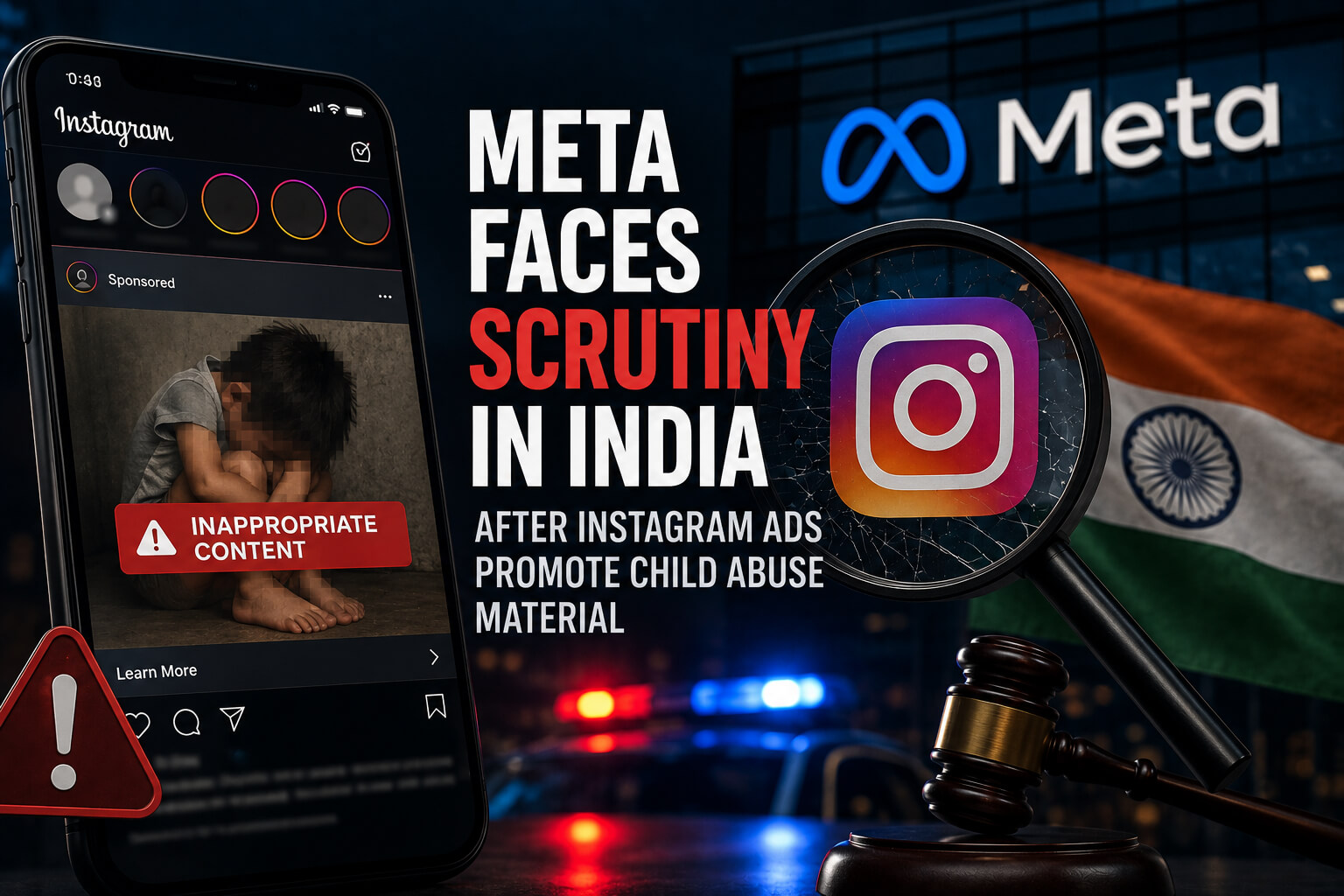
Meta has another child safety crisis on its hands, and this one cuts straight into the company’s advertising machine. Recent reports about Meta child abuse ads in India have raised serious concerns about content moderation and user protection.
According to a BBC investigation reported by Social Media Today, Meta allowed paid ads promoting child sexual abuse material to appear on its apps in India. The ads reportedly directed users to Telegram channels where illegal material was being sold. BBC said it flagged the ads to Meta, but was initially told the promotions did not violate the company’s rules. Meta later removed them.
That detail is hard to ignore. Not just because the content was illegal and dangerous. Because these were ads. Paid promotions. The part of Meta’s system that is supposed to be checked before it reaches people.
Meta’s Ad Review System Is Under Pressure
The reported ads used clear abusive language and still made it through Meta’s ad process, according to the BBC report cited by Social Media Today. Local authorities in India have now pushed Meta to explain how its systems failed to catch the promotions before they went live.
This is where the issue becomes bigger than one failed takedown.
Meta has spent years telling users, advertisers, and regulators that its platforms can operate safely at massive scale. Facebook and Instagram depend on automated review, user reports, machine learning, human moderation, and policy enforcement. But when paid ads connected to child exploitation are approved, the question becomes blunt: what exactly is the system catching?
Meta told BBC that no system is perfect and that its review process may not detect every policy violation. That is technically true. It also sounds very thin when the subject is child sexual abuse material.
India Wants Answers From Meta
India’s government has reportedly issued a strong notice to Meta after the Instagram ads controversy, demanding the immediate removal of ads and content linked to child sexual exploitative and abuse material. Reports from Indian media said authorities also asked Meta to provide an explanation over the lapse.
That matters because India is one of Meta’s most important markets. It has a huge base of Facebook, Instagram, and WhatsApp users, and regulatory pressure there is not something Meta can easily brush aside.
For social platforms, India is not just another growth market anymore. It is a place where governments are watching harder, users are more active, and safety failures can quickly become national controversies.
The Telegram Link Adds Another Problem
The reported ads did not simply stay inside Meta’s apps. They allegedly directed users to Telegram channels, where the material could be purchased. That shows how abuse networks use one platform to advertise, another platform to distribute, and payment systems or private messaging spaces to keep the pipeline moving.
This is the messy part of modern platform safety. A Facebook or Instagram ad may only be the front door. The actual abuse can move elsewhere in seconds.
For Meta, that does not remove responsibility. Its ad system was allegedly used to push users toward that ecosystem. And when advertising tools become a gateway to criminal content, regulators will not care much about whether the final transaction happened somewhere else.
AI Moderation Is Not Looking So Strong Right Now
The timing is uncomfortable for Meta.
The company has been leaning heavily into AI automation, including the use of AI agents and automated systems to assess content and support platform operations. Social Media Today noted that the case comes as Meta continues to expand AI-driven moderation and internal automation.
The promise sounds efficient: faster review, fewer human bottlenecks, lower costs, more scalable enforcement.
But child safety is not a place where “mostly works” is good enough.
If automated systems miss obvious harmful ads, and if human escalation still does not catch them immediately, the whole safety argument weakens. AI can help moderation. It can scan at scale. It can flag patterns. But it cannot become a convenient excuse for reducing accountability.
This Is Bigger Than Meta’s PR Problem
Meta has already faced growing criticism over child safety, platform harm, and moderation decisions. Social Media Today also pointed to wider concerns around Meta’s AI systems, including previous issues involving account support agents and other AI-related backlash.
This incident lands in the middle of that larger trust problem.
Advertisers want brand-safe environments. Parents want platforms that do not expose children to harm. Governments want faster compliance. Users want companies to stop treating safety failures like rare edge cases.
Meta can remove the reported ads. It can update rules. It can say it is improving detection. All of that may happen.
Still, the bigger question remains sitting there: how did ads like this get approved in the first place?
Meta’s India Controversy Could Push Tougher Platform Rules
The India case may become another example regulators use when arguing for tighter rules on social media platforms and digital advertising. Paid ads are not ordinary user posts. Platforms review them, monetize them, target them, and distribute them.
That creates a higher expectation.
If Meta’s ad tools can detect political keywords, financial scams, copyright issues, restricted products, and brand-sensitive categories, authorities will ask why child exploitation ads were not stopped before publication.
And they should.
This is not just a moderation failure. It is an advertising safety failure. For Meta, that is a far more serious problem because advertising is the engine of the company.
The Bottom Line
Meta’s reported failure in India shows how dangerous platform gaps can become when illegal content, paid promotion, private messaging apps, and automated review systems collide.
The company removed the ads after they were reported. But removal after exposure is not the same as prevention.
For a platform as large and profitable as Meta, the standard has to be higher. Especially when children are at risk.
