

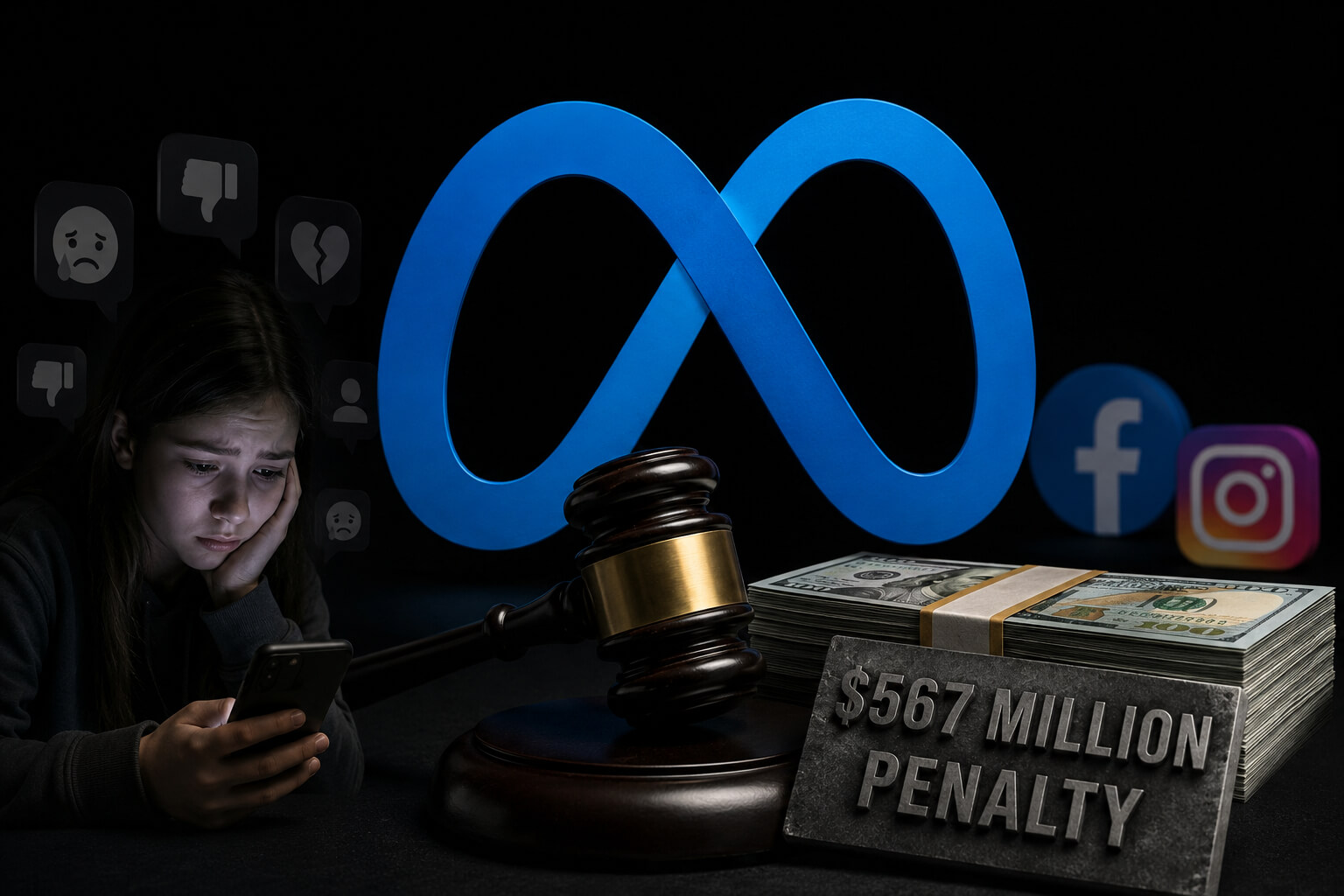
Meta has been handed another massive financial blow, with Meta fined $567 million, over the way Facebook and Instagram handle younger users.
A New Mexico judge ordered the social media company to pay $567 million as part of a case focused on harms to children and teenagers using Meta’s platforms. The decision does more than add another costly legal problem to Meta’s growing pile. It also lays out specific changes Facebook and Instagram will have to make for younger users in New Mexico.
And some of those rules go much further than the usual privacy settings or parental-control updates.
Meta’s Teen Safety Case Has Now Reached $942 Million
The $567 million judgment is the second major financial penalty to come from New Mexico’s case against Meta.
Earlier in 2026, a jury found Meta liable for failing to adequately protect young people from child predators and approved $375 million in civil damages. With the latest ruling added, the financial impact of the case has climbed to roughly $942 million.
New Mexico Chief District Court Judge Bryan Biedscheid said the state is dealing with a youth mental health crisis and identified Meta’s platforms as a significant contributor.
The money from the latest ruling is expected to support youth treatment services, awareness programs and prevention efforts.
The size of the penalty will get the headlines. The court-ordered changes to Facebook and Instagram may end up being the bigger story.
Facebook and Instagram Face Tougher Rules for Teen Users
Under the ruling, Meta will have to expand protections for younger Facebook and Instagram users in New Mexico.
Accounts belonging to users under 18 must be private by default. Adult users will also face restrictions on connecting with teenagers unless certain conditions are met.
Notifications are getting targeted too.
Meta will be required to stop sending push notifications to users under 18 between 10 p.m. and 7 a.m., along with an additional restriction between 8 a.m. and 3 p.m. during the school year.
Like counts will be hidden by default for minors.
Then there is the rule that could attract the most attention: users under 18 will be limited to a maximum of 90 hours per month across Facebook and Instagram.
That works out to roughly three hours a day over a 30-day month. Not exactly a social media ban, but certainly something teenagers would notice.
Age Verification Is Still the Awkward Part
There is an obvious problem with putting special rules around teenage accounts: platforms have to know who the teenagers actually are.
The New Mexico ruling puts more pressure on Meta to prove that its age-detection systems work.
For accounts suspected of belonging to children under 13, Meta will need to seek additional proof of age. If a user cannot verify that they meet the minimum age requirement within 30 days, the account is supposed to be removed.
This is where social media regulation often gets messy.
A teenager can type a different birth year into a sign-up form. Someone can browse certain content without logging in. Age-verification systems can become intrusive if platforms begin demanding more personal information from everyone.
Meta has already been working on AI-powered age assurance technology. In May, the company detailed systems that can examine signals from accounts and even analyze visual clues in uploaded photos and videos to estimate whether someone may be younger than the age listed on their profile.
Whether those tools can enforce strict legal requirements at scale is another question.
Meta Is Already Under Pressure Over Underage Users
The New Mexico decision is not happening in isolation. In April 2026, the European Commission preliminarily found that Meta had failed to adequately prevent children under 13 from accessing Facebook and Instagram.
European regulators said users could potentially enter a false birth date while creating an account without facing sufficiently effective checks to confirm their real age.
Meta’s own terms generally require users to be at least 13 to use Facebook and Instagram. The European case falls under the Digital Services Act and could expose Meta to additional penalties if the Commission’s preliminary findings are ultimately confirmed.
So the pressure is coming from several directions now: courts, regulators, lawmakers and parents, all asking versions of the same uncomfortable question. How much responsibility should a social media platform carry for knowing the age of the people using it?
The 90-Hour Limit Could Become the Part Other States Watch
The New Mexico ruling is especially interesting because it moves beyond simply telling Meta to “make social media safer.” It sets measurable restrictions.
A monthly usage ceiling. Quiet hours for notifications. Private teen profiles. Hidden like counts. Restrictions on adults contacting minors. Stronger action against suspected under-13 accounts. Those are concrete enough for regulators elsewhere to study.
They also create a different model from outright social media bans for young people. Instead of completely blocking teenagers from using major platforms, the approach attempts to reduce some of the design features that may encourage excessive use or unwanted contact. Whether it works depends heavily on enforcement.
A 90-hour limit means little if teenagers can simply create another account, lie about their age or continue browsing without being identified as minors. That technical problem has followed almost every serious attempt to regulate children’s access to social platforms.
Meta Says It Will Appeal
Meta is not accepting the ruling without a fight. Company spokesperson Andy Stone said Meta plans to appeal and defended the company’s record of protecting teenagers online.
Meta has repeatedly highlighted features such as Teen Accounts, private-by-default settings, parental supervision tools and restrictions on who can contact younger users.
There is some overlap between protections Meta has voluntarily introduced and what the New Mexico court is now requiring. The difference is that voluntary product features can change. Court orders come with enforcement behind them.
This Case Could Reach Far Beyond New Mexico
For now, the restrictions apply to Meta’s operations involving young users in New Mexico. But social media companies will be watching what happens next.
So will lawmakers.
The bigger precedent may not be the $567 million Meta fine itself. Large technology companies have dealt with substantial penalties before.
What is more unusual is a court prescribing how social platforms should behave around minors in fairly specific product terms.
When notifications should stop. How much time teenagers should be allowed to spend in the apps. Who can contact them. What engagement metrics they see. How platforms should respond when a user’s age appears suspicious.
Those are product design decisions being pulled directly into a legal fight. For Meta, the appeal could determine whether New Mexico’s framework survives.
For the rest of the social media industry, the case is becoming something else: a possible preview of what youth-focused platform regulation could look like when governments stop asking for vague promises and start putting numbers behind the rules.
Sources
- Social Media Today — “Meta fined $567M for failing to protect teens”
- Associated Press — “Court orders Instagram and Facebook’s Meta to pay $567M to address kids’ mental health online”
- European Commission — “Commission preliminarily finds Meta in breach of Digital Services Act for failing to prevent minors under 13 from using Instagram and Facebook”
