

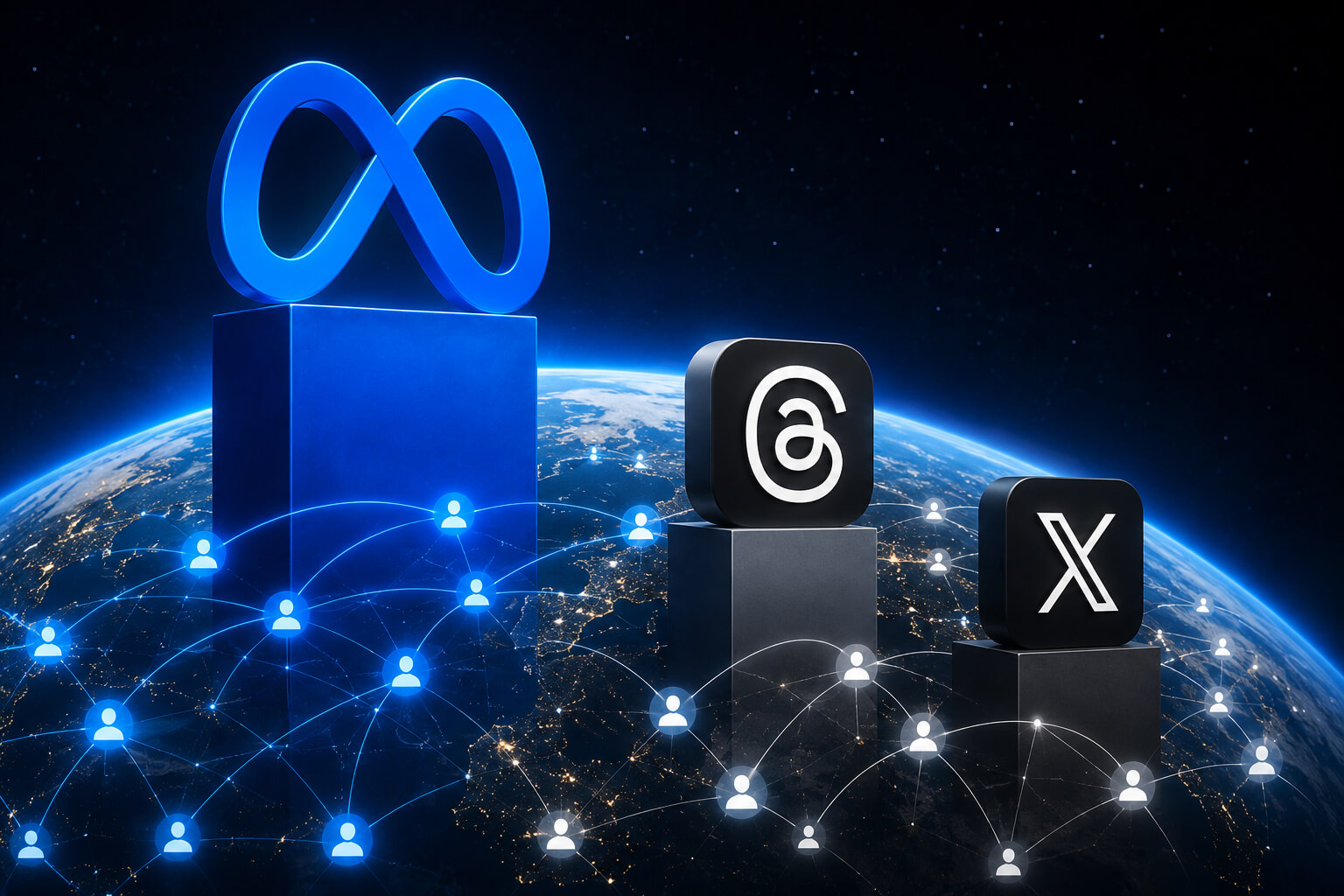
Meta’s grip on social media remains difficult to match. Facebook, Instagram and WhatsApp have each crossed the 3 billion-user mark, putting three of the world’s largest digital platforms under one company. Rivals are still growing, sometimes quickly, but Meta’s overall reach continues to sit in a different category.
That scale matters to advertisers. It also says something about how difficult it has become for newer platforms to dislodge established social habits.
Three Meta Platforms Now Sit Above 3 Billion Users
Facebook, Instagram and WhatsApp each have more than 3 billion monthly active users, according to figures compiled from platform announcements and company reporting. Facebook reached the milestone first, passing 3 billion monthly active users in 2023. WhatsApp followed in 2025, while Instagram reportedly crossed the same threshold later that year.
The numbers overlap, of course. Someone may use Facebook, Instagram and WhatsApp during the same month, so the figures cannot simply be added together. Even with that caveat, Meta’s presence is enormous. Few internet companies operate several individual services that each reach billions of people.
Meta now reports combined activity across its family of apps rather than providing detailed user totals for every platform during each quarterly update. Its reported family daily active people figure stood at 3.56 billion in the first quarter of 2026. That was slightly below the previous quarter and marked the first decline since Meta began publishing the metric.
The drop deserves attention, but it does not suddenly erase Meta’s advantage. Billions of people still open at least one of its apps every day.
Instagram Has Become More Than Facebook’s Younger Sibling
For years, Instagram often appeared in conversations as Facebook’s younger, more visually appealing companion. That description now feels outdated.
Instagram has become one of Meta’s most important platforms for creators, brands, retailers and younger users. Reels gives it a direct answer to TikTok, while Stories, direct messaging, shopping tools and creator partnerships keep users inside the app for different reasons.
Crossing 3 billion users makes Instagram’s position even harder to dismiss. It is no longer simply part of Meta’s portfolio. It is one of the largest communication and entertainment platforms on the internet.
For marketers, that broad audience creates opportunity and clutter at the same time. Instagram can deliver scale, but brands still have to compete with creators, friends, entertainment pages and increasingly polished recommendation algorithms. A large audience does not guarantee attention. It only means the attention is there to fight for.
Threads Is Quietly Becoming a Serious Competitor
Threads has grown far beyond its early reputation as Meta’s rushed response to X. The text-based platform reached around 500 million monthly active users in June 2026, according to Meta’s reported milestone. X, meanwhile, has been estimated at roughly 550 million monthly active users.
Those figures are not perfectly comparable because social platforms use different measurement methods, and X does not regularly release detailed independently verified usage data. Still, the gap has become surprisingly narrow.
Threads benefits from its connection to Instagram, which gives Meta an enormous pool of accounts to introduce to the platform. Users do not need to build an identity from scratch, while creators can bring portions of their Instagram audience with them.
Whether Threads develops its own strong culture remains a separate question. Growth through account integration is useful. Keeping people interested after they arrive is harder.
YouTube Remains the Closest Challenger to Meta’s Scale
YouTube continues to sit near the top of the global platform rankings, with estimates placing its monthly active audience at about 2.7 billion users. Its influence may be even larger than that figure suggests. YouTube operates as entertainment, search, education, music, television and creator media all at once.
Shorts has also given YouTube a much stronger position in short-form video. Daily Shorts views reportedly increased from around 30 billion in 2022 to approximately 200 billion in 2026.
That does not make YouTube a direct replacement for Facebook or Instagram. People use the services differently. It does, however, make YouTube one of the few platforms capable of competing for attention on a similarly global scale. For many brands, the real contest is not Meta versus YouTube. It is deciding how much content can realistically be produced for both.
TikTok’s True User Count Is Still Difficult to Pin Down
TikTok officially announced that it had reached 1 billion monthly active users in 2021. Outside estimates have since placed its audience closer to 1.6 billion, though TikTok has not publicly confirmed a newer worldwide monthly user total. The uncertainty has not weakened TikTok’s cultural influence.
Trends often begin there before appearing across Instagram Reels, YouTube Shorts and other platforms. TikTok also remains unusually effective at turning relatively unknown creators, songs and products into sudden global stories.
Its growth faces political and regulatory pressure in several markets, however. Restrictions, bans and ownership disputes could affect how far the platform expands, particularly in regions where government scrutiny has intensified. TikTok may not match Meta’s total reach. It can still shape what people see everywhere else.
Snapchat and Pinterest Continue Growing Outside the Spotlight
Snapchat is approaching the 1 billion-user level, reaching approximately 956 million monthly active users during the first quarter of 2026. Much of its expansion has come from markets such as India, even as the platform experienced softer performance in parts of the United States and Europe.
Pinterest has also become larger than many marketers may realize. The visual discovery platform reported 631 million monthly active users in the first quarter of 2026, up from 570 million a year earlier. Most of its recent user growth came from outside the US and Europe.
Pinterest does not generate the same volume of public conversation as TikTok or X. That may actually be part of its appeal. People often open Pinterest with an idea, project or purchase already in mind. That intent makes the platform particularly valuable for retail, travel, home design, beauty, food and lifestyle brands.
X and Threads Are Now Fighting Over Similar Territory
X remains influential in breaking news, politics, sports, technology and live public commentary. Its estimated monthly audience of around 550 million places it slightly ahead of Threads, based on available figures. The more interesting issue is direction.
Threads has been steadily adding users and features. X still carries a deeply established network of journalists, public figures and highly active communities, but its position is no longer uncontested.
User totals alone will not decide the outcome. A text platform depends heavily on conversation quality, real-time relevance and whether users believe important discussions are happening there. People may hold accounts on both. They will not necessarily give both platforms equal attention.
Large Audiences Do Not Automatically Create Better Campaigns
Platform size remains useful when marketers assess potential reach. It should not become the only number in the plan. A brand selling professional software may find a smaller LinkedIn audience more valuable than a much larger entertainment audience elsewhere. A beauty company could perform better on TikTok or Instagram. Pinterest may produce stronger results for a home improvement retailer because users arrive with clearer purchase intent.
Monthly active user figures also reveal little about how frequently people return, how long they stay or whether they engage with branded content.
Meta offers enormous scale. That is clear. The harder decision is where a particular audience is paying attention—and what kind of content it actually wants once it gets there.
Meta’s Lead Is Still Real, but the Market Is Moving
Meta remains the broadest social media company in the world by user reach. Three separate platforms above 3 billion users create a distribution advantage that competitors cannot easily reproduce. The rest of the market is not standing still.
Threads is moving closer to X. Pinterest continues to grow without much noise. Snapchat is expanding in younger and international markets. YouTube keeps turning short-form video into an even bigger part of its ecosystem.
The social media landscape is not becoming simpler. It is becoming more fragmented beneath a few extremely large platforms. Meta still owns the widest doorway into that world. What users do after walking through it is becoming much less predictable.
Sources
- Social Media Today – Meta Still Has Widest Social Media Reach
- Social Media Today – Meta’s Daily Active User Count Declined in Q1 2026
- Social Media Today – Pinterest Posts Solid Growth for Q1 2026
- Social Media Today – Snapchat Usage Declined in the US and EU in Q1
