

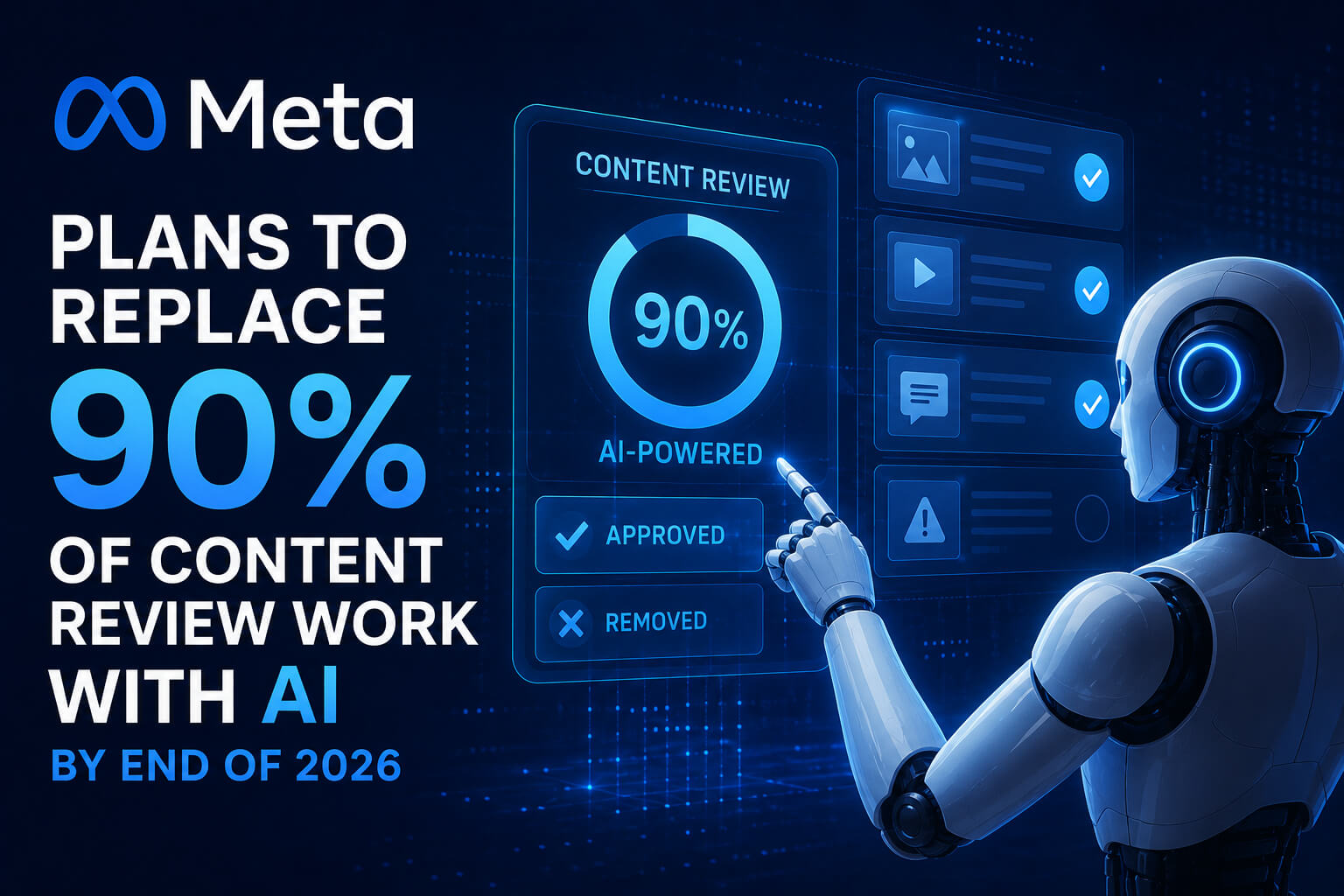
Meta is accelerating its shift toward artificial intelligence as the company prepares to rely more heavily on AI systems for content and ad review across Facebook, Instagram, and its wider family of platforms.
According to a report cited by Social Media Today, Meta currently uses AI tools to manage around 50% of its content and advertising review tasks. The company now plans to increase that figure to 90% by the end of 2026, marking one of the biggest moderation changes in the social media industry.
The move reflects Meta’s broader strategy to reduce reliance on human review teams while proving that AI can manage complex, large-scale business operations. However, the plan also raises fresh concerns about platform safety, account security, content accuracy, and the risks of allowing automated systems to make decisions that affect billions of users.
Meta AI Content Review Plans Expand Across Facebook and Instagram
Meta’s planned expansion of AI content review could affect how posts, ads, account issues, and policy decisions are handled across its platforms. If the company reaches its 90% target, most review-related decisions on Facebook, Instagram, and other Meta services could soon involve AI systems rather than human moderators.
For Meta, the business case is clear. The company manages a massive volume of daily posts, comments, images, videos, ads, and user reports. AI systems can process content quickly, operate at scale, and reduce the need for large human moderation teams.
This shift also supports Meta’s larger investment in artificial intelligence. The company has been pouring major resources into AI models, AI agents, automation tools, and superintelligence research. By applying AI to its own internal operations, Meta can demonstrate how the technology may help businesses cut costs and improve efficiency.
However, content moderation is not a simple task. Social media posts often involve context, language nuance, cultural differences, satire, political speech, misinformation, sensitive content, and rapidly changing online behavior. These areas remain difficult for AI systems to judge with complete accuracy.
AI Moderation Raises Safety and Accuracy Concerns
Meta’s plan comes at a time when the company is already facing questions about the reliability of AI-powered support and moderation tools.
A recent Instagram security issue reportedly affected around 20,000 accounts after attackers exploited Meta’s AI support system. According to reports, the attackers were able to trick the AI support bot into sending account verification codes to email addresses that did not belong to the original account owners.
Meta said the issue has been fixed, but the incident highlights a major challenge for AI-powered systems. Unlike traditional software, AI agents respond to natural language prompts. This means users can phrase requests in many different ways, making it harder to predict and block every possible misuse attempt.
As Meta gives AI tools more responsibility, the company will need stronger safeguards to prevent abuse, false decisions, and system manipulation. This is especially important when AI systems handle sensitive tasks such as account recovery, content removal, ad approvals, and policy enforcement.
Why Meta Wants AI to Handle More Review Tasks
Meta’s push toward AI content review is part of a broader industry trend. Major technology companies are using AI to automate customer support, advertising operations, safety checks, content classification, and business workflows.
For Meta, automation offers several benefits:
AI can review large volumes of content faster than human teams.
The company can reduce operational costs tied to human moderation.
Automated systems can apply certain rules consistently across millions of cases.
Meta can showcase its AI tools as practical solutions for enterprise use.
If Meta can successfully use AI to manage its own moderation and review systems, it may strengthen the company’s case for selling or integrating similar AI tools into other businesses in the future.
However, this approach also creates a difficult balance. Meta must prove that AI can improve efficiency without weakening platform trust. If AI systems make poor decisions, users may experience wrongful content removals, missed policy violations, account access issues, or inconsistent enforcement.
Human Review May Still Be Needed for Complex Cases
Even if Meta moves toward 90% AI-powered review, human oversight will likely remain important. Some cases require judgment that AI may not fully understand, especially when content involves local language, political tension, humor, news value, or real-world harm.
Human reviewers can also help audit AI decisions, handle appeals, monitor edge cases, and improve moderation policies. Without enough human oversight, Meta risks depending too heavily on systems that may fail in unexpected ways.
The future of content moderation may not be fully human or fully automated. Instead, the most effective model may combine AI speed with human judgment. AI can help filter, prioritize, and detect obvious violations, while trained human teams handle sensitive and complex decisions.
What This Means for Social Media Users and Advertisers
For everyday users, Meta’s AI content review expansion could change how quickly reports are handled, how content decisions are made, and how account support issues are resolved. Users may see faster responses, but they may also face more automated decisions with fewer direct human interactions.
For advertisers, AI-powered ad review could speed up campaign approvals and policy checks. However, brands may also need to prepare for stricter automated enforcement, possible false flags, and the need to appeal decisions when AI systems misread ad content.
For social media managers, creators, and businesses, the shift is a reminder to follow platform policies carefully. As AI systems take on more review tasks, content that appears unclear, misleading, sensitive, or policy-adjacent may face increased scrutiny.
Meta’s AI Future Comes With Big Questions
Meta’s plan to use AI for 90% of content and ad review tasks by the end of 2026 shows how quickly social media platforms are moving toward automation. The company wants to prove that AI can reduce costs, improve efficiency, and manage complex platform operations at massive scale.
But the risks are equally significant. Content moderation affects free expression, user safety, account security, advertiser trust, and platform reputation. If Meta moves too quickly, it could expose users and businesses to new forms of error, abuse, and automated decision-making problems.
As AI becomes more central to social media governance, Meta will need to show that its systems are not only fast and cost-effective, but also secure, transparent, fair, and reliable.
For now, the company’s AI content review plan signals a major turning point for the social media industry. The next challenge will be proving that automation can protect platforms without reducing the human judgment needed to keep online communities safe.
