

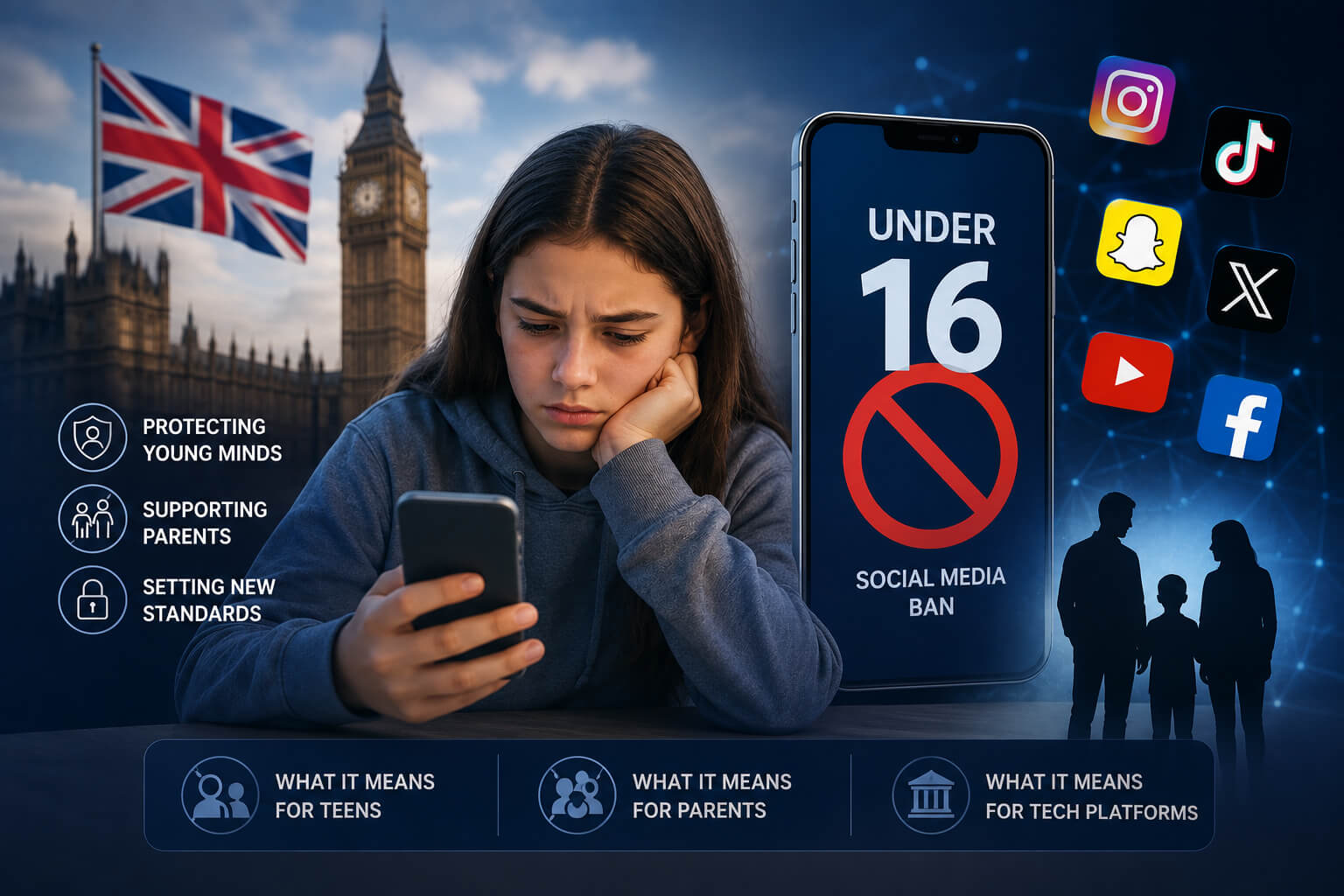
The UK government is preparing to introduce a major online safety crackdown that could block children under 16 from accessing high-risk social media apps. The proposal, described as an “Australia plus” social media ban, is expected to go beyond Australia’s under-16 restrictions by also targeting specific online features and AI chatbot risks.
Prime Minister Keir Starmer is expected to announce the measures after a public consultation on online safety closed on May 26, 2026. According to The Guardian, the consultation received more than 116,000 responses, with strong support from parents for tighter controls on children’s social media use.
What Is the UK ‘Australia Plus’ Social Media Ban?
The proposed UK social media ban for under-16s would restrict access to major social media platforms for children below the age of 16. While the final list of affected apps has not yet been confirmed, reports suggest the rules could cover large platforms such as Instagram, TikTok, Snapchat, YouTube, Facebook, and X.
The “Australia plus” label refers to Australia’s social media minimum age law, which prevents platforms from allowing under-16s to hold accounts. Australia’s rule came into effect on December 10, 2025, and applies to many social media platforms.
The UK version may go further by adding restrictions on features that are considered especially risky for younger users. These may include livestreaming, private messaging with adult strangers, and access to romantic or sexual AI chatbots.
What Features Could Be Restricted?
The UK proposal is not expected to focus only on whether a child can open a social media account. It may also limit certain features on platforms that are not fully banned.
Possible restrictions include:
- Blocking under-16s from chatting with adult strangers
- Removing or limiting livestreaming access for children
- Restricting certain platform features for teenagers
- Introducing time limits for 16- and 17-year-olds
- Blocking under-18s from romantic or sexual AI chatbots
The AI chatbot element is especially important because children are increasingly interacting with automated companions and roleplay bots. Regulators and child safety groups have raised concerns about young users being exposed to sexual, manipulative, or harmful conversations through AI-powered tools.
Why Is the UK Considering a Social Media Ban for Children?
The government says the goal is to protect children from harmful online content. It also wants to reduce the power of major technology companies over young users’ digital lives.
The move follows growing pressure from parents, MPs, and online safety campaigners. In January, more than 60 Labour MPs reportedly wrote to Starmer calling for an under-16 ban. Parents who responded to the government consultation also showed strong support for stricter limits.
However, the plan is controversial. Some child safety campaigners argue that a ban could be difficult to enforce and may not address the deeper problem of harmful recommendation algorithms. The Molly Rose Foundation warned that a ban could be “unenforceable” and might distract from the need to make platforms safer by design.
How Would Age Verification Work?
One of the biggest challenges is age verification. To enforce a UK social media ban for under-16s, tech companies would need to determine whether users are old enough to access certain platforms or features.
The UK already has the Online Safety Act, regulated by Ofcom, which requires platforms to protect children from certain harmful content. Ofcom’s guidance on “highly effective age assurance” covers approaches that can include facial age estimation, credit card checks, email-based age analysis, and digital identity verification.
The key question is whether the UK government will allow platforms flexibility in choosing age-check methods or require stricter, more specific systems. Privacy concerns will likely shape the debate, especially if platforms ask users to provide sensitive personal information.
Has Australia’s Social Media Ban Worked?
Australia’s under-16 social media law is still new. However, early figures suggest platforms have removed or restricted millions of accounts. The Australian government said platforms deactivated, removed, or restricted more than 4.7 million accounts within days of the law taking effect on December 10, 2025.
At the same time, Australia’s eSafety Commissioner said some under-16 users have kept accounts, created new ones, or bypassed age-gating systems. This highlights the difficulty of enforcing age restrictions online. Young users can still use workarounds such as false ages, alternative accounts, or technical tools.
What Happens Next?
The UK government has not yet confirmed when the proposed ban would come into force. The details of enforcement, affected platforms, age-check systems, and possible legal challenges remain unclear.
Tech companies may push back. They may argue that officials rushed the process. They could also object if the rules require intrusive verification systems.
Industry groups may challenge how the policy was developed. However, the government is likely to frame the move as a child protection measure.
Why This Matters for Social Media Platforms
If introduced, the UK’s “Australia plus” model could become one of the most significant social media regulations in the world. It would increase pressure on platforms to redesign services for younger users, strengthen age-check systems, and limit features that expose children to strangers, addictive content, or harmful AI interactions.
Parents could gain stronger legal backing to limit children’s access to social media. Meanwhile, teenagers may need to change how they use apps, messaging tools, livestreams, and AI chatbots.
For tech companies, the message is clear: governments are moving from content moderation rules toward age-based access restrictions. The next phase of social media regulation may focus less on removing harmful posts and more on deciding who can use certain platforms.
Key Takeaway
The proposed UK social media ban for under-16s could block children from major social media platforms. It could also restrict risky features such as livestreaming, adult stranger chats, and sexual AI chatbots.
Supporters say the policy could protect young people online. However, critics warn that enforcement, privacy, and platform accountability remain unresolved.
