

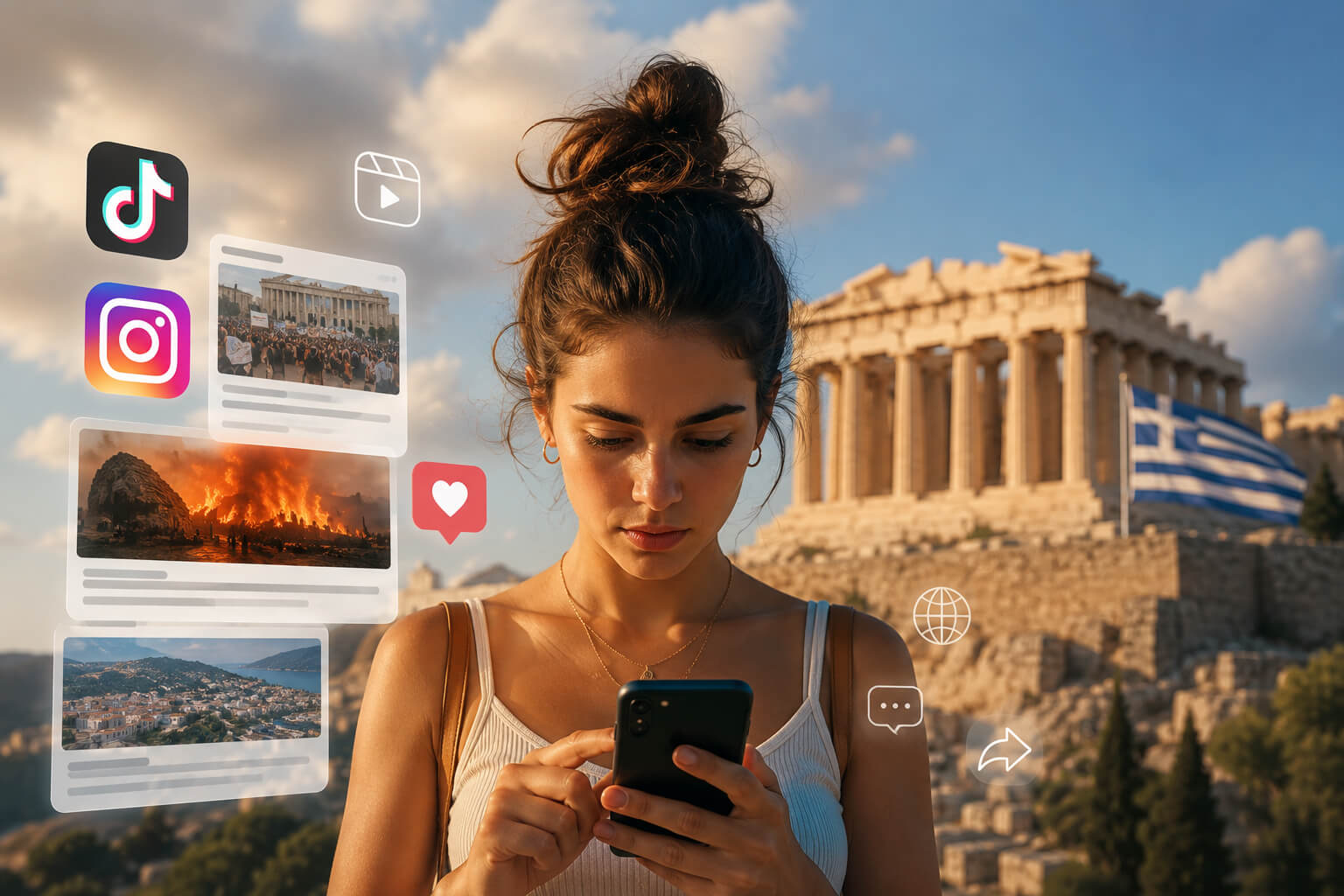
News in Greece is no longer something people only sit down to watch at a fixed hour. More and more, Greeks get news from social media, changing how information spreads throughout the country.
It appears between holiday videos, football clips, beauty tutorials and political arguments. A breaking story can reach someone through TikTok before a television bulletin has even started. An Instagram Reel may explain a government decision before the reader visits a newspaper website.
For many Greeks, particularly younger ones, that has become normal.
TikTok, Instagram and other social platforms are moving closer to the center of the country’s news habits. Traditional broadcasters and newspapers have not disappeared, but they are no longer guaranteed to be the first stop.
Social Media Is Becoming Greece’s News Front Page
The shift does not necessarily mean Greeks have stopped caring about current events. They are simply finding those events somewhere else.
Instead of opening a newspaper homepage or waiting for the evening news, users scroll through feeds assembled by recommendation algorithms. Political speeches, demonstrations, wildfires and local controversies appear beside entertainment content.
That changes the entire experience.
People may encounter a story without actively searching for it. A short clip catches their attention. They watch another explanation, read the comments and perhaps follow the creator who posted it. The platform becomes the front page, even though it was never designed like one.
Research published in 2025 found that 43% of Greeks used social media for news, while the figure rose to 58% among people aged 15 to 34. Television remained the most-used source overall, but its position was far weaker among younger audiences.
TikTok Makes News Feel Less Formal
Traditional news often arrives with familiar packaging: anchors, studio desks, official interviews and carefully written reports.
TikTok works differently.
A creator may talk directly into a phone camera from a bedroom, café or street corner. The language feels casual. Explanations are shorter. Complicated political stories get reduced to a minute or less, sometimes with captions, screenshots and quick cuts.
That style can feel more approachable than a long television debate or newspaper column.
Personality matters too. Users may trust an individual creator because they have followed that person for months. They understand the creator’s humor, political outlook and way of explaining things. The relationship feels personal, even when thousands of other viewers are watching the same clip.
Of course, feeling personal is not the same as being reliable.
Low Trust in Greek Media Is Driving the Change
Greece’s move toward social media news is not only a story about technology. It is also a story about trust.
The Reuters Institute’s 2026 Digital News Report described Greece as a fragmented digital news market with heavy social media use and one of the lowest levels of news trust among the 48 markets studied. Overall trust in news fell to just 18%, compared with a global average of 37%.
Many Greeks believe major media outlets operate under excessive political or business influence. Large television networks, newspapers and news websites are often connected to powerful corporate owners.
That creates suspicion.
When audiences do not believe traditional outlets are independent, an unaffiliated TikTok creator can look refreshingly honest. The creator may not have a newsroom, professional editors or access to official sources. Still, the lack of institutional polish can become part of the appeal.
It looks less controlled. Sometimes that is exactly what viewers want.
Younger Greeks Are Leaving Television Behind
The generational gap is hard to ignore.
Only 33% of Greeks aged 15 to 34 said they relied on television for news in the 2025 study. That compared with 64% among those aged 55 to 64 and 77% among respondents aged 65 and older.
The difference is not simply about choosing one screen over another.
Younger audiences expect news to move quickly, fit mobile displays and allow immediate participation. They want to comment, share, remix and respond. Television mostly speaks at its audience. Social media lets the audience speak back, though not always politely.
News organizations now have to compete with influencers, activists, comedians, eyewitnesses and ordinary users who happen to be filming when something happens.
A newsroom might spend hours preparing a verified report. A witness with a phone can upload footage in seconds.
Speed usually wins the first round.
Instagram Turns Headlines Into Visual Stories
TikTok may dominate conversations about short-form video, but Instagram also plays a major role in how Greeks find news.
Reels provide fast explanations, while Stories let publishers and creators post updates throughout the day. Carousel posts can turn a complicated issue into several swipeable slides. A headline that might feel dry on a website becomes easier to consume when paired with bold text, images and short summaries.
This visual approach suits users who want the main point without reading a full article.
It also creates a problem for publishers. People may absorb the summary without ever visiting the original news site. The platform keeps the audience, while the newsroom that gathered the information receives little traffic or revenue.
That is happening well beyond Greece. The Reuters Institute’s 2026 findings showed that social media and video networks had become more popular than publishers’ websites and apps as news sources in 30 of the 48 markets surveyed.
News Creators Are Competing With Established Journalists
Social platforms have opened the news business to people who may never have worked inside a traditional newsroom.
Some creators provide useful context, translate official language into everyday terms or bring attention to stories that larger outlets overlook. Others build audiences around commentary rather than original reporting.
The line gets blurry fast.
A creator may start by summarizing headlines and eventually become a recognizable political voice. Viewers may not always know whether the person is reporting, offering an opinion, promoting a campaign or repeating information from another outlet.
Traditional media had gatekeepers. Social media has algorithms.
Neither system is neutral, but the social media version is often less visible. Users see what the platform predicts will keep them watching, not necessarily what is most important or accurate.
Misinformation Can Travel With the Same Speed
The format that makes social news convenient also makes it risky.
Short videos leave little room for context. Dramatic claims perform better than cautious explanations. Anger, surprise and conflict can drive engagement, pushing questionable content deeper into users’ feeds.
A false claim does not need to survive a newsroom’s editorial checks. It only needs to sound convincing for a few seconds.
Corrections usually move more slowly. Even when a misleading video gets removed or challenged, screenshots and reposts may continue circulating.
This is especially serious in a country where trust in established media is already weak. Audiences who reject mainstream reporting may also reject fact-checks issued by those same organizations.
That leaves platforms trying to moderate political claims, manipulated footage and unverified reports at enormous scale.
Traditional Greek Media Has to Enter the Feed
News organizations cannot solve this problem by telling younger audiences to return to newspapers or television.
Those audiences are already inside TikTok and Instagram.
Publishers will have to meet them there, but copying television clips into a vertical format will not be enough. Social video needs a different rhythm. It needs recognizable presenters, clear explanations and a willingness to respond to what users are discussing.
The difficult part is keeping journalistic standards while adapting to a platform that rewards speed, emotion and constant posting.
Some outlets will manage it. Others may produce awkward videos that feel like television wearing social media clothes.
Still, ignoring the platforms is no longer a serious option.
Greece Offers a Glimpse of Where News Is Heading
Greece may look like an unusually sharp example because of its low media trust and highly fragmented digital environment. The underlying direction, however, is spreading across many countries.
News is becoming less tied to a specific publication.
People follow personalities, topics and algorithmic recommendations. They may remember the creator who explained a story but forget which newsroom originally reported it. They might watch ten videos about an event without opening one full article.
That does not automatically mean journalism is dying. It means distribution has changed, and the old routes to an audience are weakening.
For Greek media, the challenge is no longer just producing the news.
It is getting into the feed without becoming another piece of disposable content.
Sources
- The Christian Science Monitor – Why Greeks Are Going to TikTok for News Instead of Newspapers or TV
- Reuters Institute – Digital News Report 2026: Greece
- To Vima – How Do Greeks Get Their News?
- Nieman Journalism Lab – People Are Abandoning News Sites for Social Media
