

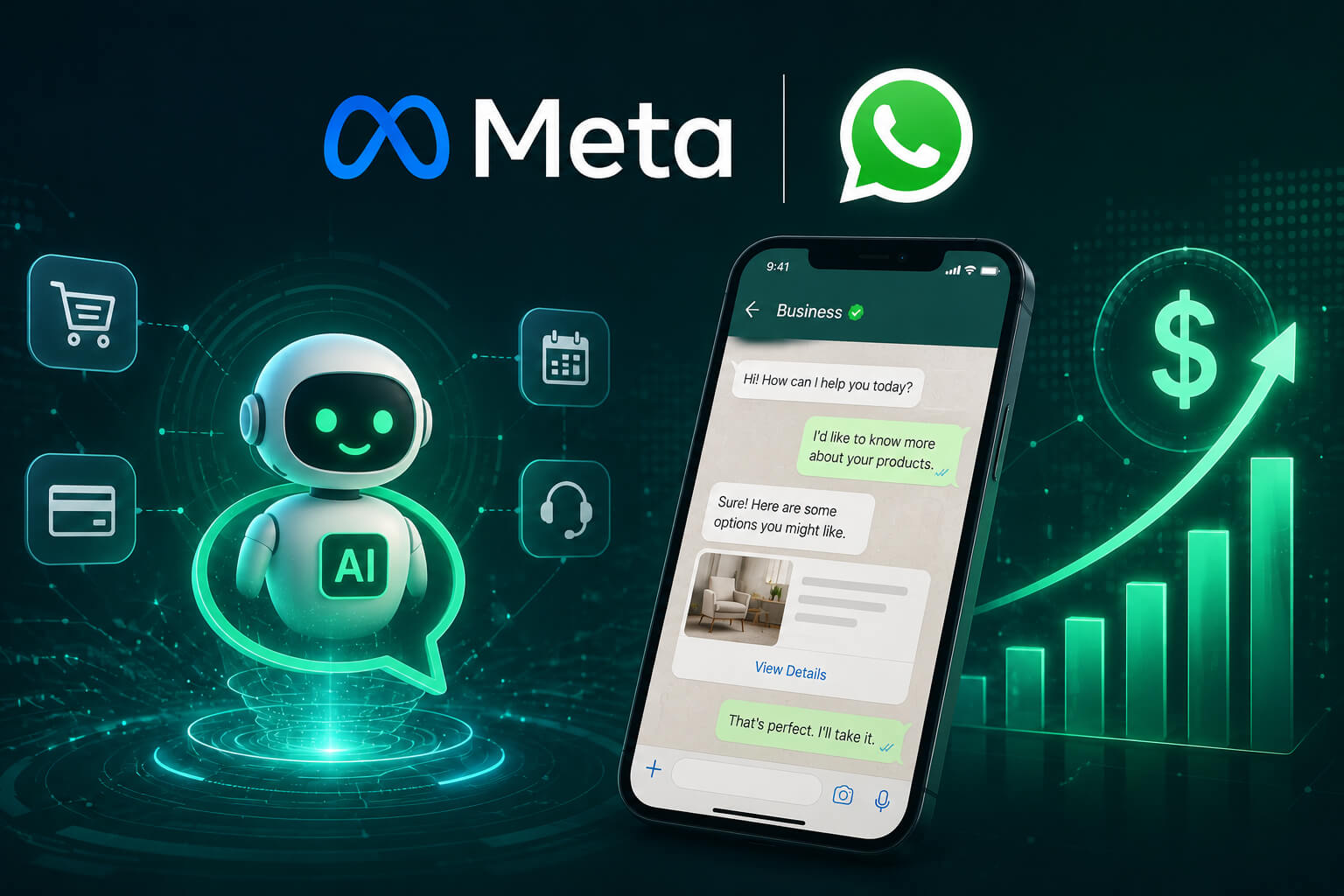
Meta is turning to artificial intelligence as it looks for new ways to grow revenue from WhatsApp. WhatsApp is one of the world’s most widely used messaging platforms.
The company is expanding AI-powered business agents for WhatsApp, giving companies tools that can respond to customers, answer product questions, support bookings, and assist with sales conversations. This move is part of Meta’s wider strategy to make AI a bigger part of its business model. In fact, the company wants to go beyond traditional social media advertising.
WhatsApp has long been a major global platform, but it has remained harder to monetize than Facebook and Instagram because of its private messaging structure and strong focus on encryption. As a result, with AI agents, Meta is now trying to create a new commercial layer inside business messaging.
Meta Expands AI Business Agents on WhatsApp
Meta’s AI business agents are designed to help companies automate customer interactions on WhatsApp. These agents can handle common customer questions, provide product recommendations, guide users through purchases, and support appointment bookings.
For small businesses, the technology could act like a low-cost customer service assistant that operates around the clock. Meanwhile, for larger companies, AI agents could be embedded into larger customer engagement systems to help reduce response times and improve sales conversion.
The rollout is a sign of how Meta is trying to position WhatsApp as more than just a messaging app. It’s increasingly a platform for business communication, customer support and digital commerce.
Why WhatsApp Is Important to Meta’s AI Strategy
WhatsApp has more than 3 billion users globally and is one of Meta’s crown jewels. But unlike Facebook or Instagram, WhatsApp hasn’t been dependent on a sprawling advertising model in personal conversations.
That has led Meta to seek out other sources of revenue, including paid messaging, business tools, click-to-message ads and now AI-enabled customer service.
The advent of AI agents could enable Meta to increase its revenue from businesses that already utilize WhatsApp for customer communication. In addition to providing a messaging platform, Meta can offer automation, sales support, and customer engagement tools. Companies might be willing to pay for these additional tools.
AI agents could change how businesses communicate
AI agents could significantly change how companies interact with customers online. Many small businesses already use WhatsApp as a key sales and support channel. This is especially true in markets where messaging apps are integral to everyday commerce.
The addition of AI can enable Meta to help businesses respond faster and handle more customer messages. That could be helpful for retailers, restaurants, service providers, travel companies, healthcare clinics and local businesses that get many customer inquiries.
The experience may feel like talking to a business representative, but the answer may be generated by an AI system that’s trained to answer questions and complete simple tasks.
A new revenue stream beyond ads
Meta still makes most of its cash from advertising, but AI business agents could open up a new monetization route.
Businesses might pay via subscriptions, usage-based pricing, or premium automation tools. Larger enterprises might pay more for advanced AI features, deeper integrations, or higher message volumes.
The strategy provides Meta with a way to boost WhatsApp revenues without putting traditional ads into private conversations. It also plays into Meta’s larger push to make AI core to its apps, advertising products and business services.
Privacy and Encryption Questions Linger
The growth of AI tools on WhatsApp also brings up privacy questions. WhatsApp is known for end-to-end encryption in personal chats. However, AI-powered business chats might not have the same data handling rules, depending on how the tools are used.
Meta will need to be clear about what information AI agents can access, how customer messages are processed, and whether business conversations can be used to improve AI systems.
Privacy is going to be key because WhatsApp users often think of the platform as a secure, personal space for communication. Any confusion around AI data usage could create trust concerns for both users and businesses.
Meta’s Bigger AI Push
The WhatsApp AI agent rollout is part of Meta’s wider investment in artificial intelligence. The company has been adding AI features across Facebook, Instagram, Messenger, WhatsApp, ads, content creation tools, and business products.
Meta CEO Mark Zuckerberg has repeatedly positioned AI as a major growth area for the company. AI is already being used to improve ad targeting, content recommendations, creative tools, and productivity inside Meta’s platforms.
With business agents, Meta is now moving deeper into practical AI tools that can help companies automate everyday work.
What This Means for Businesses
For businesses, Meta AI agents on WhatsApp could reduce the need for manual replies and help teams manage more customer conversations at scale.
Small businesses would likely benefit the most, as they usually do not have dedicated customer support staff. An AI assistant could answer basic questions, recommend products and assist customers even outside of business hours.
But companies will also have to ensure that AI responses are accurate, brand safe, and transparent. Poorly managed automation could frustrate customers if the system gives wrong answers or fails to escalate complex issues to a human.
What It Means for the AI Industry
Meta’s decision highlights a developing trend in the AI industry: Big tech companies are seeking to convert AI agents into mainstream business tools.
Instead of relying solely on AI for search, chatbots or content creation, organizations are now developing agents that perform commercial tasks like customer support, sales support, booking, lead qualification and transaction support.
If Meta pulls this off, WhatsApp could become a major real-world test bed for business AI at scale.
Bottom line
Meta’s bet on AI agents for WhatsApp could be a big pivot in how the company monetizes messaging.
Meta is trying to leverage WhatsApp’s huge user base and AI-powered business automation to generate a new revenue stream outside of traditional advertising. The move could help companies respond more quickly. It could also help them sell more efficiently and manage customer relationships at scale.
At the same time, Meta will need to balance growth with privacy, transparency and user trust. If it can do that successfully, AI agents could be a key component of WhatsApp’s future. They could also be a key driver of Meta’s next phase of AI-powered revenue growth.
For more Breaking AI news, visit: https://breakingai.news
