

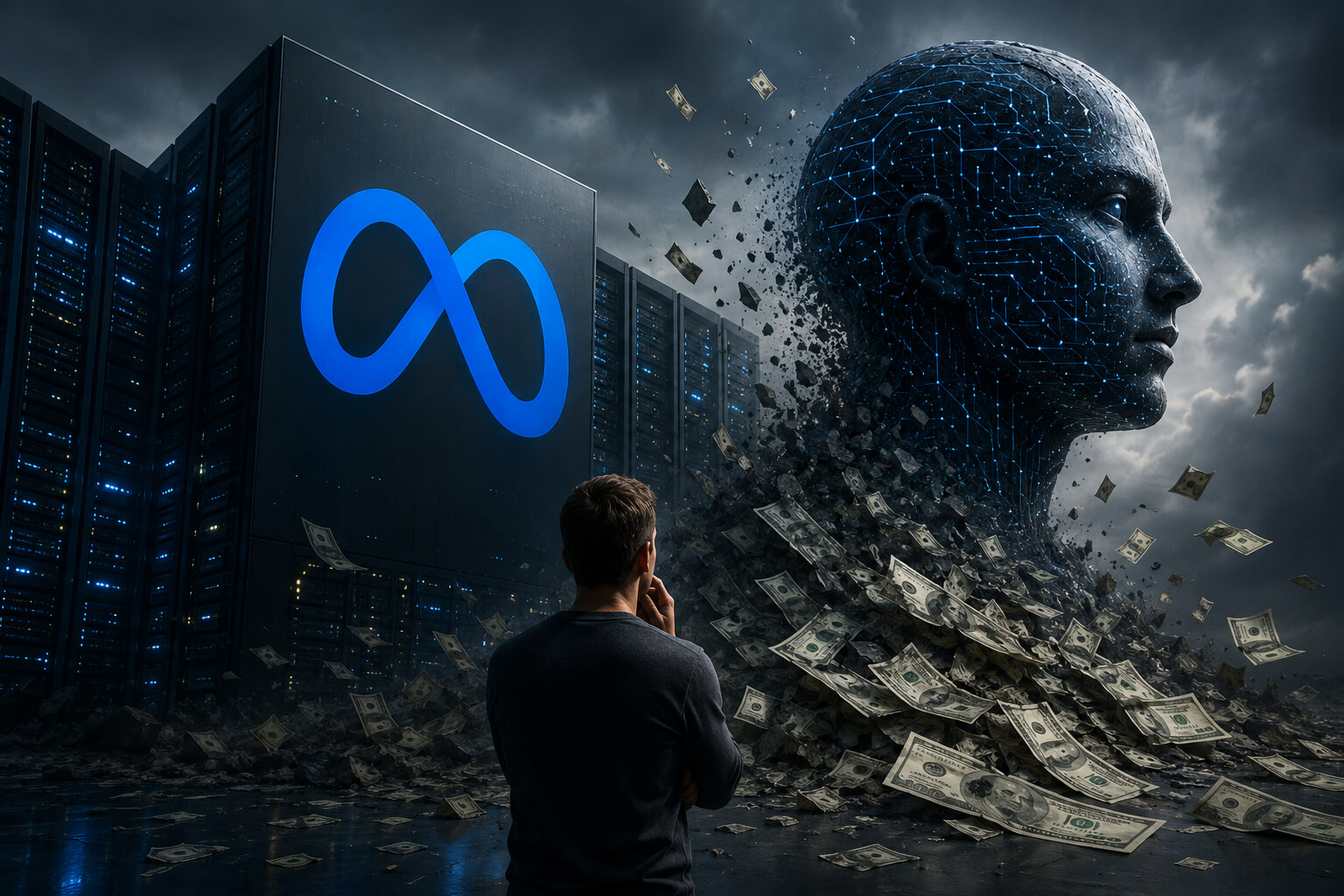
Meta has reached the point where artificial intelligence is no longer just another feature inside Facebook or Instagram. Meta AI investment has become the company’s defining financial bet.
Mark Zuckerberg is pouring money into data centers, advanced chips, research teams and new AI products, all while promising that personal superintelligence could eventually reach billions of users.
The scale is difficult to brush aside. Meta expects its 2026 capital expenditure to land between $125 billion and $145 billion, up from an earlier forecast of $115 billion to $135 billion. Much of that increase will support AI infrastructure and future computing capacity.
Plenty of technology companies are spending heavily on AI. Meta, though, is making the wager with the confidence of a company that believes it can reshape the consumer internet again.
That does not mean the economics already make sense.
Meta Is Building AI Infrastructure at an Unusual Scale
Meta’s AI ambitions require far more than clever software. They need enormous physical infrastructure.
The company is building and leasing data centers across several markets, including new AI-optimized facilities in the United States, Canada and India. Its planned data center in Lebanon, Indiana, carries an investment of more than $10 billion and is designed to deliver one gigawatt of capacity. A separate Alberta project will cost more than CAD $13 billion.
Meta also signed a long-term agreement with AMD covering up to six gigawatts of AI chips. That agreement gives the company another path to the computing power needed for training and operating increasingly complex models.
These are not experimental side projects. They are industrial-scale commitments involving power, cooling systems, chip supply, network connections and years of construction.
Once Meta builds that capacity, it needs to keep using it. Empty or underused infrastructure would quickly turn an ambitious AI strategy into a very expensive burden.
Advertising Is Still Paying the Bills
For now, Meta’s social media advertising machine is carrying the investment.
The company generated $56.31 billion in revenue during the first quarter of 2026, representing 33% year-over-year growth. Advertising accounted for $55.02 billion of that total. Ad impressions increased by 19%, while the average price per ad rose by 12%.
Those figures explain why Meta can afford to spend at this level. Facebook, Instagram, WhatsApp and Messenger still reach billions of people, and advertisers continue paying to reach them.
AI is already helping that established business. Meta uses machine learning to rank content, recommend posts, improve ad targeting, generate campaign materials and predict which ads are more likely to produce a conversion.
That matters because Meta does not necessarily need to sell a standalone chatbot subscription to earn money from AI. A stronger recommendation system can keep people scrolling longer. Better ad matching can lift conversion rates. Automated creative tools can encourage smaller businesses to spend more.
This is probably the most believable route to an AI payoff. It is also less exciting than the idea of superintelligence.
Meta Needs More Than Better Recommendations
Improving advertising may justify part of the spending, but perhaps not all of it.
Meta reported total revenue of $200.97 billion for 2025. Most of that came from advertising, while non-advertising revenue remained relatively small. The company spent $72.22 billion on capital expenditure during the year and now expects that figure to rise sharply in 2026.
The gap creates an uncomfortable question. How much additional advertising revenue can AI realistically produce before the returns begin to flatten?
Meta can improve recommendations, automate campaigns and introduce AI assistants for businesses. Yet its platforms already operate at immense scale. Finding another few billion dollars in efficiency is possible. Recovering hundreds of billions in long-term AI investment is a different challenge.
Eventually, Meta may need AI to become a substantial business of its own.
That could involve paid access to advanced models, business agents, developer tools, AI-generated advertising services or premium features inside Instagram and WhatsApp. Smart glasses may become another distribution point. None of these paths has yet proved that it can match the scale of Meta’s advertising empire.
Billions of Users Give Meta a Real Advantage
Meta does have something most AI companies lack: immediate access to a global consumer audience.
The company reported an average of 3.56 billion daily active people across its family of apps in March 2026. It does not need to persuade people to download an unfamiliar platform before introducing them to AI. The technology can simply appear inside products they already use.
That distribution advantage could become more valuable than having the most impressive model on a technical benchmark.
Meta can place AI assistants inside WhatsApp conversations, add creation tools to Instagram, automate customer support for businesses and use generated recommendations throughout Facebook. It can test features on a scale that smaller developers cannot easily replicate.
Still, distribution alone does not guarantee demand. Users may enjoy an AI feature without paying for it. Businesses may test automated tools without increasing their advertising budgets. People may also grow tired of synthetic content filling their feeds.
A product can reach billions and still struggle to become a meaningful new revenue stream.
Meta Has Changed Grand Visions Before
The company’s previous metaverse push remains part of the discussion because it showed how quickly Zuckerberg can reorganize Meta around a long-term technology thesis.
Meta changed its corporate name, invested heavily in virtual reality and presented immersive digital worlds as the next major computing platform. Reality Labs continues operating, but the company’s public narrative now revolves far more heavily around AI.
Reality Labs recorded a $4.03 billion operating loss during the first quarter of 2026. Meta’s Family of Apps, by comparison, generated $26.9 billion in operating income.
That history does not prove the AI strategy will fail. AI already has clearer commercial uses than the metaverse did at a similar stage. It improves advertising, content recommendations, translation, moderation and business messaging today.
It does show that Meta is willing to spend heavily before consumer demand becomes obvious. Investors are being asked to trust Zuckerberg’s conviction again, only with even larger numbers involved.
The Payoff May Look Less Dramatic Than Zuckerberg’s Vision
Meta may never launch one AI product that suddenly repays the entire investment. The return could arrive through dozens of smaller improvements scattered across its business.
A slightly stronger ad model. More effective Reels recommendations. Automated campaign production. AI customer service inside WhatsApp. Better translation between creators and audiences. Paid tools for businesses and developers.
Stack enough of those gains together and the spending begins to look more reasonable.
But Meta has set expectations much higher than ordinary product optimization. Zuckerberg is talking about personal superintelligence, massive computing clusters and a new generation of devices powered by AI.
That vision demands a similarly large commercial result.
Meta’s advertising business gives it time, cash and room to experiment. Few companies could spend this aggressively without placing their core operations at immediate risk. Even so, the size of the bet means “useful” AI will not be enough.
It needs to become extremely profitable.
Sources
- Social Media Today – Will Meta’s massive AI bet pay off?
- Meta – First Quarter 2026 Results
- Meta – Fourth Quarter and Full Year 2025 Results
- Meta – New Data Center in Lebanon, Indiana
- Meta – First Canadian Data Center in Alberta
- Meta – AMD AI Infrastructure Agreement
