

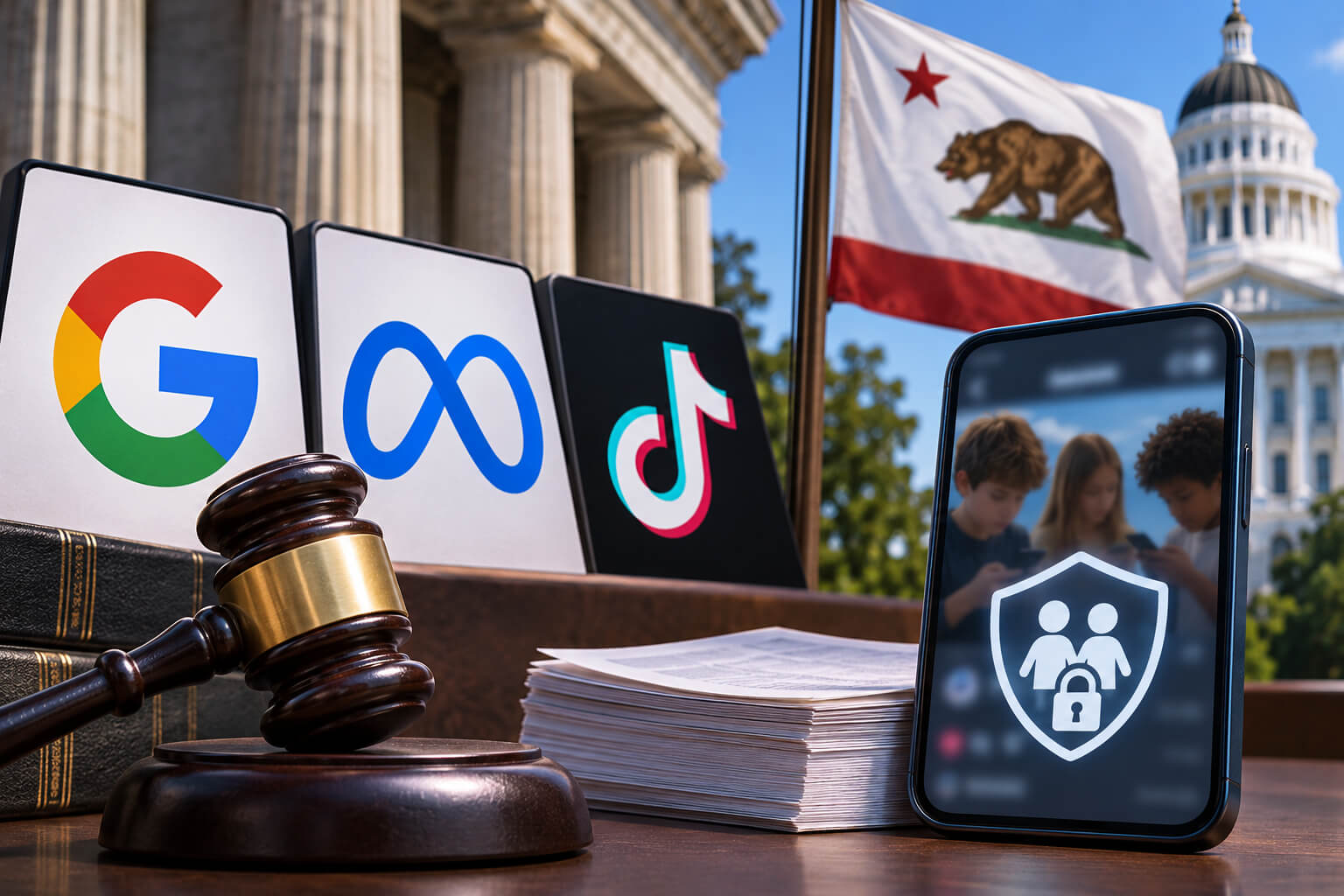
Google, Meta and TikTok have filed lawsuits against California over a new law designed to protect children from potentially addictive social media features. The companies argue that the legislation violates constitutional protections and interferes with how their platforms recommend and display content.
The legal challenges come as California prepares to introduce stricter rules governing the online experiences of users under 16. The legislation targets features such as endless scrolling, autoplay videos and personalized recommendation feeds.
The California social media law is scheduled to take effect on January 1, 2027. The technology companies want federal courts to block its enforcement before that deadline.
California officials maintain that the restrictions are necessary to address growing concerns about children’s online safety. The companies, however, argue that the state is attempting to regulate decisions protected by the First Amendment.
Google, Meta and TikTok Challenge California’s Social Media Restrictions
The lawsuits focus on California Assembly Bill 1709, which Governor Gavin Newsom signed into law in September 2026. The legislation seeks to limit children’s exposure to social media features designed to encourage prolonged engagement.
Google filed its lawsuit in federal court in San Jose, while Meta brought its case in San Francisco. TikTok filed a separate challenge in Los Angeles. All three companies named California Attorney General Rob Bonta as the defendant.
The companies argue that California’s restrictions interfere with their ability to organize, recommend and present content to users. They maintain that these decisions involve editorial judgment protected under the First Amendment.
Their complaints also raise questions about Section 230 of the Communications Decency Act, which provides certain legal protections for online platforms.
The lawsuits could determine whether California can regulate specific platform design features without violating federal law or constitutional protections.
California Targets Endless Scrolling and Personalized Content Feeds
California’s new legislation focuses on features that encourage users to spend extended periods browsing social media platforms.
Endless scrolling allows people to continuously view new posts without reaching a natural stopping point. Autoplay automatically starts another video after the previous one ends, while personalized recommendation systems select content based on viewing habits and interactions.
These features play an important role in how platforms such as TikTok, Instagram and YouTube maintain audience engagement.
Under the legislation, companies would need to prevent children younger than 16 from accessing covered addictive features. Platforms would also be required to introduce reasonable age-verification measures to determine whether users fall within the restricted age group.
Companies that violate the law could face substantial financial penalties, potentially reaching $50,000 for each affected underage user.
California lawmakers believe the restrictions could help reduce excessive social media use among children. Technology companies argue that the measures are too broad and could interfere with legitimate online activities.
Meta Argues California’s Law Violates Free Speech Protections
Meta has challenged the legislation on constitutional grounds, arguing that California is attempting to control how Facebook and Instagram organize and distribute content.
The company maintains that selecting and recommending posts involves editorial decisions protected by the First Amendment.
Meta also argues that the restrictions could interfere with features that help teenagers discover relevant content, communicate with friends and participate in online communities.
The lawsuit comes amid continuing legal scrutiny of Meta’s approach to children’s online safety.
In August 2026, the company reached a settlement worth up to $18 billion involving allegations about the effects of its platforms on younger users. The agreement included additional child-safety commitments.
Despite those measures, Meta continues to face pressure from regulators and advocacy groups seeking stronger protections for minors.
The California case adds another challenge as the company attempts to defend its recommendation systems while responding to demands for greater accountability.
TikTok Says Algorithm Restrictions Could Affect Content Discovery
TikTok argues that California’s restrictions interfere with how its platform recommends videos and connects users with content that matches their interests.
The company maintains that personalized recommendations are comparable to editorial decisions made by bookstores, television networks and other media services.
TikTok also believes parents should retain greater authority over their children’s online experiences.
According to the company’s position, families should be able to decide which digital services and features are appropriate rather than having those decisions imposed through broad government restrictions.
TikTok already provides parental supervision tools and safety settings intended to support younger users.
The company has faced similar legal challenges elsewhere in the United States. In September 2026, TikTok reached a settlement with Alabama over allegations involving addictive platform features.
Its latest lawsuit reflects the growing conflict between social media companies and state governments seeking tighter oversight of recommendation algorithms.
Google Warns California’s Law Could Disrupt YouTube Safety Features
Google has raised concerns that the legislation could interfere with YouTube’s existing systems for providing age-appropriate content.
The company argues that personalized recommendations can help younger users discover educational videos, entertainment and other material suited to their interests.
YouTube already offers parental supervision tools and safety settings for minors. These include restrictions on certain features and controls that allow parents to manage their children’s viewing experiences.
Google maintains that California’s approach could undermine some of these existing protections by imposing broad restrictions on content recommendation systems.
The company also argues that parents should play a central role in determining how their children use online platforms.
California officials disagree with the suggestion that existing safeguards are sufficient. They believe additional restrictions are necessary to address features that may encourage excessive use.
The disagreement highlights a central issue in the lawsuits: whether restricting engagement-focused design features will improve online safety without unnecessarily limiting access to useful content.
California Defends Stronger Online Protections for Children
California officials have defended the legislation as part of a broader effort to protect children from potentially harmful online experiences.
Governor Gavin Newsom has supported stronger oversight of social media platforms, particularly features that may encourage prolonged use among younger audiences.
The state argues that technology companies should take greater responsibility for the design of their products and the effects those designs may have on children.
Attorney General Rob Bonta’s office has indicated that it is reviewing the lawsuits and remains committed to defending California’s child-protection measures.
The legal dispute comes as social media companies face growing scrutiny from parents, educators and lawmakers.
Across the United States, lawsuits have accused major platforms of designing products that encourage compulsive use among children and teenagers. The companies dispute many of those allegations.
California’s legislation reflects a growing regulatory focus on platform design rather than harmful content alone.
Age Verification Requirements Raise Privacy Concerns
California’s proposed restrictions have also sparked concerns about how social media platforms would verify users’ ages.
Digital rights organizations, including the Electronic Frontier Foundation, have warned that mandatory age-verification systems could create privacy risks.
Depending on how companies implement the requirements, users may need to provide additional personal information or undergo automated age assessments.
These systems could affect adults as well as children, particularly if platforms require all users to demonstrate that they meet certain age thresholds.
Critics also question whether age-verification measures could discourage people from accessing lawful online content.
Supporters of the legislation argue that effective age checks are necessary to prevent younger users from accessing restricted features.
The debate illustrates how efforts to improve children’s online safety can create additional questions about privacy, access and digital rights.
What California’s Social Media Lawsuits Mean for the Technology Industry
The lawsuits could influence how governments regulate social media platforms across the United States.
If California successfully defends its legislation, other states may consider similar restrictions on autoplay videos, endless scrolling and personalized recommendation systems.
A ruling in favor of Google, Meta and TikTok could establish limits on how far state governments can go when regulating the design of digital platforms.
The dispute also reflects an international trend toward stronger protections for younger social media users.
Australia began enforcing restrictions on social media accounts for children under 16 in December 2025, while other governments continue examining age-verification requirements and platform safety obligations.
For technology companies, these developments create uncertainty around products that rely heavily on personalized recommendations.
For policymakers, the challenge is finding ways to protect children without unnecessarily restricting lawful online expression or creating new privacy risks.
California’s Social Media Law Faces a Legal Test Before 2027
With California’s new restrictions scheduled to take effect on January 1, 2027, the lawsuits from Google, Meta and TikTok could determine whether the legislation proceeds as planned.
The companies argue that the law interferes with constitutionally protected editorial decisions and imposes excessive restrictions on digital platforms.
California officials maintain that stronger safeguards are necessary to address concerns about children’s exposure to addictive social media features.
The courts will now need to consider those competing arguments.
The outcome could influence future legislation involving social media algorithms, age verification and children’s digital safety.
For now, the dispute highlights a growing question facing the technology industry: how much authority should governments have over the features that shape what children see online?
Sources
- Associated Press – Google, Meta and TikTok Sue California Over Social Media Law
- Reuters – Google, Meta and TikTok Challenge California Youth Social Media Law
- TechCrunch – Meta, Google and TikTok Sue California Over Teen Social Media Law
