

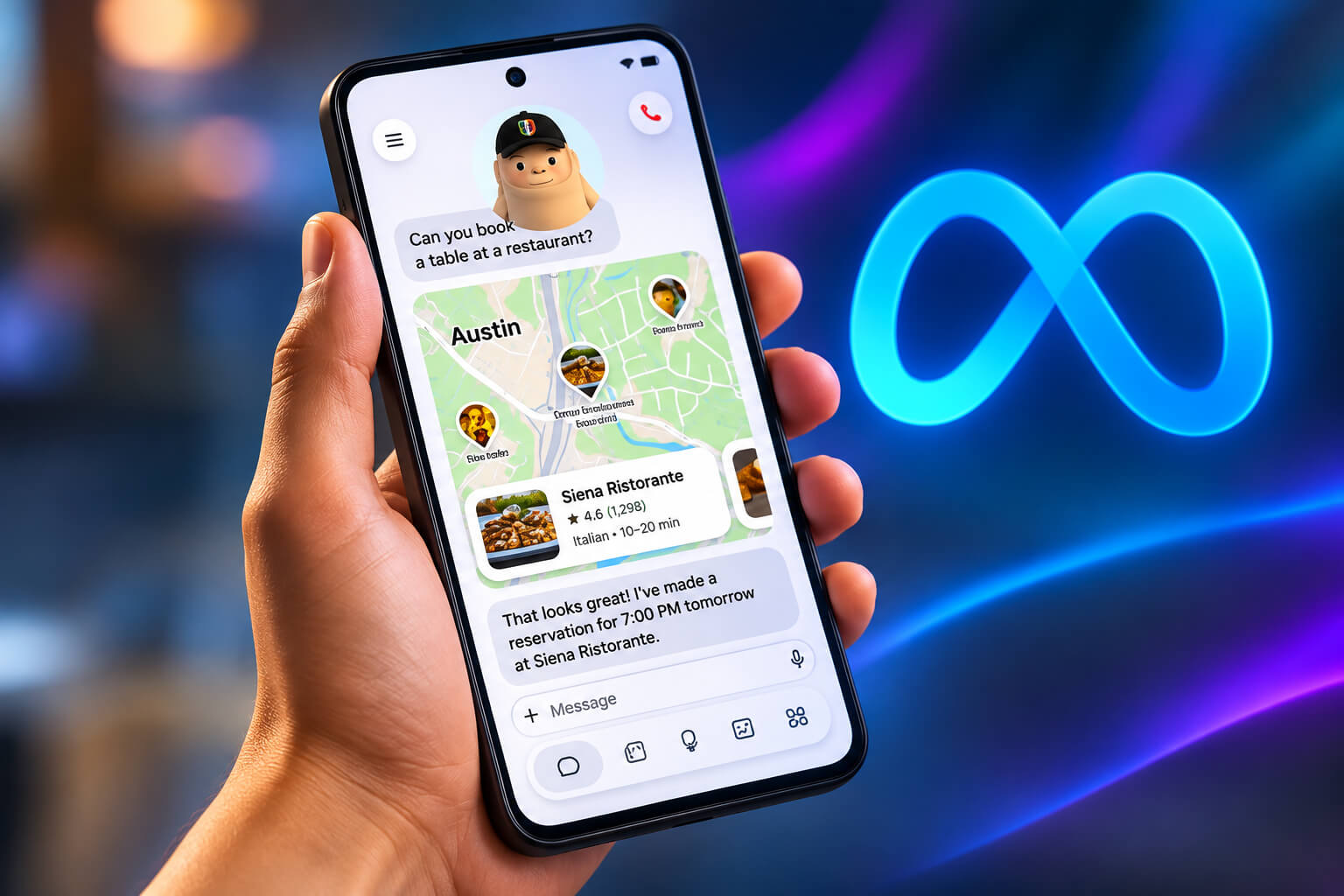
Meta wants its AI agents to do more than answer questions on a screen. The company is introducing voice conversations and animated avatars to Muse, its personal AI assistant, allowing users to speak with their digital agents instead of typing instructions.
Announced on November 5, 2026, the update brings real-time voice interactions to the Muse app, along with customizable voices and avatars that respond through facial expressions and gestures.
Users can choose how their AI agent sounds, talk through ideas, rehearse presentations or ask Muse to handle tasks while they’re busy doing something else.
Meta says the new capabilities are designed to make AI interactions feel more natural. But the company is also revisiting a concept it has experimented with before: giving artificial intelligence a recognizable personality.
Meta Introduces Real-Time Voice Conversations for Muse AI
Meta’s latest update allows Muse users to communicate directly with their AI agents through spoken conversations. Instead of writing prompts, people can simply talk to Muse and receive immediate voice responses.
The feature builds on the personal AI agent Meta introduced in September 2026, which was designed to help users complete everyday tasks, organize information and manage projects.
With the new voice capabilities, Muse can follow conversations as they happen, respond to questions and adjust when users change direction. People can even interrupt the assistant while it is speaking, making the interaction feel less like issuing commands to a chatbot.
Meta first previewed these real-time conversations during Connect 2026. The company is now rolling out the functionality through the Muse app on mobile devices, the web and Mac computers.
Users can start a voice conversation by selecting the phone icon in the upper-right corner of the app.
The feature is initially available in the United States, with broader availability yet to be announced.
Muse AI Avatars Can React With Facial Expressions and Gestures
Meta is also introducing expressive avatars that visually respond during conversations.
Rather than displaying a static character while the AI speaks, Muse avatars can use subtle facial expressions and gestures that match the tone of the interaction.
The avatar also reacts while listening, creating the impression that it is following the conversation rather than simply waiting for the next instruction.
Users can decide how prominently the character appears. They can communicate through voice alone, display the avatar alongside their conversation or switch to a full-screen view for a more direct interaction.
Meta believes these visual responses will make conversations with AI agents more engaging, particularly when users are discussing ideas or practicing spoken presentations.
Still, animated expressions don’t necessarily make an assistant more intelligent. Their value will depend on whether users find the added personality useful or distracting.
For people who prefer straightforward interactions, the voice-only option provides a way to use the feature without an animated character.
Meta Lets Users Customize Their Muse AI Agent’s Voice
Personalization is another major part of the update. Meta is allowing users to select from hundreds of voice options, giving their Muse agents different speaking styles and personalities.
Someone might prefer an energetic New York-style accent, while another user could choose a more theatrical voice, such as a pirate-inspired speaking style.
The options are designed to make the assistant feel more personal, with users able to change voices whenever they want.
Meta’s Muse Realtime Voice technology handles the spoken interaction, while its Realtime Avatar technology coordinates the character’s visual responses.
Together, the systems aim to create conversations that flow more naturally than traditional text-based exchanges.
The customization options may appeal to users who enjoy experimenting with AI personalities. Whether they become a regular part of how people use Muse is another question.
Meta has offered personality-driven AI experiences before, and those earlier efforts struggled to maintain audience interest.
Muse Voice Features Could Make Everyday Tasks Easier
Beyond animated characters and unusual accents, Meta is emphasizing practical uses for Muse’s new speaking capabilities.
The company suggests that voice conversations could help people brainstorm ideas, organize travel plans, prepare for interviews or rehearse presentations.
A user planning a vacation, for example, could describe a destination and discuss accommodation preferences while Muse helps develop an itinerary.
Someone preparing for a job interview could practice answering questions aloud, making the experience more interactive than reading suggested responses.
The same approach could work for business presentations, project planning or developing a sales pitch.
Voice interaction also allows users to communicate with Muse while walking, cooking or handling other activities that make typing inconvenient.
Because Muse was designed as an AI agent capable of completing tasks, the voice feature adds another way for people to provide instructions without constantly interacting with a screen.
The bigger advantage may not be the ability to make Muse speak. It could be the convenience of explaining what needs to be done through an ordinary conversation.
Meta Revisits Its Earlier Experiments With Celebrity AI Voices
Meta’s interest in giving AI personalities distinctive voices isn’t entirely new.
In 2023, the company introduced celebrity-inspired AI chatbots on Messenger, allowing users to interact with digital characters associated with well-known personalities.
The experiment attracted attention at launch but failed to generate enough sustained interest. Meta eventually discontinued the celebrity-character experience.
The company later explored AI voice interactions featuring recordings from recognizable performers, including Judi Dench, Keegan-Michael Key and Awkwafina.
Those efforts also encountered challenges.
According to earlier reporting referenced by Social Media Today, some users exploited celebrity-style AI voice features to generate inappropriate content, raising concerns about how recognizable voices could be used.
The latest Muse update takes a somewhat different approach by focusing on customizable voices for personal AI agents rather than relying primarily on celebrity identities.
Even so, the underlying question remains familiar: do people actually want their AI assistants to behave like digital characters?
Meta appears convinced that personalization can make AI agents more appealing. Previous experiments suggest that novelty alone may not be enough to keep users interested.
Meta’s Muse AI Expands Beyond Traditional Chatbots
Muse represents Meta’s broader effort to develop AI systems that can perform tasks rather than simply respond to questions.
When the company introduced Muse in September, it positioned the assistant as a personal agent capable of organizing schedules, making travel arrangements, sending emails and helping users work toward longer-term goals.
Unlike a conventional chatbot, Muse can navigate websites, complete forms and interact with connected services under user-defined permissions.
Meta also developed a dedicated security environment called Muse Secure VM, which separates the agent’s working environment and helps protect sensitive information.
The addition of voice conversations could make those capabilities easier to access.
Instead of opening an app and typing a detailed request, users can describe what they need and continue the conversation while Muse works through the task.
However, the technology still depends on users trusting an AI system with personal information and, in some cases, permission to take actions on their behalf.
Adding a friendly voice or expressive avatar doesn’t eliminate those concerns.
Meta will need to demonstrate that Muse can complete tasks reliably while maintaining the security and privacy protections the company has promised.
What Muse’s New Voice Capabilities Mean for Creators and Businesses
Meta’s latest development could also be relevant to content creators, marketers and businesses exploring AI-assisted workflows.
Voice-enabled AI agents may offer another way to brainstorm campaign ideas, rehearse presentations or organize creative projects without relying entirely on written prompts.
A content creator could discuss video concepts aloud, refine a script through conversation or use Muse to organize upcoming production tasks.
Marketing professionals might find the feature useful when preparing client presentations, reviewing campaign ideas or practicing sales pitches.
The ability to interrupt and redirect conversations could make these activities feel more collaborative, particularly when users are developing ideas that aren’t fully formed.
However, Meta has not announced specific new advertising tools or creator monetization features connected to the voice update.
For now, the announcement focuses on improving how people interact with Muse rather than introducing additional commercial capabilities.
The potential business value will depend on how well the assistant handles real tasks, not simply how naturally it speaks.
Muse Voice Conversations Are Coming to Meta AI Glasses
Meta is already planning to extend Muse’s voice capabilities beyond smartphones and computers.
The company says voice conversations will eventually become available through its AI glasses and the upcoming Muse Charm wearable device.
That expansion could make spoken interaction a more central part of the Muse experience.
Wearable devices offer a different setting for AI assistance because users may want information or help without reaching for a phone.
A person could potentially ask Muse to organize a task, provide information or continue a conversation while moving through their day.
Meta has not announced a specific release date for voice support on these devices, but the planned integration reflects its ambition to make AI agents accessible across different hardware products.
The company appears to be building toward an assistant that follows users between devices rather than remaining confined to a single app.
Can Meta Make Conversational AI Agents Part of Everyday Life?
Meta’s decision to give Muse a voice highlights how quickly personal AI assistants are evolving.
Text-based chat remains useful, but companies are increasingly experimenting with systems that can listen, speak and respond through more human-like interactions.
Muse now combines real-time conversations, customizable voices and expressive avatars with the task-completion capabilities Meta introduced earlier this year.
The technology sounds promising, especially for people who prefer talking through ideas instead of typing detailed instructions.
But Meta’s previous experiments with personality-driven AI also show that entertaining features don’t always translate into lasting engagement.
Users may enjoy trying different accents or watching an animated character react. Whether they continue using those features will depend on how much value Muse provides in everyday situations.
For now, Meta’s Muse AI voice feature is rolling out in the United States, with additional device integrations planned.
The company has given its personal AI agent a voice. The next challenge is convincing people that it’s worth having a conversation with.
Sources
- Social Media Today – Meta Makes Muse Agents Speak
- Meta Newsroom – Give Your Muse a Voice
- The Verge – Muse Has a Voice Mode Now
- Meta Newsroom – Introducing Muse: The World’s First Personal AI Agent Built for Everyone
- Social Media Today – Meta Launches Muse Personal AI
