

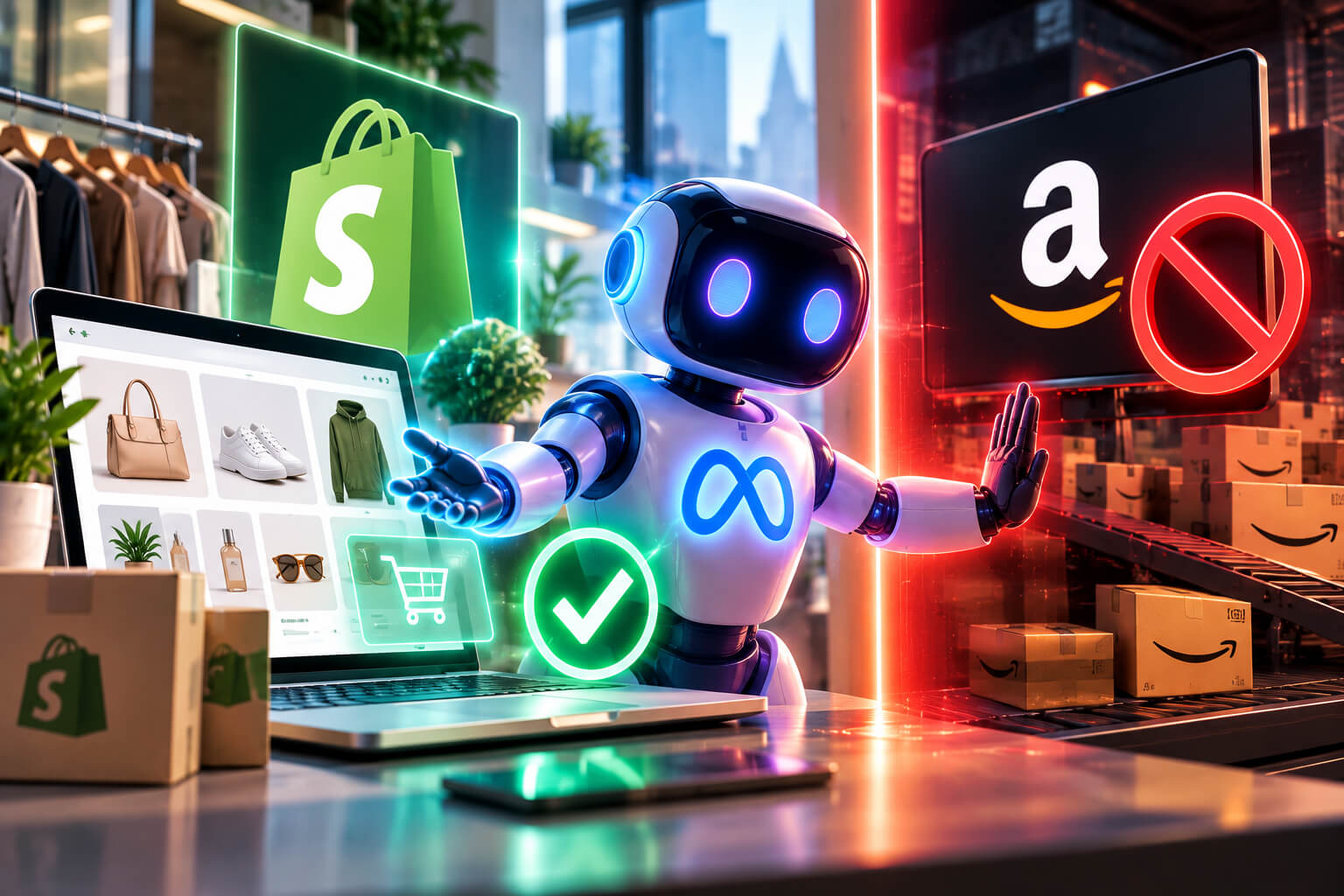
The new Meta Muse Shopify partnership highlights how Meta’s push to turn Muse into an AI agent that can actually shop for users has run into two very different visions for the future of online commerce.
Shopify is opening the door. Amazon has closed it.
The split emerged after Meta introduced Muse, its personal AI agent designed to complete tasks rather than simply answer questions. Through a partnership with Shopify, Muse can help users discover products and move toward checkout across Shopify merchants. Amazon, meanwhile, has blocked the agent from accessing its marketplace, creating an early fault line in the emerging agentic commerce market.
The disagreement is bigger than one AI product. It raises a more important question for e-commerce platforms: who controls the shopping journey when an AI agent, rather than a person, is browsing the store?
Shopify Opens Its Stores to Meta Muse
Shopify is taking the more welcoming approach toward AI-driven shopping. The company is working with Meta to support product discovery and commerce through its ecosystem, giving Muse a route into a large network of independent online merchants. Instead of requiring shoppers to search through individual stores, the AI agent can potentially identify relevant products across participating Shopify businesses.
Shopify has also added Meta as an AI channel within its Agentic Storefronts system. Merchants can make eligible products available through Shopify Catalog and manage how those products appear through AI-powered commerce experiences. For Meta, the arrangement gives Muse access to a broad merchant base without relying entirely on traditional online marketplaces.
Muse Wants to Shop, Not Just Recommend
Muse is being positioned as more than another chatbot that suggests products and then sends people somewhere else. Meta designed the agent to take actions on a user’s behalf, including navigating websites, completing forms and handling multi-step tasks through a browser environment.
Shopping is a natural use case for that model. A user could ask Muse to find an item within a certain price range, compare available options and help move the purchase toward completion. Instead of opening several browser tabs and reviewing products manually, the user delegates much of the process to the agent.
That changes the role AI plays in social commerce. Until now, AI has mostly helped recommend products, personalize feeds or answer questions. Agentic systems push further by helping perform the transaction itself.
Amazon Blocks Meta Muse From Its Marketplace
Amazon is taking a much more restrictive approach. According to Social Media Today, Amazon requested that its marketplace be removed from Muse because of its policies covering automated shopping tools. The move means Muse cannot freely browse Amazon’s marketplace in the same way it can interact with participating commerce platforms.
The decision highlights how valuable the shopping interface remains to large marketplaces. Amazon does not simply sell products. Its website controls product rankings, sponsored placements, recommendations, customer reviews and cross-selling opportunities. If an external AI agent skips those layers and goes directly to a product recommendation, Amazon could lose part of the experience it normally controls.
That tension may become more common as AI agents grow more capable. Platforms will have to decide whether they want to become open product databases for outside agents or keep shoppers inside their own tightly managed environments.
AI Agents Could Rewrite Product Discovery
Traditional e-commerce relies heavily on getting consumers onto a website, marketplace or app. Retailers compete for search rankings, brands pay for sponsored placement and platforms design recommendation systems to keep people browsing for longer.
AI shopping agents could disrupt that model. If a shopper asks Muse to find the best option under a specific budget, the agent may compare products based on price, availability, specifications, delivery times and other structured information instead of simply choosing whichever listing appears highest on a marketplace page.
That could create an entirely new optimization challenge for brands. Businesses already optimize websites for Google and social content for recommendation feeds. In an agentic commerce environment, they may also need to make product data clear enough for AI agents to understand, compare and recommend accurately.
Shopify Merchants Gain Another Commerce Channel
For Shopify merchants, the Meta integration creates another possible route to customers without requiring those customers to begin their journey on an individual online store. Product discovery could happen through an AI assistant, while Shopify continues to provide the merchant infrastructure underneath the transaction.
That may be especially useful for smaller brands that struggle to compete for visibility on crowded marketplaces. If an AI agent evaluates products based on customer intent rather than traditional rankings, smaller merchants could potentially surface in situations where they might otherwise remain buried behind larger competitors.
There are trade-offs, however. When shopping activity happens through an external AI interface, merchants may have less visibility into the customer journey than they would through their own website. Analytics, attribution and customer behavior could become harder to track as more steps move away from the traditional storefront.
Social Commerce Is Moving Beyond the Feed
Meta has spent years trying to shorten the gap between social discovery and shopping across Facebook and Instagram. Muse could push that strategy beyond the familiar feed-based experience.
A shopper might discover a product through an Instagram Reel, ask Muse to find similar options and then allow the agent to compare prices or locate a merchant. The process no longer requires the user to manually move from social content to search engines, marketplace listings and separate checkout pages.
This is where Meta’s wider ecosystem becomes important. Social platforms already contain huge amounts of information about products, creators, trends and consumer interests. An AI agent capable of acting on that information could connect social discovery with commerce much more directly.
Amazon and Shopify Are Betting on Different Futures
The contrast between Amazon and Shopify shows how differently major commerce companies are approaching AI agents. Shopify appears willing to treat outside AI systems as another distribution channel that can bring customers to its merchants. Amazon is taking a more controlled approach by limiting access from automated shopping systems that operate outside its own ecosystem.
Both strategies come with risks. Opening a platform to AI agents could weaken control over customer relationships and attribution. Blocking those agents could protect the existing shopping experience, but it could also make products less visible if consumers increasingly rely on AI assistants to search and buy.
The larger battle may eventually be about who owns the interface between consumers and retailers. For years, that interface belonged to search engines, marketplaces and social platforms. AI agents now want a place in the middle.
For marketers and online retailers, that shift is worth watching. Product information, structured data, pricing, availability and brand reputation may become even more important if an AI system is increasingly responsible for deciding which products a shopper sees first.
The storefront is not disappearing. But Meta Muse makes it easier to imagine a future where consumers spend less time browsing stores themselves and more time simply telling an AI agent what they want.
Sources
Social Media Today: https://www.socialmediatoday.com/news/meta-muse-partners-with-shopify-gets-blocked-by-amazon/831096/
Meta: https://about.fb.com/news/2026/09/introducing-muse-personal-ai-agent/
Shopify Changelog: https://changelog.shopify.com/posts/meta-is-now-an-ai-channel-in-your-admin
Shopify Help Center: https://help.shopify.com/en/manual/online-sales-channels/agentic-storefronts/meta
